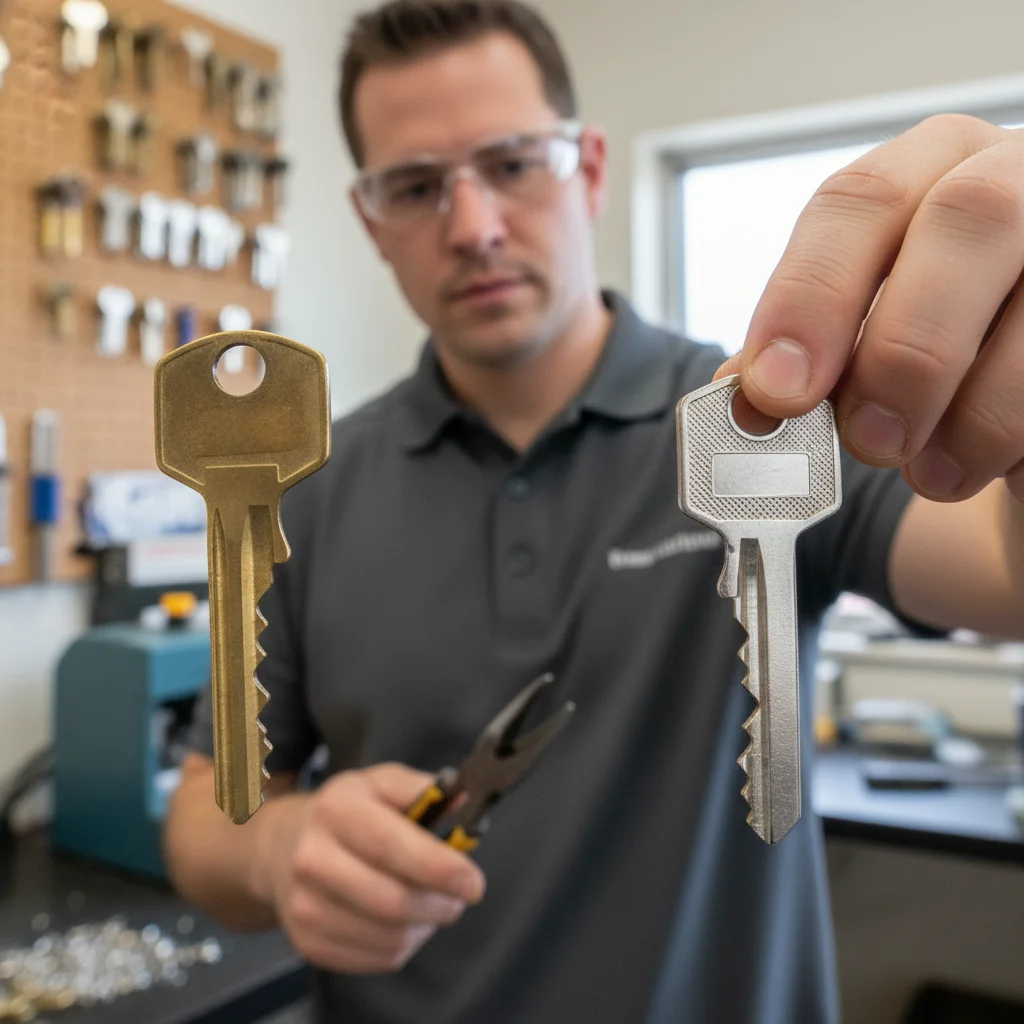
You stand in front of the self-service key machine at the big-box store, jiggling the fresh-cut key in your hand. It looks right, but when you get home, it’s a different story. The key sticks, it grinds, or it just won’t turn. This is a common frustration in San Diego, and it highlights a crucial difference between getting a key copied at a hardware store versus a professional locksmith.
The choice seems simple: one is fast and cheap, the other is a dedicated service. But the result you get depends entirely on the technology, the expertise, and the process behind the cut. Understanding why a locksmith provides a superior result isn’t about paying more; it’s about paying for accuracy that works the first time.
How key cutting machines actually work
At a glance, all key cutting machines seem to do the same thing. You put one key in, a blank key in the other, and a new key comes out. But the method they use to get there is fundamentally different, and that difference is everything.
Most machines you’ll find in hardware stores are duplicators. They work by tracing. One side of the machine has a stylus or guide that physically traces the cuts and valleys of your original key. On the other side, a cutting wheel grinds down a blank key, mimicking the movements of the tracer. It’s a direct, physical copy. If your original key is in perfect, factory-new condition, a well-maintained duplicator can often produce a working copy.
However, professional locksmiths use a more advanced method alongside simple duplication. They rely on code cutting machines. A code cutter doesn’t trace your worn key. Instead, it cuts a key based on the lock’s original manufacturer specifications. Every lock has a “key code” that dictates the precise depth and spacing of each cut. A locksmith can look up this code and enter it into a machine that cuts the key to its exact, ideal specifications. It’s like having a brand-new original key created from the blueprint, rather than photocopying an old, faded document.
This distinction is the root of most key-copy failures. Tracing an imperfect original only creates a more imperfect copy. Cutting from code restores the key to its intended design.
Why copies of copies fail
Think of making a photocopy of a photocopy. The first copy looks pretty good. The second, a copy of that first copy, is a little fuzzier. By the fifth or sixth generation, the text is blurry and hard to read. Information is lost with each iteration. The exact same principle applies to key duplication.
Your house key is a precise piece of machinery. The pins inside your lock need to be lifted to an exact height to align with the “shear line,” allowing the cylinder to turn. Even a deviation of a few thousandths of an inch can cause a key to fail.
Here’s how the degradation happens:
- Original Key Wear: Your daily-use key is made of soft brass. Every time you insert it, turn it, and pull it out, microscopic bits of metal wear away. The sharp edges of the cuts become rounded. The valleys become slightly shallower.
- Duplicator Inaccuracy: The tracer on a hardware store duplicator follows this worn-down pattern. It can’t tell the difference between the original intended cut and the new, worn shape.
- Compounded Error: The new key is now cut with those small imperfections built-in. It might work, but it will probably feel “gritty” or require some jiggling.
- The Next Generation: Now, imagine you lose your original and take this “copy of a worn key” to be duplicated again. The machine traces the already-imperfect copy, adding another layer of error. The cuts will be even more rounded and less precise.
This is the “copy-of-a-copy” failure loop. After two or three generations, the key’s specifications have drifted so far from the original that it no longer has enough precision to lift the lock pins correctly. The result is a key that won’t turn, gets stuck, or worse, damages the internal components of your lock over time.
The locksmith advantage: calibration and code cutting
When you’re looking for accurate key cutting, a professional locksmith offers two major advantages that hardware stores simply can’t match: precision equipment and deep expertise.
First, let’s talk about the machines. A locksmith’s key cutting machines are their livelihood. Locksmiths in our network invest in high-end, professional-grade equipment that costs thousands of dollars, not the few hundred a retail kiosk might cost. More importantly, they meticulously maintain and calibrate them. Calibration ensures the tracer and the cutting wheel are perfectly aligned, that cut depths are exact, and that there is no “slop” or “play” in the machine’s moving parts. A misaligned machine, even by a hair’s breadth, will produce a bad key every time. Hardware store machines are used by hundreds of people and rarely serviced with the same level of care.
The second, and most significant, advantage is their ability to perform key cutting by code. As mentioned, this bypasses the problem of a worn original entirely. If you bring a locksmith a key that’s barely working, they don’t just copy its flaws. They can often “decode” your worn key, measuring its cuts to determine the original factory bitting code. They then enter that code into the machine to generate a brand-new key cut to its original, perfect specifications. This is the only way to guarantee a functional key when your only sample is old and worn. This process is central to our key duplication service. It’s not just a copy; it’s a restoration of your key to its original state.
When a hardware store copy is good enough
While a locksmith offers superior accuracy, we’ll be the first to admit there are times when a quick copy from the local hardware store is perfectly fine. It’s about matching the tool to the job. If you understand the risks, you can make an informed decision.
A hardware store key copy is most likely to succeed under these conditions:
- The original key is new or barely used. If you’ve just had your locks changed and want an extra spare right away, the original is still close to its factory specs. Tracing it will probably work.
- The lock is for a low-security, low-consequence application. Need a copy for the padlock on your garden shed or a simple interior closet door? A key that needs a little jiggle is probably not a major issue.
- The lock itself is old and worn. Sometimes, a slightly “off” key might actually work better in a lock that has its own internal wear and tear. This is rare, but it can happen.
However, for your front door, your business, your car, or any lock that is critical for your security and convenience, the risk of a faulty key isn’t worth the small savings. A key that fails could mean you’re locked out, late for an important meeting, or unable to secure your property. The small extra cost for a professionally cut key from a San Diego locksmith is an investment in reliability.
Handling ‘do not duplicate’ keys
You’ve probably seen keys stamped with “Do Not Duplicate” or “DND.” Many people believe this stamp carries legal weight, but in most cases, it’s simply a request. An automated kiosk at a hardware store can’t read it, and a low-wage employee may not be trained on how to handle it. They will often copy it without a second thought.
A professional locksmith operates differently. Many follow a code of ethics through professional organizations like the ALOA (Associated Locksmiths of America). While the “DND” stamp isn’t a legal mandate, a reputable locksmith respects the security system it represents and will typically ask for a letter of authorization from the property owner or manager before duplicating such a key.
More importantly, locksmiths understand the difference between a simple DND stamp and a true restricted or high-security keyway. These keys are legally protected by patents. The key blanks are only distributed to authorized locksmiths, making it impossible for a hardware store to even get the raw materials to make a copy. If your business in San Diego needs to control who can make copies of keys, a simple stamp isn’t enough. You need a restricted key system. Locksmiths in our network can help you transition to one, often through a simple lock rekey service that provides true, enforceable key control.
Frequently asked questions
Why does a hardware store key copy sometimes not work?
Hardware store duplicators trace your original key physically. If that key is worn, the machine copies its imperfections too. A key cut from a worn original can drift enough from the factory spec that the pins in your lock don’t align correctly, causing the key to stick, grind, or refuse to turn entirely.
What is code cutting and why does it matter?
Code cutting means a locksmith looks up the manufacturer’s original key specification and cuts the new key to those exact dimensions, rather than tracing your worn copy. It’s the difference between photocopying a faded document and reprinting it from the original file. If your only remaining key is heavily used, code cutting is the only way to get a reliable duplicate.
Can a locksmith make a copy from a worn key?
Yes. A locksmith can often “decode” a worn key by measuring its cuts against known factory bitting codes and determining what the key should be rather than what it has become. Hardware store kiosks have no way to do this; they can only trace what they’re given.
How much does professional key duplication cost compared to a kiosk?
A hardware store kiosk charges $2 to $5 for a basic house key. A locksmith charges $5 to $15 for the same key but uses calibrated equipment. For car keys, restricted keys, or anything with electronic programming, a locksmith is the only practical option anyway since kiosks can’t handle those key types. The cost difference on basic keys is small; the reliability difference is significant.
When is a hardware store copy good enough?
It works fine when your original key is nearly new and the lock it’s for is low-stakes, a garden shed, a storage locker, an interior door. For your front door, a vehicle, or any lock where a failure means you’re stranded, pay for professional key duplication and know it’ll work the first time.
When to call us
A key is more than a piece of metal; it’s your ticket to access and security. For a quick spare on a non-critical lock, a hardware store might do the trick. But when accuracy and reliability matter, a professional locksmith is the only choice.
Call us if:
- Your only remaining key is old, worn, or bent.
- You need a copy of a car key, especially one with a transponder chip.
- A previous copy from a kiosk or hardware store failed to work.
- You need to control who can make copies of your business’s keys.
- You simply want the peace of mind that your new key will work perfectly the first time.
Call us at (858) 400-4082 for an estimate.