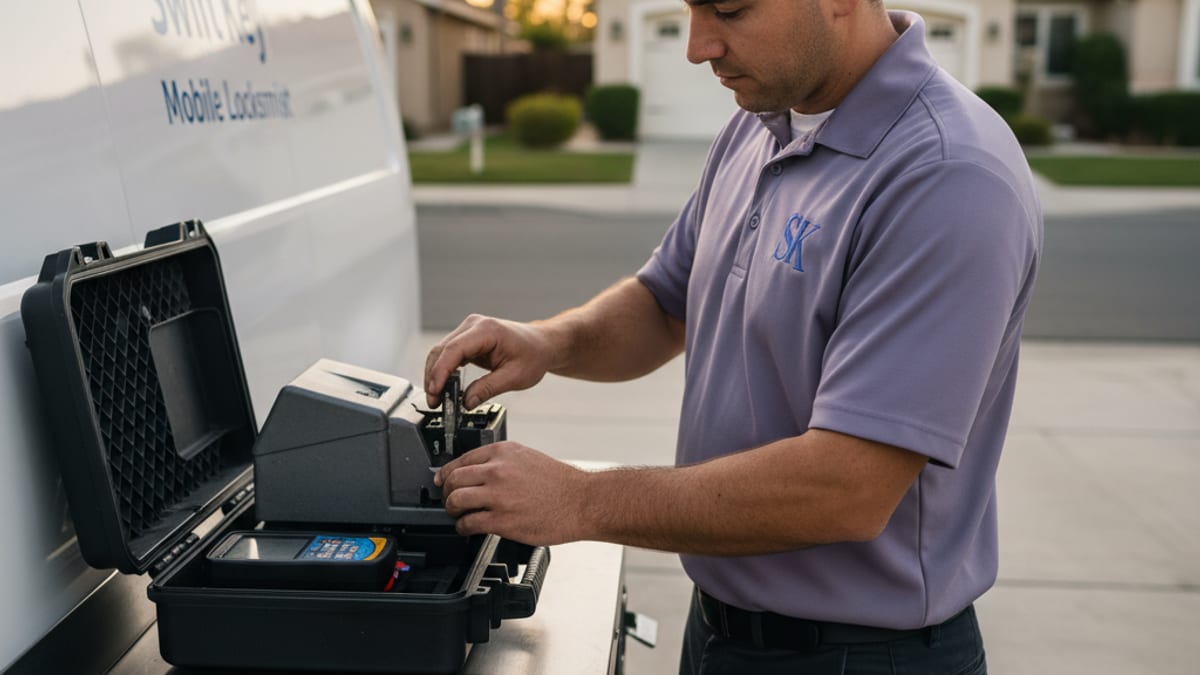
Losing the only working key to your car used to mean a tow and a dealer invoice. Independent locksmiths come to you for car key replacement, at your driveway, the airport long-term parking lot, or the grocery store parking garage, and cut and program a replacement key on-site. Ask both for a line-item quote on the same key type before you decide.
Here’s how to decide between a mobile locksmith and the dealer in San Diego in 2026.
Locksmith vs. dealer: what to compare
Different key types have different quotes. Ask both for the same year, make, and key type.
Transponder keys (chip in the blade head)
Ask the locksmith and the dealer whether they support this exact year, make, model, and key type. A mobile locksmith can often cut and program on-site. The dealer usually wants the car in a bay and may add a tow if every key is gone.
Laser-cut / sidewinder transponder keys
These have a ridge cut along the side of the key instead of traditional teeth. Mobile locksmiths with a sidewinder cutter handle many of these. Confirm before they roll.
Smart keys / proximity fobs
The heavier job. Ask both whether their tools cover this VIN. Some European and EV platforms still route all-keys-lost through a dealer.
Key fob reshell or battery replacement
If your fob buttons stopped working but you haven’t actually lost the chip, a shell or battery job is usually cheaper than a new fob. Compare the locksmith visit to the dealer parts counter.
When you may need the dealer
Some cars require manufacturer-specific programming tools that not every locksmith carries for all-keys-lost scenarios. A professional locksmith says before quoting when that car still needs the dealer. Ask about your specific year, make, and model before deciding.
For duplicates (you still have one working key) on most vehicles, a locksmith handles the job.
What happens during a car-key replacement call
Here’s what a typical on-site key replacement looks like:
1. Verification
The tech arrives and confirms:
- Your ID matches the address on the vehicle registration or title
- The VIN matches the title (checking the dashboard tag through the windshield)
- You’re the legal owner or authorized agent
Heads up: if you bought the car recently and the title is still in transit, a bill of sale with matching ID is usually acceptable. If you’re handling a deceased relative’s vehicle, bring inheritance or probate paperwork.
2. Key cutting
The tech cuts a blank key to your factory code. Most modern locksmiths use laser-cutting machines for precision. For basic transponder keys, the cutting is traditional file-cutting on a calibrated machine.
3. Programming
The tech connects an OBD programming tool to the diagnostic port under your dashboard and programs the new key to the car. Total time depends on the vehicle and key type.
4. Testing
The tech tests every function on the key: door unlock, door lock, trunk release, remote start (if equipped), panic button, and the ignition. If anything doesn’t work, they re-cut or re-program before leaving. Ask that locksmith what they test before they leave, and who writes any warranty.
What you need to have ready
When you call, have this info available:
- Year, make, model, and trim of your vehicle
- VIN (from the registration or the corner of your dashboard through the windshield)
- Whether you’ve lost all keys or still have a working spare
- Location of the car (driveway, parking lot, etc.)
- Ownership documentation (title, registration, or bill of sale)
The tech may call back after they look up your specific key type to confirm pricing and scheduling. Don’t be alarmed, it means they’re doing due diligence before committing to a job they can’t complete.
Avoiding scams on car key replacement
Same rules as any locksmith service in 2026:
- Get a price over the phone. Any locksmith who refuses to quote a car key for a specific year/make/model is hiding something.
- Ask for the LCO. Check it at search.dca.ca.gov before they arrive.
- Be skeptical of absurdly low quotes. A legitimate laser-cut transponder key in 2026 is not a teaser-price ad. If someone quotes a number that sounds like a coupon, expect a much larger bill at the door.
Preventing the next lost-key incident
A few practical moves to make the next lost-key scenario less painful:
- Always have a spare. If you only have one key, that’s the biggest single risk factor. Get a duplicate cut and programmed when times are good, including key fob programming if your car uses a proximity fob. Duplicating from a working key skips the VIN lookup step.
- Keep the spare somewhere you trust. Not in the glovebox (easy to lose with the car), not in your jacket pocket (where you might lose both sets at once), but in a home drawer, safe, or with a nearby family member.
- Consider a Tile or AirTag. A small Bluetooth or UWB tracker on your keychain doesn’t prevent loss, but it dramatically cuts down on the “did I leave them at the restaurant or in the car?” panic window.
- Photograph your key with the VIN. If you ever need a replacement, knowing the exact key type and VIN makes the quote easier. Send yourself an email with both.
Frequently asked questions
How do I compare a locksmith and a dealer for car key replacement in San Diego?
Ask both for the same key type. Basic transponder keys are the lighter job. Smart keys and proximity fobs are heavier. Some cars still require the dealer. Compare line items.
How long does on-site car key replacement take?
On-site car key replacement involves a few steps: verifying your ID and vehicle ownership, cutting the key, and programming it to your car. Total time depends on the vehicle and key type.
Are there cars where I have to go to the dealer even if I use a locksmith first?
Yes. Some newer Mercedes, BMW, Hyundai, Kia, Range Rover, and Jaguar models require manufacturer-specific programming tools that not every locksmith carries. A professional locksmith says before quoting when that car still needs the dealer.
Can I get a duplicate key made while I still have a working spare?
Yes, and that’s the simpler time to do it. Duplicating from a working key skips the all-keys-lost VIN lookup step. A key fob programming appointment when you still have the original is almost always simpler than an emergency replacement.
What do I need to have ready when a locksmith arrives to make a new car key?
Have your ID, vehicle registration or title, and the VIN ready. The VIN is visible through the lower corner of the windshield on the driver’s side. If the title is still in transit after a recent purchase, a bill of sale with matching ID works. For a deceased relative’s vehicle, bring inheritance or probate paperwork.
Swift Key San Diego is a referral service. Independent locksmiths quote. That locksmith says whether they can cut and program that car at that location. Call (858) 400-4082 to connect with a licensed independent locksmith. That locksmith quotes after they see the year and make. Swift Key does not quote.