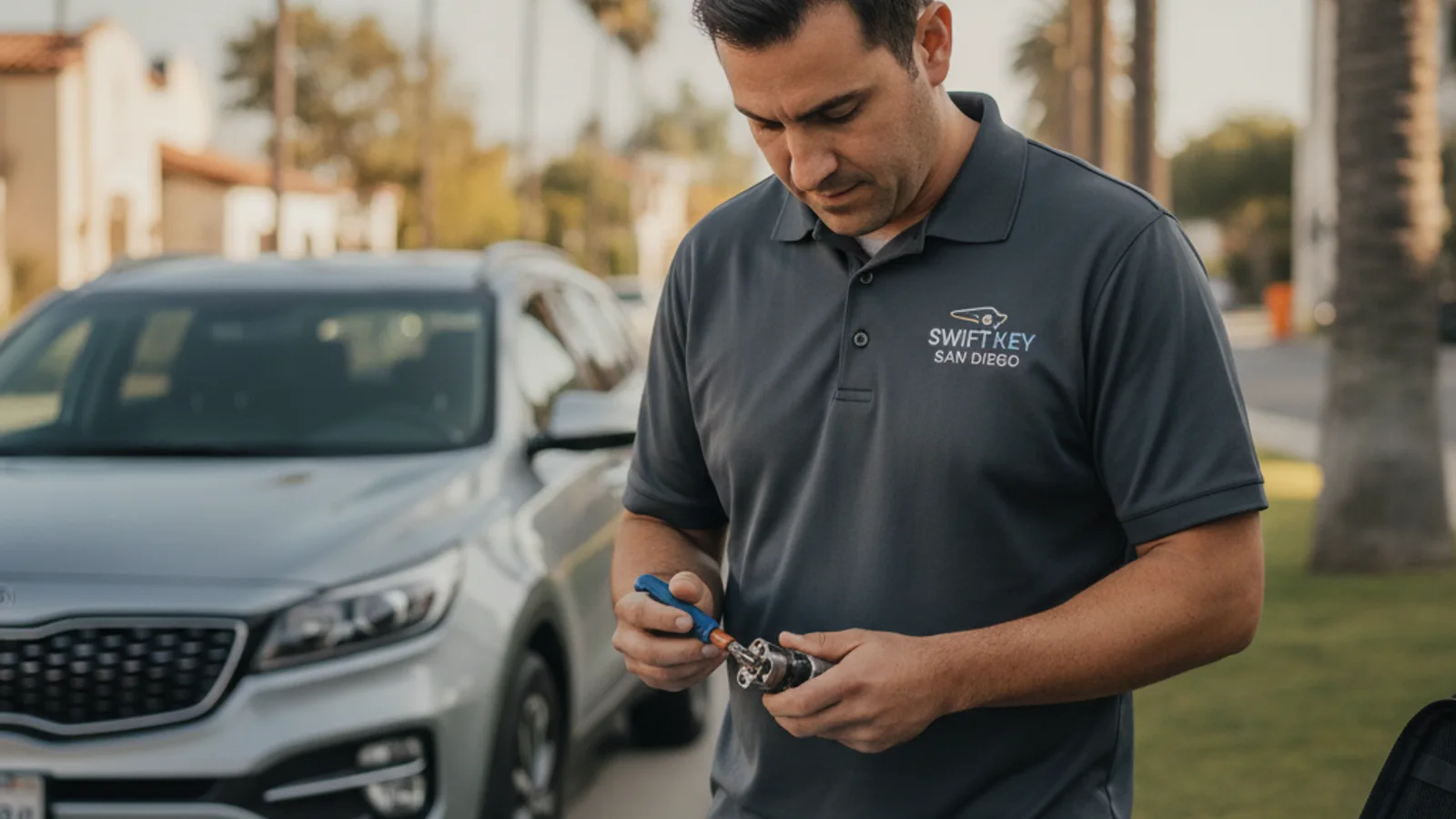
Replacing a Kia or Hyundai key in San Diego costs $60 to $450, depending on the year, trim, and key type. A basic non-transponder key on an older base model runs $60 to $120. A smart fob for a newer vehicle runs $280 to $450. The dealer typically charges $300 to $550 for the same job. A mobile locksmith gets you back on the road faster and for less, right where you’re parked.

There’s one thing worth understanding before you call anyone: some 2011 to 2021 Kia and Hyundai base trims shipped from the factory without engine immobilizers. That affected how those cars were targeted and, in some cases, how the key replacement process works today. This post covers all of it.

Kia and Hyundai key replacement cost by type

The biggest price driver is the key technology in your specific vehicle, not just the brand.

Key typeTypical vehiclesLocksmith costDealer estimate
Non-transponder basic key2011-2021 base trims without immobilizer$60 - $120$100 - $200
Transponder keyMany 2010-2018 mid trims$150 - $250$200 - $350
Flip key / remote head keySelect 2014-2020 models$200 - $320$280 - $420
Smart fob (push-to-start)Most 2017+ models, all current trims$280 - $450$300 - $550

These are ranges, not quotes. The exact figure depends on your VIN, trim level, and whether you have any working keys left. Call with your VIN ready and you’ll get an accurate number before anyone comes out.

The immobilizer gap: what it means for your key replacement

Starting around 2015 and continuing through roughly 2021, a significant portion of base-trim Kia and Hyundai models were sold in the United States without factory engine immobilizers. An immobilizer is the electronic security system that prevents the car from starting unless a programmed key is present. Without it, any mechanically cut key that fits the ignition will start the car.

This became widely known as the Kia Boys vulnerability, named after a theft trend that spread through social media. Both Kia and Hyundai acknowledged the issue publicly. Both manufacturers offered free remedies: Kia and Hyundai ran software update programs that added anti-theft logic to affected vehicles, and both offered complimentary steering wheel lock kits through dealerships as a stopgap.

What this means for your key replacement:

If your vehicle was built before the anti-theft software update was applied, you likely have a basic non-transponder key. Replacing it is straightforward and inexpensive: a locksmith cuts a new metal key from your vehicle code. No programming required.

If your vehicle received the software anti-theft update, the programming process may have changed. Some vehicles gained immobilizer-like behavior through that update. A locksmith needs to know this before arriving, because the procedure differs. This is why calling with your VIN ready matters: it tells us the build year, trim, and whether your car is in the affected range.

Not every Kia or Hyundai from this period is affected. Higher trims, vehicles sold in states with stricter anti-theft requirements, and post-2021 models generally shipped with standard immobilizers. Check the door jamb sticker or your owner’s manual if you’re unsure what you have.

Dealer vs. locksmith for Kia and Hyundai keys

For most Kia and Hyundai models, a mobile locksmith is the faster and more affordable choice.

When a locksmith wins:

  • You’re not towing the car. We come to your location anywhere in San Diego County.
  • Turnaround is same-day. Dealers often order keys and schedule you for another visit.
  • Cost is 20 to 40 percent lower on most models.
  • We carry the programming tools for all current Kia and Hyundai systems, including smart fobs on Forte, Sportage, Telluride, Elantra, Tucson, Santa Fe, and others.

When the dealer makes sense:

  • Your vehicle is a current model year (less than six months old) and our software may not yet have full programming support.
  • You need warranty work done at the same time.
  • You have a documented reason to need dealer records on file.

For most situations across San Diego County, from Chula Vista to Oceanside, a mobile locksmith handles Kia and Hyundai keys without issue. Check out the full breakdown in our dealer vs. locksmith guide if you want to see the comparison across all vehicle types.

Upgrading security on an affected Kia or Hyundai

If you have one of the base-trim models that came without a factory immobilizer, a few options are worth knowing:

The Kia/Hyundai software update. Both manufacturers offered free software updates through their dealerships that add electronic anti-theft logic to the vehicle. If you haven’t done this yet, it’s the first move. It doesn’t add a true immobilizer, but it extends the time needed to steal the car and has been credited with reducing thefts of these models. Call your local Kia or Hyundai dealer to check if your VIN is eligible.

Steering wheel lock. Both manufacturers offered complimentary steering wheel locks to affected owners through their dealership programs. A visible steering wheel lock is a deterrent: it slows down a theft attempt and shifts attention to a less-defended vehicle. If you didn’t get one through the program, aftermarket options are available and effective.

Aftermarket immobilizer. A professional-grade aftermarket immobilizer (a hidden kill switch wired into the ignition circuit) prevents the car from starting without a separate authorization step, usually a hidden button or a passive transponder. This is a meaningful security upgrade for vehicles that never got the factory equipment. Installation runs $150 to $350 at a shop that handles automotive security.

These aren’t required to get your keys replaced. They’re worth knowing about if you’re dealing with an affected model and want to strengthen the situation while you’re already thinking about keys.

What happens when all keys are lost

An all-keys-lost situation on a Kia or Hyundai with a transponder or smart key system requires generating a new key from scratch, without an existing working key to copy from. A locksmith does this by connecting programming equipment directly to the OBD-II port under the dashboard and communicating with the vehicle’s security module.

For basic non-transponder models, the process is simpler: the locksmith cuts a new key from the vehicle’s key code, which is derived from your VIN.

Either way, you don’t need a tow. Have these ready when you call:

  • Driver’s license matching the registration
  • Current vehicle registration
  • VIN (on the door jamb sticker or your title)
  • Proof of ownership

No locksmith worth using will cut a key without verifying ownership. Having the paperwork ready speeds things up.

For a broader look at the all-keys-lost scenario across vehicle types, see our guide on lost car keys with no spare in San Diego.

Frequently asked questions

How much does a Kia key replacement cost?

A Kia key replacement in San Diego runs $60 to $450 depending on the key type. Non-transponder basic keys on older base-trim models cost $60 to $120. Transponder keys run $150 to $250. Flip keys run $200 to $320. Smart fobs for push-to-start models run $280 to $450. The dealer typically charges $300 to $550. A mobile locksmith is faster, comes to your location, and generally costs 20 to 40 percent less.

How much does a Hyundai key replacement cost?

Hyundai key replacement costs follow the same structure as Kia, since the two brands share platform technology. Expect $60 to $120 for a basic key on an older base model, $150 to $250 for a transponder key, and $280 to $450 for a current smart fob. Dealer pricing runs $300 to $550 for most models.

Does my Kia or Hyundai have an immobilizer?

It depends on the year and trim. Many 2011 to 2021 base-trim Kia and Hyundai models sold in the United States were built without factory engine immobilizers. Higher trims, post-2021 models, and vehicles that received the manufacturer’s anti-theft software update have additional protection. If you’re unsure, check your owner’s manual, call your dealer with your VIN, or let us know your VIN when you call us and we’ll confirm before arriving.

Can a locksmith make a Hyundai key after the anti-theft update?

Yes. After the anti-theft software update, some affected Kia and Hyundai models changed how their key programming works. A locksmith with current equipment handles this without issue. The key is calling with your VIN ready so we know your exact configuration before arriving. The process may take a few extra minutes compared to an unaffected vehicle, but it’s a normal job.

Is the Kia Boys theft issue still a problem in San Diego?

The original vulnerability applied to base-trim models built without immobilizers, primarily 2011 to 2021 model years. The manufacturer software updates and the broader awareness of the issue reduced the theft rate significantly for those models. If you have an affected vehicle and haven’t done the software update, that’s the first thing to address. It’s free through your Kia or Hyundai dealer. If you want to go further, a steering wheel lock or aftermarket immobilizer adds another layer.

What’s the fastest way to get a replacement Kia or Hyundai key in San Diego?

Call a mobile car key replacement service with your VIN ready. We can confirm your key type, give you a quote, and come to your location same day. For most models, the job takes 30 to 60 minutes on-site. You don’t need to arrange a tow or wait for a dealer appointment.


If you’ve lost your Kia or Hyundai key in San Diego County and need a fast quote, call us at (858) 925-5546. Have your VIN ready and we’ll confirm the key type and cost before we head out.

For more on key replacement costs across all vehicle types, see our car key replacement cost guide by vehicle. For key fob programming specifically, visit our key fob programming service page. And if security is on your mind after dealing with the immobilizer issue, our San Diego burglary data analysis breaks down what the numbers actually show about vehicle and residential security.