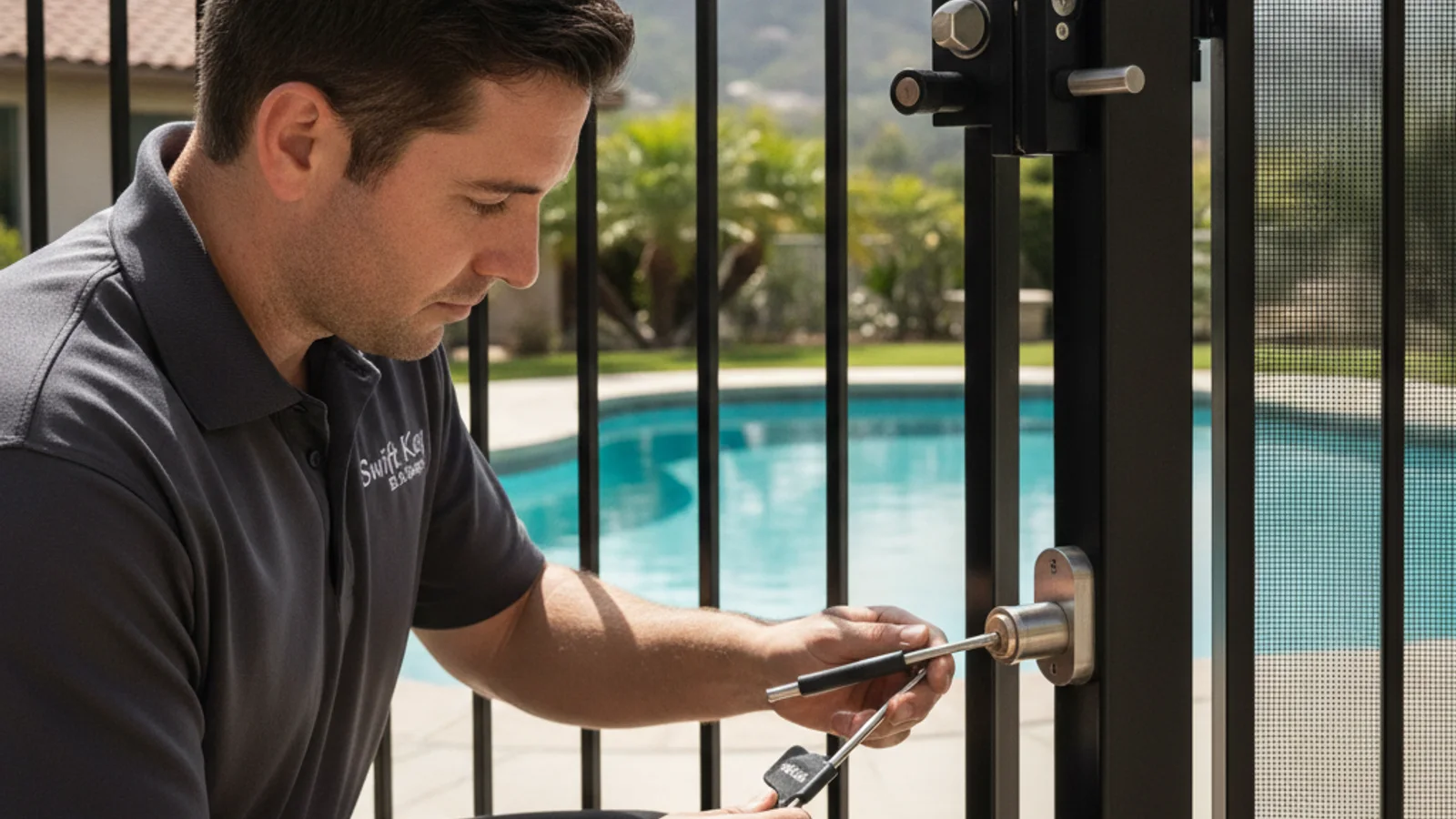
California requires most residential pools to have at least two of seven approved drowning-prevention safety features, and a self-closing, self-latching gate lock is the one most homeowners already have or can add cheapest. The rule comes from Health and Safety Code Section 115922, the state’s Swimming Pool Safety Act. It applies when a building permit is issued for new pool construction or a pool remodel at a single-family home. As of January 1, 2025, home inspectors are also required to note which of the seven features your property has, which makes this a real factor if you’re selling.
Here’s what the law actually requires, who it applies to, and what it costs to bring a gate up to standard in San Diego.
What are California’s pool gate lock requirements?
Not exactly, and this is the part most homeowners get wrong. California doesn’t mandate a self-latching gate lock specifically. It mandates that your pool have at least two of seven approved safety features, and a self-closing, self-latching gate is one of the easiest and cheapest of the seven to install or repair. Most single-family homes with a permitted pool end up using it as one of their two, paired with an alarm or a second barrier feature.
The law applies at the point a permit is pulled, either for new pool or spa construction or for remodeling an existing one. It isn’t a standing requirement that gets enforced independent of a permit, and there’s no roving inspector checking backyard gates on older, unpermitted pools.
What are the seven approved pool safety features?
Health and Safety Code 115922 lists seven features. A qualifying pool needs at least two:
- An enclosure barrier that isolates the pool from the house, at least 60 inches tall.
- Removable mesh fencing meeting the ASTM F2286 standard, paired with a gate that’s self-closing and self-latching.
- An approved safety pool cover meeting the ASTM F1346 standard.
- Exit alarms on doors that provide pool access, rated at 85 decibels or louder.
- Self-closing, self-latching devices on doors and gates that provide pool access.
- A pool water entry detection alarm meeting the ASTM F2208 standard.
- Other protective measures approved case-by-case by the local building official.
A locksmith’s role sits in features 1, 2, and 5: the physical gate, fence, and door hardware. Features 3, 4, and 6 are pool-cover and alarm equipment, which is a different trade. If your inspection or remodel plan calls for one of those, we can point you to who handles it, but we install and repair the lock and latch hardware.
What makes a gate lock “compliant” under California code?
For the enclosure-barrier and mesh-fencing options, the gate has to do three things:
- Close itself. The gate returns to closed from any open position without anyone pushing it shut. A sagging hinge or a gate that hangs open at 30 degrees doesn’t meet this even if the latch itself works.
- Latch itself. The latch engages automatically the moment the gate closes; nobody has to reach down and flip anything.
- Resist a small child. Most compliant hardware mounts the release mechanism high, 54 inches or more off the ground is the common benchmark, with no footholds or handholds near the latch that a child could use to climb up and reach it.
The gate also has to swing away from the pool, not toward it, and the barrier itself can’t have gaps wider than four inches or any climbable rail pattern. A gate that swings freely, has a latch mounted at knee height, or has horizontal rails a five-year-old could use as a ladder fails on inspection even with a lock installed.
This is also where a lot of older San Diego backyards fall short without anyone noticing. A self-latching gate installed correctly ten or fifteen years ago can drift out of compliance as the gate sags, the hinge loosens, or the latch mechanism wears down and stops catching reliably. The hardware looks fine from a glance. It just doesn’t self-close anymore.
Does this law apply to every pool in San Diego?
No, and the exceptions matter:
- Single-family homes only. The statute applies to private single-family residences. Apartment buildings, condos, and commercial pools follow separate rules, generally the California Building Code and local health department standards for public and shared pools.
- Pools built before January 1, 1998 are grandfathered. If your pool predates that and hasn’t had a permitted remodel since, HSC 115922 doesn’t apply to you directly. That said, insurance carriers and buyers increasingly expect the same barrier standard regardless of the legal trigger.
- The trigger is the permit, not the pool’s age. A 1985 pool that gets a permitted resurfacing or equipment upgrade today falls under the current rule at that point.
If you’re in a master-planned San Diego community with an HOA-managed common pool, like the amenity pools we service regularly in Rancho Peñasquitos and Mission Valley, that pool is governed by the HOA’s own barrier standards and, if it’s open to the public or a large membership, separate state health and safety rules, not HSC 115922. HOA common-area gate hardware is a different scope of work; see our commercial locksmith service if you manage one.
What changed under SB 552 in 2025?
Senate Bill 552 took effect January 1, 2025, and made three changes that matter for homeowners:
- Pool covers got a specific standard. Safety covers now have to meet the 2023 version of ASTM F1346 specifically, and carry a label confirming it.
- Mesh fencing gates got clarified, not newly required: a removable mesh fence has to use a gate that’s self-closing, self-latching, and can accept a key-lockable device.
- Home inspectors now have to report on this. SB 552 amended Business and Professions Code Section 7195 so that home inspectors identify which of the seven features a property has, whether each one is in good repair and operating as designed, and include a written statement on pool barriers in the inspection report. Inspectors aren’t required to certify that a feature meets the exact ASTM standard, just to note what’s present and whether it looks functional.
That last point is the one that catches people off guard.
Why this matters if you’re selling your San Diego home
Before 2025, a worn-out pool gate latch was mostly a private safety concern. Now it shows up in the paperwork. If a buyer’s inspector notes that your gate doesn’t self-close, or that the latch doesn’t catch reliably, that’s in the report the buyer reads before they finalize an offer. In a negotiation, a $150 latch repair that gets flagged as a safety item tends to get used against you, not treated as a minor line item.
The fix is straightforward and worth doing before you list, not after an inspector catches it. A functioning self-closing hinge and a self-latching gate lock, correctly mounted, is one of the cheapest items on any pre-listing punch list relative to what it prevents in negotiation friction.
The same logic runs the other way if you’re buying a home with a pool anywhere from Rancho Santa Fe to Scripps Ranch. Ask specifically whether the gate self-closes and self-latches, not just whether there’s a lock on it. A gate with a padlock someone remembers to use isn’t the same as hardware that latches on its own every time.
What it costs to bring a pool gate into compliance in San Diego
Most pool gate compliance work falls into one of two jobs, and both are things we handle as standard lock and hardware work, not a specialty pool-code service call.
| Job | What it involves | Typical cost |
|---|---|---|
| Gate lock/latch replacement | Old or worn latch swapped for a self-latching gate lock, hinge checked and adjusted | $85–$250 (parts and labor) |
| Full gate hardware install | New self-closing hinge plus self-latching lock on a gate that has neither, includes mounting the release at proper height | $120–$280 (hardware and labor) |
| Multiple gates or estate-property scope | Side gate, pool gate, and secondary access points done together | Quoted per gate, typically discounted as a set |
These numbers track directly with our standard lock replacement and deadbolt installation pricing, since a pool gate latch install is the same door-hardware work, just applied to a fence gate instead of a house door. If the existing hinge is solid and only the latch has failed, it’s usually the lower end of that range. If we’re prepping a gate that’s never had proper self-closing hardware, budget for the higher end.
Frequently asked questions
Does every pool in California need a self-latching gate?
Not by name, but most compliant pools end up with one anyway. California requires at least two of seven approved safety features on single-family homes with a permitted pool, and a self-closing, self-latching gate is the cheapest and most common of the seven to install, so it’s the default choice for most homeowners pairing it with an alarm or a second barrier.
What height should a pool gate latch be mounted at?
The common benchmark used in compliant hardware is 54 inches or higher above the ground, with no footholds or handholds within reach of the release mechanism. The goal is a latch a young child can’t reach or climb to, even standing on the gate frame itself.
Is my older pool grandfathered out of this law?
If your pool was built before January 1, 1998 and hasn’t had a permitted remodel since, Health and Safety Code 115922 doesn’t apply to you directly. It applies at the point a building permit is issued for new construction or a remodel, not automatically based on the pool’s age.
Do apartment or HOA community pools have to follow this law?
No. HSC 115922 covers private single-family residences. Apartment complexes, condos, and HOA-managed community pools follow separate barrier and safety standards under the California Building Code and, where applicable, public health rules for shared pools.
Will a home inspector flag my pool gate when I sell?
Likely, yes. As of January 1, 2025, California home inspectors are required to identify which of the seven approved safety features a property has and note whether each is in good repair and working as designed, including gate self-closing and self-latching hardware. That goes in the inspection report a buyer sees.
Have a pool gate that doesn’t close or latch on its own anymore? Swift Key San Diego repairs and installs self-closing, self-latching gate hardware throughout San Diego County, from Rancho Santa Fe estates to Scripps Ranch family homes. Call (858) 400-4082 for a quote.