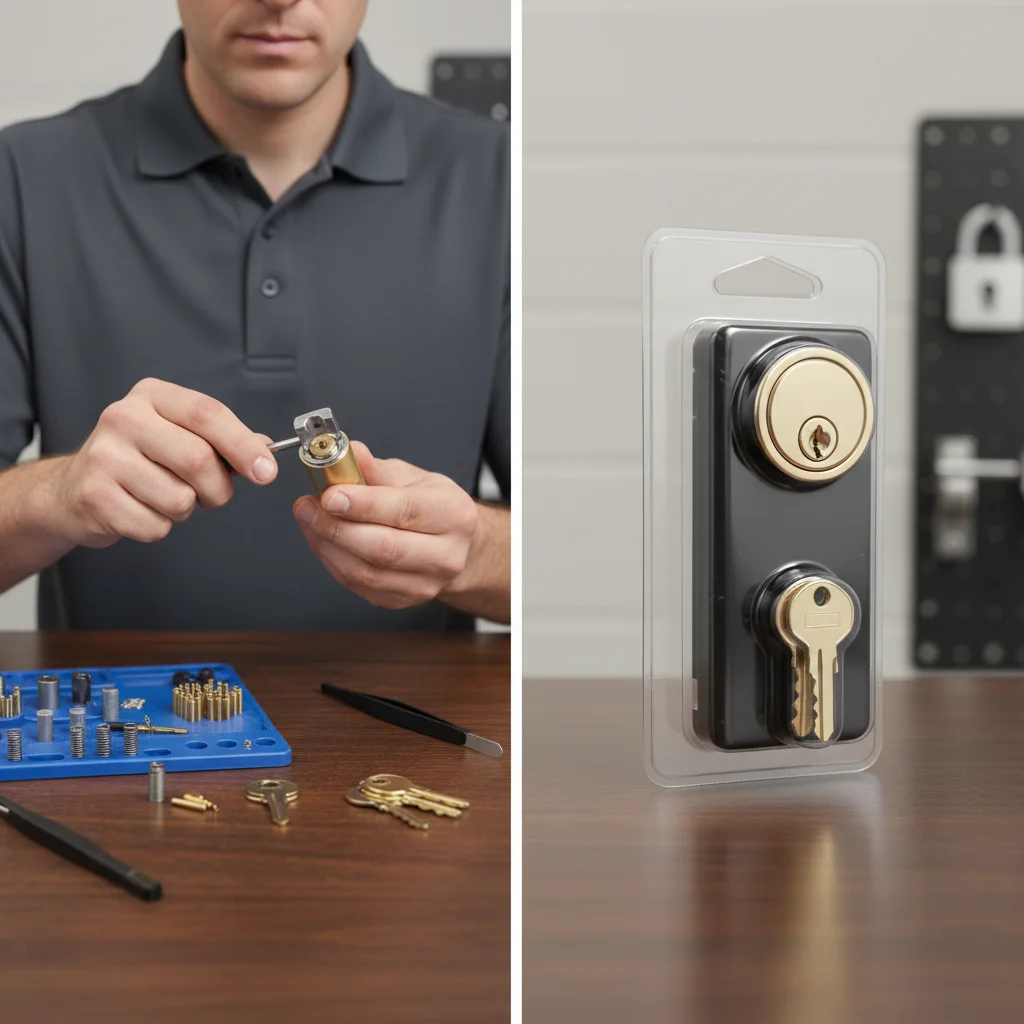
If your existing locks are in good shape, rekey them. Rekeying is cheaper than buying new locks in almost every case, because you pay for the locksmith’s time and a set of pins rather than for new hardware on every door. Rekeying changes the internal pins so old keys no longer work, giving you a clean security reset without touching the hardware. Replacement makes sense when locks are damaged, worn, or you’re upgrading to a smart lock or higher-security grade.
What rekeying actually changes inside the lock
Many people think rekeying is just a minor adjustment, but it’s a precise process that completely changes who has access to your home. Think of it as changing the password for your door. The lock hardware, the deadbolt, knob, and casing, all stay in place. What changes is the internal mechanism.
Inside every standard pin-tumbler lock is a cylinder containing a series of small pins of varying lengths. These pins are what the grooves on your key align with. When the correct key is inserted, it lifts all the pins to a specific, uniform height called the shear line, allowing the cylinder to turn and the lock to open.
A lock rekey service involves a locksmith disassembling the lock cylinder and replacing these internal pins with a new set that matches a brand-new key. Once reassembled, the old key will no longer align the pins correctly, rendering it useless.
The benefits are clear:
- It’s fast. A skilled locksmith can rekey multiple locks in a relatively short visit.
- It’s secure. It effectively bars anyone with an old key, like a previous owner, tenant, or contractor, from entering.
- It’s convenient. The locksmiths we send can often rekey multiple locks of the same brand (like all your Schlage deadbolts) to work with a single key.
Rekeying is a highly effective security measure that preserves your existing hardware while invalidating all previous keys.
When rekeying isn’t an option
While rekeying is a fantastic, budget-friendly solution in many cases, it’s not a universal fix. It only works if the lock itself is in good working order. There are several clear situations where you’ll need to opt for a full lock replacement instead.
1. The lock is damaged or worn out. Locks are mechanical devices. Over years of use, especially in San Diego’s coastal areas where salt air can accelerate corrosion, internal parts wear down. If your lock is sticky, difficult to turn, or visibly rusted, rekeying it is like putting a new set of tires on a car with a failing engine. A replacement is the only safe option.
2. You want a security or style upgrade. Your current locks might be functional but low-grade. You may want to upgrade from a basic Grade 3 knob lock to a high-security Grade 1 deadbolt for better protection against forced entry. Or perhaps the tarnished brass finish on your old locks clashes with your newly painted door. In these cases, replacement is the only way to get the new look, features, or security level you want.
3. You’re switching to a smart lock. If you’re ready to embrace keyless entry with a keypad or smart lock, you’ll be replacing the entire unit. Rekeying isn’t part of this process, though you may want to rekey other, non-smart locks in your home to match the new physical key that comes with your smart lock.
4. Your locks are from different, incompatible brands. Let’s say you have a Kwikset lock on the front door, a Schlage on the back door, and a Weiser on the garage entry. If you want one key to operate all three, you can’t just rekey them. Their internal keyways and pinning systems are fundamentally different. To consolidate to a single key, you’ll need to replace some or all of the locks with a single brand.
Cost ranges in San Diego: rekey vs. replace
This is the core of the decision for most people. While prices vary based on the specific job, here’s a realistic look at what to expect for professional locksmith services in San Diego County.
The cost of rekeying locks
Rekeying is almost always the more affordable option. The cost has two main parts:
- Service Call Fee: This covers the locksmith’s travel time and initial assessment. In San Diego, this typically ranges from $50 to $100.
- Per-Cylinder Fee: You pay a fee for each lock cylinder that is rekeyed. This usually falls between $20 and $40 per cylinder. A standard door has one cylinder in the deadbolt and sometimes another in the knob.
Example Scenario: Rekeying three doors (front, back, garage), each with one deadbolt.
- Service Call: $75
- Rekeying 3 Cylinders: 3 x $30 = $90
- Total Estimated Cost: $165
The cost of replacing locks
Lock replacement costs are higher because you’re paying for new hardware in addition to labor.
- Service Call Fee: Same as above, typically $50 to $100.
- Labor per Lock: The time to remove the old lock and install the new one. Expect to pay $40 to $75 per lock.
- Hardware Cost: This is the biggest variable. A basic residential deadbolt (Grade 3) might cost $30. A heavy-duty, high-security deadbolt (Grade 1) can be $150 or more. Smart locks range from $200 to $400+.
Example Scenario: Replacing the same three deadbolts with mid-range (Grade 2) hardware.
- Service Call: $75
- Labor to Install 3 Locks: 3 x $60 = $180
- Cost of 3 New Deadbolts: 3 x $50 = $150
- Total Estimated Cost: $405
As you can see, the rekey vs new locks cost difference is significant. Rekeying can be less than half the price of a full replacement, making it the clear winner on budget if your existing locks are in good shape.
Lifespan: how each choice ages
A lock’s lifespan is determined by its quality, usage, and environment, not by whether it’s been rekeyed.
Rekeying does not affect the physical longevity of your lock. If you have a 10-year-old deadbolt, rekeying it gives you a fresh start on security, but you still have a 10-year-old deadbolt. It will continue to wear at the same rate. In coastal San Diego communities like La Jolla or Pacific Beach, the salt in the air can cause corrosion. If your lock is already showing signs of rust or stiffness, its lifespan is limited, and rekeying is just a temporary security fix.
Lock replacement, on the other hand, resets the clock entirely. When you install a brand-new lock, you’re getting a mechanism with zero wear and tear. A quality Grade 1 or Grade 2 deadbolt, properly installed, should last for decades. This is why replacement is the better long-term investment if your current hardware is old, cheap, or showing signs of failure.
Think of it this way: rekeying is about access control, while replacement is about the physical integrity and longevity of the hardware itself.
Mixed approach: rekey some, replace others
You don’t have to choose one or the other for your entire home. The smartest and most cost-effective strategy is often a hybrid one. A professional locksmith can assess your home’s security door by door and recommend a mixed approach.
This is a common scenario we see in San Diego homes:
- Front Door: The main entry has a sturdy, high-quality deadbolt that’s only a few years old. It works perfectly. Recommendation: Rekey.
- Back Patio Door: This door has a flimsy, low-grade knob lock that feels loose and has some visible rust. It offers minimal security. Recommendation: Replace with a proper deadbolt.
- Garage Service Door: The lock is a standard, builder-grade model in decent condition. Recommendation: Rekey to match the new front door key.
- Side Gate: The gate has an old padlock that’s been exposed to the elements for years and is tough to open. Recommendation: Replace.
This selective process ensures you’re not spending money replacing perfectly good hardware, but you’re also not trying to salvage locks that are past their prime. You get the security you need where it matters most, while saving money where you can.
What we recommend after a move-in or break-in
Two of the most common triggers for considering a lock change are moving into a new home and experiencing a break-in. The best course of action is different for each.
After a Move-In: When you buy a new home, you have no idea who has a key. Previous owners, their family, real estate agents, contractors, the list is long. Your first priority should be to ensure only you have access. In nearly all move-in situations, we recommend a full lock rekey of all exterior doors. It’s the most efficient and affordable way to secure your property. As we’ve detailed in another post, the choice between rekeying or replacing when moving in almost always favors rekeying unless the locks are visibly old or damaged.
After a Break-In: A break-in is a more complex situation that requires a careful assessment.
- If the burglar gained entry by picking, bumping, or using a stolen key, and the lock itself was not physically damaged, rekeying is a sufficient response. It immediately invalidates the compromised key or method.
- If the lock was visibly damaged, kicked in, drilled, or pried open, it must be replaced. The lock’s structural integrity is gone, and it can no longer protect you. This is also an opportunity to upgrade to a stronger, more pick-resistant, and kick-resistant lock to prevent a repeat incident. A professional locksmith can help you choose hardware that offers better protection.
In either case, acting quickly is essential for restoring your sense of security.
Frequently asked questions
Is getting lock rekeyed cheaper than buying new lock hardware?
Rekeying is typically 60 to 75 percent cheaper than full replacement. A three-door rekey in San Diego runs roughly $150 to $200 all-in. Replacing those same three deadbolts with mid-range hardware lands closer to $400 to $450. The gap narrows if you’re replacing with basic hardware, but rekeying stays the cheaper option in almost every scenario where the existing locks are in good shape.
How long does a rekey take?
A skilled locksmith rekeys a lock cylinder by cylinder, cutting new keys and testing each lock as they go. It’s one of the fastest security upgrades you can make, and a typical two or three door home is finished in a single visit.
Can I rekey my locks myself without a locksmith?
You can with a Kwikset SmartKey lock, which has a built-in self-rekey feature. For standard pin-tumbler locks from Schlage, Medeco, or most other brands, you need a locksmith and a re-pinning kit. DIY attempts on standard cylinders often result in damaged pins or a reassembled lock that doesn’t work reliably, so professional service is worth it.
Does rekeying work if I have different lock brands on different doors?
Each brand uses its own keyway, so you can’t rekey a Kwikset and a Schlage to the same key. If you want one key to open all your exterior doors, the locks all need to be the same brand and keyway. That usually means replacing some locks and rekeying the rest to match, a mixed approach a locksmith can plan out for you.
When does it make sense to replace locks instead of rekeying after a break-in?
Replace when the lock itself was physically damaged during the break-in, kicked in, drilled, or pried. A damaged cylinder or strike can’t be rekeyed to provide reliable security again. If entry was gained by picking or a stolen key and the hardware is otherwise intact, rekeying is sufficient. A locksmith can assess the lock on-site and tell you which option applies.
When to call us
There is a third option between the two when only the cylinder has failed: replacing just the lock cylinder keeps the trim and the bolt. Deciding between rekeying and replacing involves more than just cost. It’s about the age of your hardware, your security goals, and your long-term plans. A professional from a reputable company like Swift Key San Diego can provide an honest assessment and help you make the smartest choice for your home and budget. The locksmiths we send do the work with quality parts and stand behind it under their own service agreement.
Call us at (858) 400-4082 for an estimate.