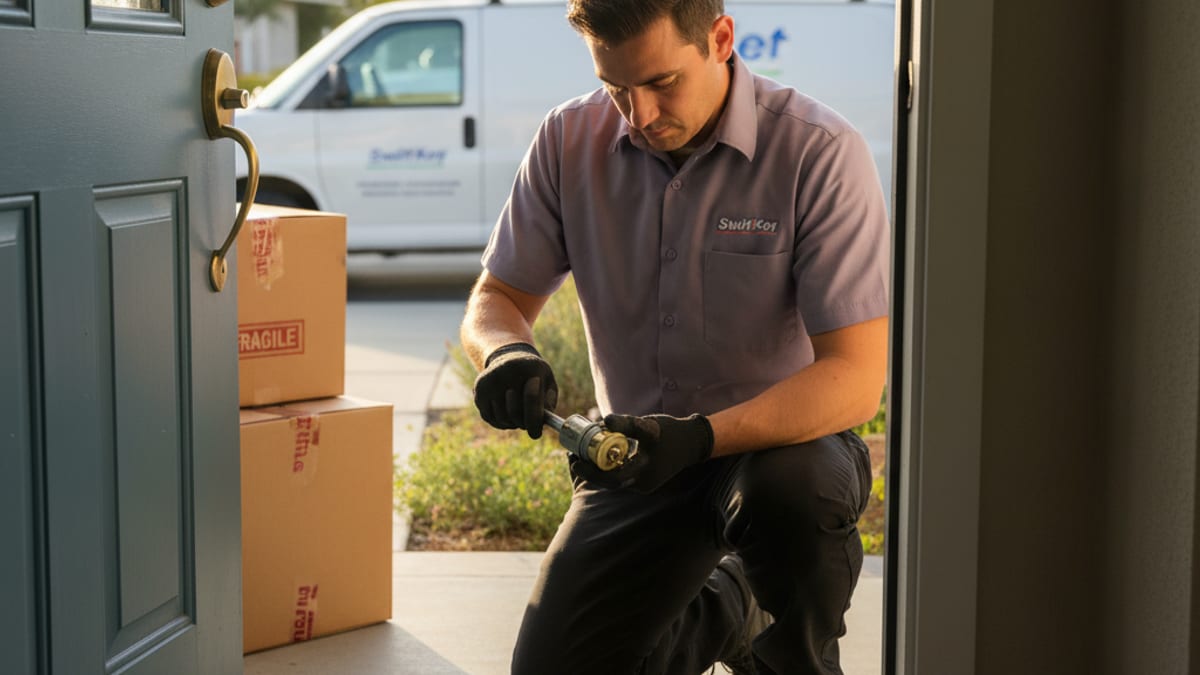
The day you close on a new home, or sign the lease on a rental, you usually cannot list every person who still has a working key. Builders, contractors, previous occupants, real estate agents, cleaners, and family members may still hold copies.
A lock rekey changes who can open working hardware. A lock replacement is the better path when the lock itself is worn, damaged, or due for an upgrade. This guide is a decision tree, not a price list. Swift Key San Diego is a referral service. Independent licensed locksmiths inspect the hardware, confirm what they can do, and set their own terms.
First, the vocabulary
Rekeying changes the internal pin configuration of a lock so old keys stop working. The hardware itself, the deadbolt, the knob, the finish, the cylinder body, stays in place. The locksmith removes the cylinder, rearranges the pins, and cuts keys that match the new configuration.
Replacing a lock swaps the entire hardware for something new. That is the usual path when the existing lock is worn out, damaged, below the security level you want, or you want to switch to a smart lock.
Keyed alike means multiple locks share the same key. If you rekey your front deadbolt, back deadbolt, side gate, and garage-to-house door to the same pin configuration, you carry one key instead of four. Whether that is possible depends on brand, keyway, and cylinder condition. The locksmith confirms compatibility on site.
When owners should rekey
Rekey when the existing hardware works and you only need to change who has a working key. Common owner move-in cases:
- Just bought a home. You do not know how many keys were issued. Rekeying the working exterior cylinders is the usual first security reset.
- Ended a roommate or co-tenant arrangement you control. When someone with a working key moves out, rekey after you confirm you have authority over that door.
- Lost a key that can be tied to the address. If the missing key sat with ID, a parking pass, or a labeled fob, treat the old key as compromised until the cylinders change.
- A contractor or housekeeper had a key. A returned key does not prove no copy exists. Rekey if you cannot account for every copy.
When you should replace instead
Replacement is the right call when the existing hardware is not worth rekeying:
- The lock feels loose, sticky, or wobbly. A rekey changes who has a key. It does not repair a failing mechanism.
- The finish is pitted, corroded, or rusting. Coastal salt air can wear finishes. Ask the locksmith whether the cylinder is still serviceable.
- You want a higher-security or smart lock. You cannot turn a mechanical deadbolt into a smart lock by rekeying. You need new hardware.
- The lock was damaged in a break-in attempt. If the cylinder, bolt, or strike is stressed or bent, replace rather than re-pin.
Grade labels on packaging can help you compare hardware, but they are not a substitute for inspecting the door in front of you. Ask the locksmith which cylinders are sound enough to rekey and which should come off.
The keyed-alike advantage
If you have more than one exterior lock of the same brand and keyway, ask whether they can share one new key. A locksmith can pin compatible cylinders to the same configuration so one key opens:
- Front deadbolt
- Back or patio deadbolt
- Side gate
- Garage-to-house door
- A shed lock, if it uses a compatible residential keyway
If the doors mix brands, keyed-alike usually requires replacing some hardware first. If the doors carry a mix of brands, can Schlage and Kwikset locks use one key covers the compatibility question.
Restricted keyways
If you want tighter control over copies, ask an independent locksmith whether a restricted-keyway cylinder is available for your doors and who is authorized to cut duplicates. Restricted systems typically require ID and authorization through the dealer of record. Swift Key does not sell or control those blanks.
Restricted hardware is not required for every move-in. A standard rekey of sound cylinders is often enough when the goal is only to retire unknown prior keys.
Mail and mailbox keys
Cluster mailbox keys are often controlled by USPS, not by a residential locksmith. If you move in and the previous resident did not hand over the mailbox key, contact your local post office and ask what they require for a replacement or box change. Do not assume a locksmith can rekey a USPS cluster box.
A private wall-mounted mailbox that uses a standard keyway may be eligible for locksmith work. The locksmith confirms the hardware and authorization.
A sample owner move-in plan
For a typical San Diego home purchase:
- Before or on move-in day: list every exterior door, gate, garage keypad, and spare-key location.
- Once you have keys to the house: have an independent locksmith inspect the cylinders and either rekey the sound ones or replace the ones that fail the inspection.
- Mailbox separately: contact USPS or the building manager if the mailbox is not a private box you control.
- Optional later: add a smart lock on a door you choose, after the mechanical access reset.
Ask the locksmith for an itemized quote that lists each cylinder, whether it will be rekeyed or replaced, how many new keys are included, and whether keyed-alike is possible. Do not start work on a lump-sum number with no cylinder count.
Renting or in an apartment? The rules are different
Everything above assumes you own the door or otherwise control it. If you rent, the lock is usually under management’s control. California does not impose a general turnover-rekey duty through Civil Code section 1940.5 (waterbeds) or Civil Code section 1941.3 (operable deadbolts). Start with the lease. Ask management in writing whether the unit was rekeyed, and request a rekey if you cannot confirm who still has keys.
We cover that path separately, including rekeying apartment locks after a roommate moves out and tenant rekey rights in California.
Frequently asked questions
How much does it cost to rekey a house after moving in?
The independent locksmith sets the price. Ask for an itemized total that includes the service call, each cylinder, extra keys, and any hardware that must be replaced instead of rekeyed. Cylinder count and brand mix drive the quote more than a generic “whole house” number.
Is the landlord responsible for rekeying between tenants in California?
There is no general California Civil Code rule that requires a turnover rekey between ordinary tenancies. Check the lease and ask management in writing. Civil Code 1941.3 requires specified operable locks, not a new keying between occupants. Separate abuse-or-violence lock-change paths are explained in the tenant rekey rights article.
Can a locksmith key multiple locks to the same key when moving in?
Often, when the cylinders share a brand and keyway and are in good condition. That is keyed-alike service. Mixed brands usually cannot share one key without replacing some hardware. The locksmith confirms this during the inspection.
Should I rekey or replace the locks at a newly purchased home?
Rekey working hardware when the only problem is unknown prior keys. Replace locks that bind, wobble, show corrosion damage, or that you want to upgrade to a smart lock. Many homes use a mix: replace the weak door, rekey the rest.
How soon after moving in should I get the locks rekeyed?
For owners, as soon as you can schedule an authorized locksmith visit is the practical answer, because unknown prior keys remain usable until the cylinders change. Renters should get written management approval first.
Swift Key San Diego matches San Diego County callers with independent licensed locksmith professionals. The professional confirms authorization, hardware condition, and price. Call (858) 400-4082.