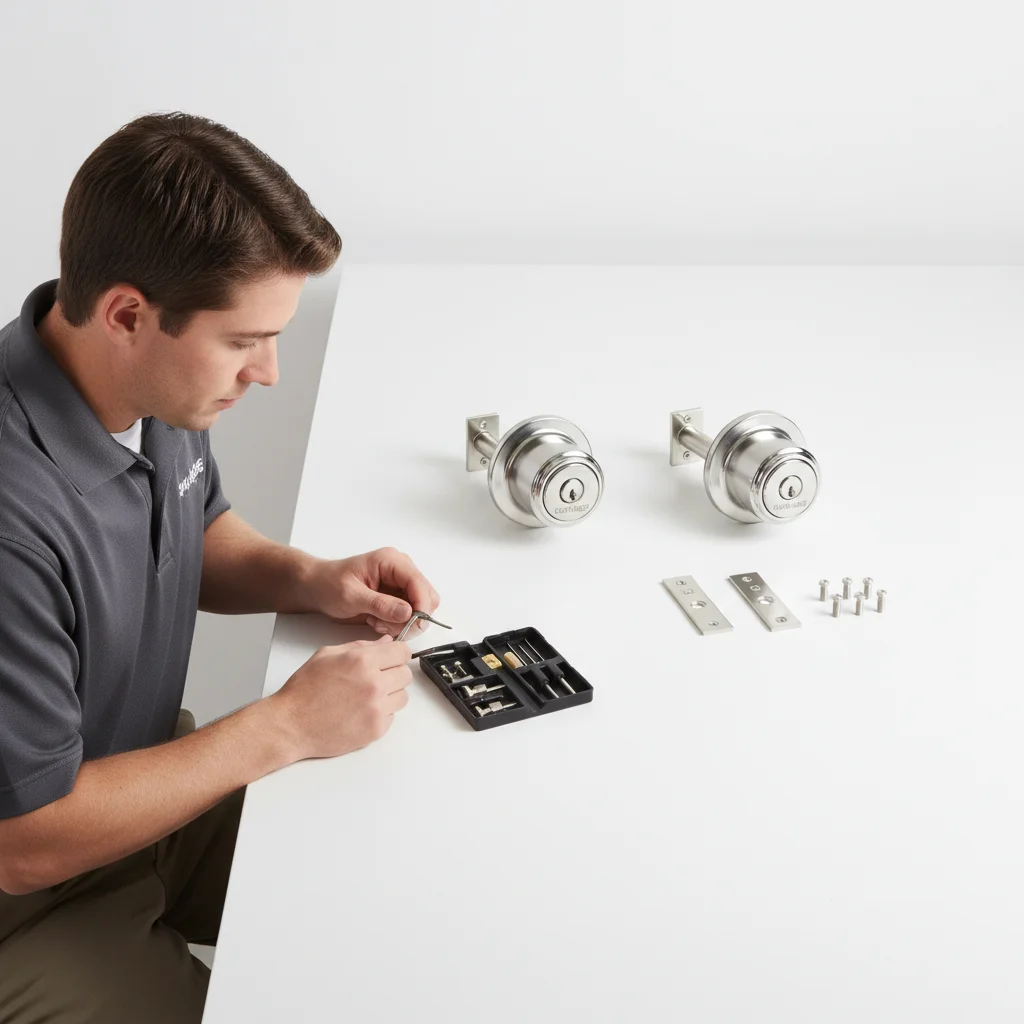
For a primary home front door, buy Schlage. For a rental where rekeying between tenants matters most, Kwikset SmartKey wins on convenience. The tradeoff is real: Schlage uses a standard pin-tumbler cylinder with anti-pick spool pins and heavier-gauge steel, while Kwikset’s SmartKey lets you rekey the lock yourself in seconds but uses a different internal mechanism that most locksmiths consider less proven. This guide covers price, installation, smart-lock options, and finish durability so you can make the call for your property. For a deep dive on forced-entry resistance, see our Schlage B60 vs Kwikset security review.
Pick resistance: how each brand actually performs
Lock picking is what most people think of when they imagine a lock being defeated without a key. While it’s far less common in real-world burglaries than a swift kick to the door, a lock’s ability to resist picking is still a good measure of its overall security and quality.
A standard Kwikset lock uses a simple pin-tumbler design with standard pins. For a novice, it’s not trivial to pick, but for someone with a bit of practice or basic tools, it can be opened relatively quickly. They meet basic standards, but they aren’t designed to be high-security in this regard.
Schlage, even in their common residential deadbolts like the popular Schlage B60N, includes security pins. These are typically “spool pins,” which are shaped like a spool of thread. When a pick attempts to set them, they give a false sense of being set and bind up the lock core, making it much more difficult and time-consuming for a picker to open. This feature alone gives Schlage a clear edge in pick resistance over a standard Kwikset lock. While a highly skilled locksmith can still pick a Schlage, it’s a significant deterrent against the average attacker.
Bump and drill resistance compared
While picking is rare, brute-force attacks like bumping and drilling are more practical concerns for a homeowner. A “bump key” is a specially cut key that can be used with a sharp rap to “bump” the pins into alignment and open the lock. Drilling involves using a power drill to destroy the lock cylinder.
Here again, we see a difference in build quality. Kwikset’s standard deadbolts are functional but are often made with lighter-weight materials. This makes them more susceptible to a drill attack, where a hardened drill bit can chew through the cylinder relatively fast.
Schlage deadbolts are typically built with heavier, more heavier-gauge materials like solid brass and have hardened steel components designed to resist drilling. The Schlage B60N, for example, is an ANSI/BHMA Grade 1 deadbolt, the highest residential security rating. This rating means it has been tested to withstand a higher degree of force, including drilling and kicking attacks. If you want to understand what goes into that rating, our guide on how to choose a Grade 1 deadbolt offers a deep dive. For most homeowners, the superior construction of a Schlage lock provides a meaningful upgrade in resistance against common forced entry techniques.
SmartKey vs. standard pin tumbler tradeoffs
This is perhaps the biggest functional difference between the two brands and where Kwikset has a major selling point: its SmartKey technology. This feature allows you to rekey the lock yourself in seconds using a special tool. If you lose a key or have a tenant move out, you don’t need to call a locksmith. You can just rekey the existing lock to a new key. The convenience is undeniable.
However, that convenience comes with a significant security tradeoff. Kwikset SmartKey locks don’t use a traditional pin-tumbler mechanism. They use a system of sliders and a sidebar. Unfortunately, early generations of this technology proved to have serious vulnerabilities. Specialized tools were developed that could easily bypass or decode the lock, sometimes faster than picking a traditional lock.
While Kwikset has updated the design to improve its security, many locksmiths remain wary of the fundamental mechanism. The kwikset smartkey security debate is a hot one in our industry, but the consensus is that a traditional pin-tumbler system is more proven and generally more secure against covert attacks.
Schlage uses a standard pin-tumbler cylinder. It’s a design that’s been trusted for over a century. It’s sturdy, reliable, and can’t be bypassed with the same tools that defeat some SmartKey locks. The downside? You can’t rekey it yourself. You’ll need a locksmith to do it. But for that, you get a time-tested mechanism with no known major design vulnerabilities.
Warranty and finish durability
Your front door lock is exposed to the elements every day. In San Diego County, that can mean intense sun in East County or corrosive salt air along the coast from Imperial Beach to Oceanside. The lock’s finish needs to be able to handle it.
Both Schlage and Kwikset offer limited lifetime warranties on the mechanical parts and the finish of their products. On paper, they look similar. In practice, our experience in the field shows a noticeable difference. Schlage locks generally feel heavier and more substantial in your hand. Their finishes, particularly on their higher-end models, tend to hold up better against fading, chipping, and corrosion over the years.
Kwikset provides a good product for its price point, but we often see their finishes begin to pit or wear thin sooner than a comparable Schlage, especially on homes near the coast. The internal components of a Schlage are also typically made from more durable brass and steel, contributing to a smoother, more reliable operation for longer. If long-term durability and a lasting high-quality look are important to you, Schlage usually has the advantage.
Price point: what you’re really paying for
When you compare them on the shelf, Kwikset is almost always the more affordable option. A standard Kwikset deadbolt might be 20-40% cheaper than its Schlage equivalent. For a builder or landlord outfitting multiple doors, this cost savings can be very attractive.
So, what are you paying for with Schlage? You’re paying for heavier materials, more heavy-duty construction, and added security features like anti-pick pins.
- Kwikset: You’re paying for convenience (with SmartKey) and accessibility. It’s a good, budget-friendly lock that meets basic security needs for many situations.
- Schlage: You’re paying for a higher grade of security and durability. The added cost reflects the solid brass components, hardened steel inserts, and more complex cylinder design. It’s an investment in a lock that is built to better withstand both force and time.
Choosing between them is a matter of value. Is the added security and longevity of a Schlage worth the extra $15-$30 per lock? For the front door of your family’s home, we believe it absolutely is. For an interior door or a low-risk application, a Kwikset may be perfectly adequate.
Our pick by use case (rental, primary home, vacation)
There is no single “best deadbolt brand” for everyone. The right choice depends on your specific property and security needs. Here are our professional recommendations for common scenarios in San Diego.
For a rental property
Our Pick: Kwikset SmartKey For landlords and property managers, the ability to rekey a lock instantly between tenants is a massive advantage. It saves time and the cost of a locksmith service call for a simple rekey. While the security isn’t as strong as Schlage, the risk can be managed, and the convenience factor often wins out in a rental environment.
For your primary home
Our Pick: Schlage B60N (or higher) This is your family’s main line of defense. Security should be the top priority. A Schlage Grade 1 deadbolt offers superior resistance to picking, drilling, and brute-force attacks. It’s built to last and provides the peace of mind that comes with a proven, solid locking mechanism. The one-time cost of professional deadbolt installation and any future rekeying is a small price to pay for this level of security.
For a vacation home or Airbnb
This is a toss-up, leaning toward Schlage. If you live locally and can manage key exchanges, the security of a Schlage is still the better choice. However, for remote owners or properties with frequent guest turnover, the convenience of Kwikset’s SmartKey is tempting. An even better solution for this use case is often a high-quality smart lock, which allows you to manage access remotely without physical keys at all.
Ease of installation: which is simpler to swap out?
Both brands use a standard two-bore deadbolt format that fits most residential doors. If your door already has a 2-1/8-inch cross bore and a 1-inch edge bore with a 2-3/8-inch or 2-3/4-inch backset, either lock slides in without new drilling.
Kwikset is slightly more beginner-friendly. The hardware is lighter, the tolerances are a bit looser, and the SmartKey feature means you can rekey it yourself the moment it’s in the door. No locksmith needed.
Schlage is just as simple to install mechanically, but the rekeying step requires a professional. If you’re swapping it in on a rental turnover and want to hand it off today, build that service call into the plan. For a primary home where rekeying is rare, it’s not a real drawback.
Smart-lock options: which brand plays nicer?
Both Schlage and Kwikset have smart-lock versions of their deadbolts. Schlage’s Encode and Connect lines are well-regarded for physical security and have broad smart-home compatibility. Kwikset’s Halo and SmartCode lines also work with most hubs.
If you already have a Google Home, Amazon Alexa, or Apple HomeKit setup, check compatibility before buying. Schlage Connect works over Z-Wave, which requires a hub. Schlage Encode has built-in Wi-Fi and pairs directly. Kwikset Halo also runs on Wi-Fi, which is a simpler setup for most households.
For a deeper comparison of which electronic deadbolt makes sense for San Diego homes, see our Schlage B60 vs Kwikset security review, which covers how the underlying Grade 1 mechanism holds up once you strip away the smart features.
Where to buy and what to expect to pay
Both brands are available at Home Depot, Lowe’s, and most hardware stores in San Diego County. Online pricing is usually 10-20% lower than in-store, though you lose the ability to handle the hardware before buying.
As of mid-2026, a standard Kwikset Grade 1 deadbolt runs roughly $25-$50. A comparable Schlage B60 typically lands between $45-$75 depending on the finish. Smart-lock versions of either brand start around $100-$180 and climb from there.
The finish matters in San Diego. Satin nickel and matte black hold up better than polished brass in coastal environments. If your door faces direct sun in an inland area like Santee or El Cajon, look for a UV-resistant finish rating in the product specs.
Frequently asked questions
How much more does a Schlage deadbolt cost than a Kwikset?
About $20 to $30 more for comparable models at retail. A standard Kwikset Grade 1 deadbolt runs $25 to $50, while a comparable Schlage B60 lands between $45 and $75 depending on finish. Smart-lock versions of both brands start around $100 to $180. That price gap closes further when you factor in that Schlage hardware tends to last longer without finish degradation, especially in coastal San Diego homes near the salt air.
Can I rekey a Schlage deadbolt myself?
No. Schlage uses a standard pin-tumbler cylinder that requires a locksmith to disassemble and re-pin. Kwikset’s SmartKey line is the one you can rekey yourself with the included tool. If self-rekeying between tenants matters to you, Kwikset SmartKey is the practical choice. If you want maximum security and don’t mind a locksmith visit for rekeying, Schlage is the better lock.
Which brand works better with smart home systems?
Both work well, but the connection method differs. Schlage Encode has built-in Wi-Fi and pairs directly to most systems without a hub. Schlage Connect runs on Z-Wave and needs a compatible hub. Kwikset Halo also uses Wi-Fi and is straightforward to set up. Check your existing smart home platform for certified compatibility before buying, since some older hubs only support Z-Wave or Zigbee.
Is Kwikset SmartKey actually less secure than a standard Schlage?
Most locksmiths think so. The SmartKey mechanism uses a slider-and-sidebar system instead of traditional pin tumblers, and early versions had documented bypass vulnerabilities. Kwikset has improved the design over time, but the consensus in the industry is that a standard pin-tumbler Schlage is more proven against covert attacks. For a rental where convenience wins, SmartKey is fine. For a primary home front door, the extra security of a Schlage pin-tumbler is worth the trade-off.
Does the finish really matter for San Diego homes?
Yes, especially within a few miles of the coast. Salt air accelerates corrosion on lower-quality finishes, and we regularly see Kwikset brass finishes pitting or peeling within three to five years in coastal neighborhoods. Satin nickel and matte black hold up better than polished brass for any home facing salt air or direct sun. Both brands offer corrosion-resistant finishes, but Schlage’s higher-end models generally hold up longer in San Diego’s coastal conditions.
When to call us
No matter which brand you choose, a lock is only as good as its installation. A high-security deadbolt installed improperly in a weak door frame offers a false sense of security. If you want to ensure your new lock is installed correctly for maximum protection, it’s best to call a licensed professional.
Call us at (858) 400-4082 for an estimate.