The leasing office in Mission Valley closed hours ago. You’re on a concrete landing with your phone, your ID, and a door that will not open. After hours, call the right people in the right order, and keep any locksmith inside the scope the property actually allows.
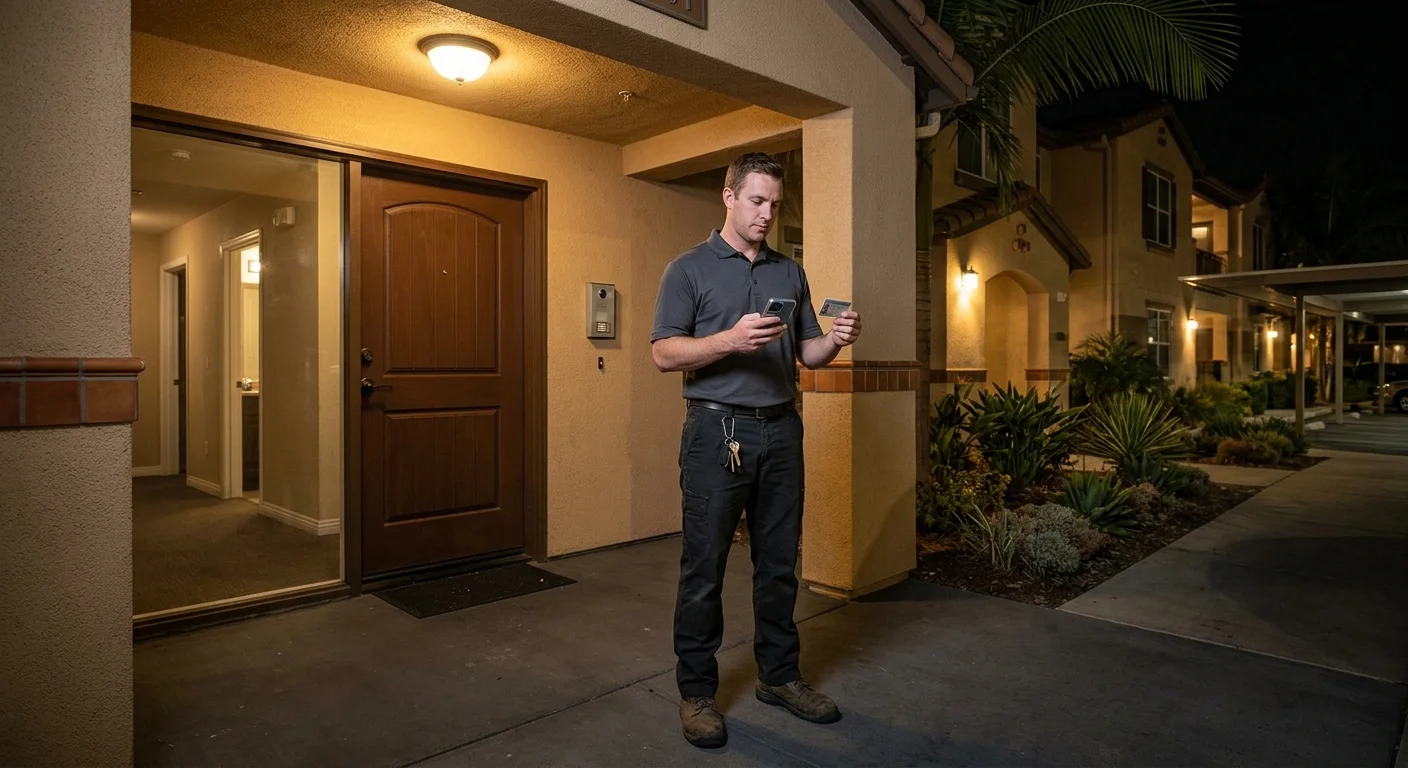
Contact the property after-hours number first
Start with the property, not a locksmith. Most San Diego rentals list an after-hours number on the lease, in the resident app, or on the lobby directory. Use that line before anyone touches the hardware.
Office staff are gone. An answering service or on-call tech may have a spare or a written lockout process. Some East Village and Little Italy buildings keep a night attendant. Many Mira Mesa, Scripps Ranch, and Otay Ranch complexes don’t.
Have this ready: your full name, unit number, building letter if there is one, and a callback number. Say you’re locked out of your own unit. Say whether a roommate is inside. Say if a child, a pet, or a stove is part of the problem. If someone is in danger, call 911.
For the daytime version of this mess, use our apartment lockout guide for San Diego. Tonight, text a roommate, a spare-key neighbor, or a friend driving I-8 while you wait on hold.
Don’t assume the office will send someone. Some desks let a listed resident in. Some tell you to hire a locksmith and report it in the morning. Charges, if any, depend on your lease and California rules. Read whether a landlord can charge for a lockout in California and confirm the process with your manager. Don’t guess a dollar amount in the dark.
A matched locksmith can’t override a property manager, an HOA, or a building policy. If they say wait, log the time and the name. If they say hire a locksmith, ask which doors they’ll authorize.
Confirm the unit, building, and shared access
San Diego apartments aren’t one floor plan. A Mission Valley podium building, a Coronado courtyard, and an El Cajon two-story walk-up fail in different ways at night. Tell whoever you call the real entrance you’re standing at, not just the mailing address.
Read the building letter and the unit number. Downtown towers stack gates, garage roll-ups, elevators, and corridor doors in front of your lock. Gated complexes in Carmel Valley and Rancho Bernardo add a vehicle keypad and a pedestrian fob. Stuck at the lobby is a different job than a deadbolt on 2B.
Shared access is the part people skip. Your metal key may still be in your pocket while the fob is dead. Or the fob works and the unit cylinder doesn’t. Say which layer failed. A locksmith who only hears that you’re locked out may prepare for a bedroom door when you can’t reach the elevator.
Give a landmark the driver can use after dark. UTC towers look identical from the street. National City and Chula Vista courtyards often hide the unit door where GPS drops at the wrong curb. Name the pedestrian gate, not only the street number.
If you parked in a garage, note the level and whether that garage needs a separate opener. Don’t prop a common door with a rock. Management will treat that as a security problem in the morning.
Write the details in a note before the next call: unit, building, gate, garage, and which lock actually failed.
Gather ID and proof you live there
After hours, you look like a stranger in a hallway. Treat identification as part of getting in. A licensed locksmith in California opens locks for a living. That person has to confirm you belong in the unit before any tool comes out.
Bring a photo ID with your current name. A lease PDF on your phone helps. A rent-portal screenshot or mail with the unit address helps more. If your license still shows a parent’s house in Escondido and you rent in North Park, the lease is the paper that ties you to this door.
If the lease lists only one name, that person should be the one who speaks. Don’t ask a locksmith to open a unit for a guest who can’t prove tenancy.
Property staff may ask for the same packet. Night desks log after-hours entry. Independent owners in older City Heights or Golden Hill stock may just want your face and your ID. Have it in your hand before anyone arrives.
California locksmiths are licensed by the Bureau of Security and Investigative Services, not the contractors board. You can verify a company license on the state site. California law requires locksmiths to carry a pocket license and show it on request. If a caller won’t give you a license name to look up, stop.
Swift Key San Diego is a referral service. We match you with licensed, independent local locksmiths. We don’t hold a locksmith license, and we don’t open doors. The pro you are connected with confirms you live there, then does only the work that is authorized.
Keep your phone charged enough to show documents. Sit in your car if you have it, or in a lit lobby, while you pull the lease up.
Separate a private door from a lobby or gate
Your unit door is private. The lobby, the elevator, the courtyard gate, and the garage are not. After hours, that split decides who is allowed to open what.
A matched locksmith can often handle a home lockout at a private apartment door. That is after identity is confirmed and the property hasn’t forbidden the work. Shared hardware is different. Many San Diego communities own the gate cylinders, the fob system, and the stairwell locks. Opening those without the manager’s blessing can violate the building’s rules even if you truly live there.
Say it clearly. You’re past the gate and locked out of your unit. Or you can’t get through the pedestrian gate at all. Those are two jobs. A dead fob on a Mission Beach alley gate is building access. A snapped key in a unit deadbolt is a private-door problem.
Don’t climb a balcony. Don’t fish a latch with a card. Coastal buildings from Ocean Beach to Imperial Beach salt the hardware, and forcing it leaves marks you’ll pay for in the deposit.
If the failure is a common fob or a community gate, tell the after-hours line that first. They may remote-open a vehicle gate or buzz a lobby. A locksmith isn’t a workaround for an HOA that wants staff to handle the perimeter.
Offices follow the same split in our business lockout after hours in San Diego guide. Common doors and private doors aren’t the same authorization.
Once you’re at your own cylinder, stay there. Don’t wander onto a neighbor’s patio to try a slider. That’s how a lockout becomes a police call.
Confirm the locksmith’s authorized scope
Authorization is the last check, and it’s the one that keeps you from a morning fight with management. Ask the property, by text if you can, what the locksmith may do: open the existing unit lock, drill it, rekey it, or replace the hardware. Those are four different jobs.
A licensed independent locksmith confirms that scope on site. The pro shouldn’t punch a restricted common cylinder because you’re cold. The pro shouldn’t swap a building-standard lock for a hardware-store knob because it was faster. If the lease requires a specific keyway so management can enter, changing it without approval creates a new problem.
Tell the locksmith what you already tried, then show ID and the lease. Ask how they plan to open it. You approve any change, including a drill, before tools come out.
Ask for a company name and a BSIS lookup before work starts. You can refuse extra work you didn’t request. You pay the professional directly. Swift Key San Diego doesn’t set the price and doesn’t warranty the work. Those terms belong to the locksmith in front of you.
If the property never called back and you still need the unit open, say so. The locksmith still verifies you. The locksmith still stays off shared gates the building didn’t release. That’s the pro staying inside California locksmith licensing rules and the building’s policy.
When the office can’t help, an emergency locksmith visit is the remaining path. Availability varies by the independent pro, the neighborhood, and the night. We don’t promise a window, and we don’t claim every matched locksmith is available. We connect you, and the locksmith tells you what they can take on.
When to call us
Call when the office is closed, the property can’t let you in, and you need a licensed locksmith to open a private door you can prove is yours. Stay off shared gates the building didn’t authorize, and skip DIY force that marks the frame. Call us at (858) 400-4082 and we’ll connect you with a licensed local locksmith.