If you’re locked out of your apartment in San Diego, try building management first, then call a licensed mobile locksmith if they’re unavailable or it’s after hours. Most apartment lockouts are resolved by non-destructive entry, meaning the locksmith picks the lock instead of drilling it, so you’re back inside with the hardware intact. Have your ID or a copy of your lease ready before the technician arrives.
When you’re locked out of your apartment, the fastest path back inside is to contact building management during business hours or call a licensed locksmith after hours.
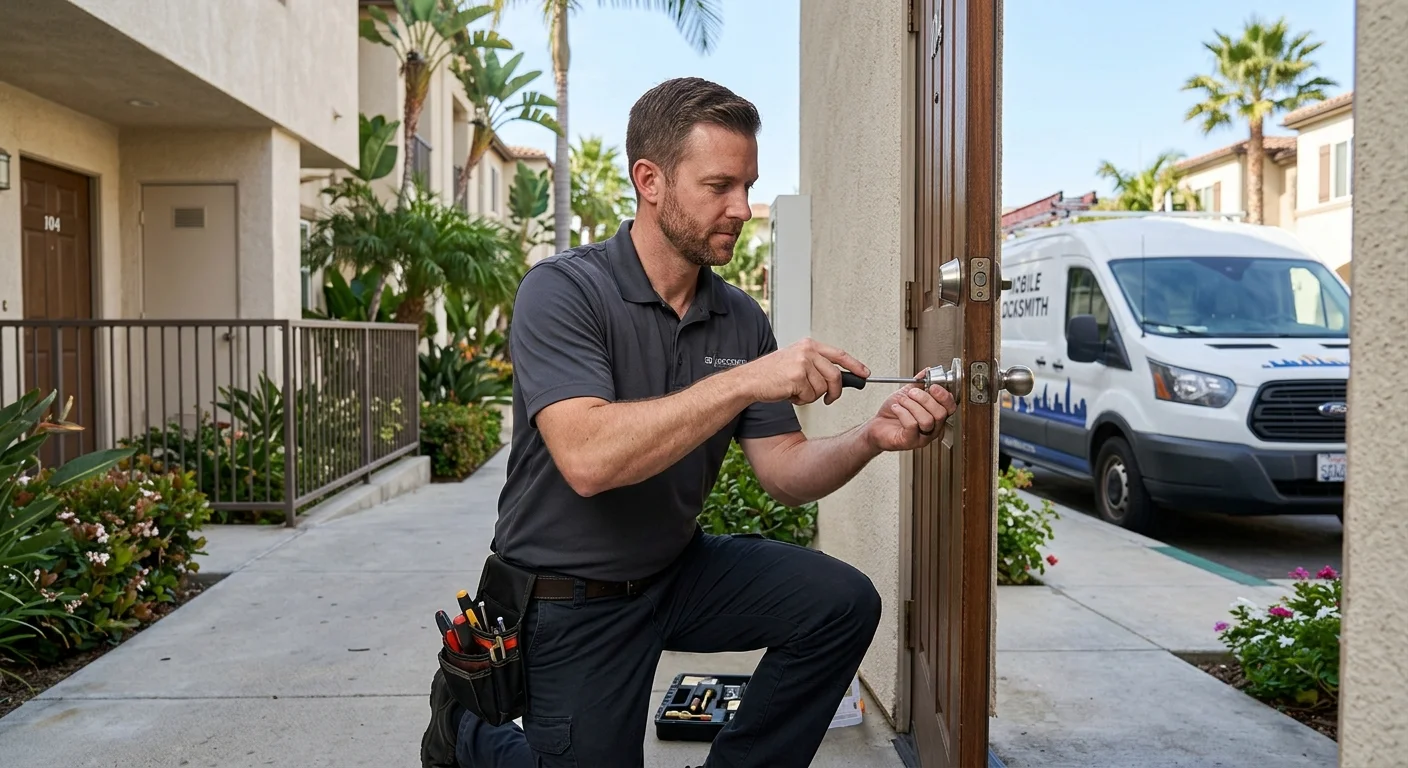
What to do when you’re locked out of your apartment
If you’re locked out of your apartment, start with building management. If they’re unavailable or it’s after hours, call a licensed locksmith. Don’t try to force the door or a window. Forced entry risks damaging the frame and will almost certainly cost more than a locksmith call. Have your ID or lease ready before the technician arrives.
Should I call a locksmith when I’m locked out of my apartment?
Yes, once management has failed you or it is after hours. A licensed locksmith can legally open an apartment door for the lawful occupant, and picking the lock leaves the hardware intact, so there is nothing for the landlord to charge you to repair. What the locksmith cannot do is rekey or replace the lock without the owner’s authorization, because the hardware belongs to the property, not to the tenant. Bring photo ID and something tying you to the unit, such as a lease page, a utility bill, or mail with your name and apartment number on it.
Management and maintenance aren’t answering. Now what?
This is the most common version of an apartment lockout and the one most guides skip, because the standard advice, call the office, has already failed you.
Work down this order before you call anyone paid. Check your lease or tenant portal for an after-hours emergency number that is different from the office line, since most complexes run a separate one and it is rarely on the office voicemail greeting. Try the property management company rather than your building: the corporate line often answers when the on-site office does not, and they can call the on-call maintenance tech directly. If your building has a courtesy patrol, a concierge, or a security desk, they frequently hold a master or can reach someone who does. A neighbor with the same layout is worth a knock, not for a key, but because long-term residents usually know the actual after-hours number.
If none of that lands within about fifteen minutes, stop calling and call a locksmith. Waiting on a callback that may not come costs more than the lockout does, and it gets worse after midnight when fewer locksmiths are working. Nothing about hiring a locksmith yourself breaches a standard lease. You are a lawful occupant asking to be let into your own home, and a licensed locksmith will verify that before touching the door.
One thing not to do while you wait: do not let a stranger who “knows a guy” work on the door, and do not accept an offer to slip the latch with a card from someone who turns up. If the door gets damaged, you own that repair, and the odds go up sharply when the person holding the tool is not insured.
First steps: check with the leasing office or building manager
Your first point of contact after realizing you are locked out should always be your apartment building’s management or leasing office. Most apartment complexes, from the high-rises in UTC to the beachfront properties in Pacific Beach, have a protocol for resident lockouts. They might possess a master key that allows them to grant you access. This is usually the quickest and most cost-effective solution during business hours.
When you call, be prepared to provide your name, apartment number, and some form of identification. Many complexes will have a staff member available during office hours who can quickly come to your unit. It is wise to check your lease agreement or tenant handbook for specific instructions regarding lockouts, as some buildings charge a small fee for this service. Keep their contact information handy, perhaps saved in your phone or noted on a card in your wallet, for these unexpected situations. Acting quickly during business hours can often resolve your lockout without needing outside assistance.
Locked out of apartment after hours: how to get in and who to call
What happens when your lockout occurs on a Saturday night, a holiday, or in the middle of the night? This is a common challenge for residents across San Diego County, from Coronado to Oceanside. During these times, your leasing office or building manager likely won’t be available to help. Many apartment complexes have after-hours emergency lines, but these are typically reserved for maintenance emergencies like a burst pipe, not usually for routine lockouts.
This is exactly when you need to consider calling a professional emergency locksmith. A licensed locksmith provides a crucial service when you cannot access your home through conventional means. It is important to avoid trying to force your way in or attempting DIY solutions, as this can easily damage your door or lock, leading to more expensive repairs. A reputable locksmith has the tools and expertise to gain entry to your apartment safely and efficiently, minimizing any potential damage. They understand the urgency of being locked out, especially in San Diego’s evening chill or when you have plans, and are equipped to respond outside of typical business hours. When your building management is out of reach, a professional locksmith is your most reliable next step.
Locksmith apartment lockout: how it works and what they’ll ask for
When you call Swift Key San Diego for an apartment lockout, you can expect a streamlined and professional process. Our goal is to get you back inside without damage. First, we will ask for your exact location, the type of lock on your apartment door (if you know it), and any details about how you got locked out. This helps match you with a locksmith who has the correct tools for the job. Once on site, the locksmith will assess the situation. Most apartment door lockouts can be resolved through non-destructive entry methods, such as lock picking. (Here’s how locksmiths open doors without damaging the lock.) This means the locksmith can often open your door without needing to drill or replace the lock.
In cases where the lock is damaged, or if non-destructive entry is not possible, the locksmith might need to carefully drill the lock cylinder. If this happens, they can usually replace the cylinder on the spot, restoring your door’s security. The locksmiths in our network are trained to handle various types of apartment locks found throughout San Diego, from standard deadbolts to more complex electronic systems. Throughout the process, the locksmith will communicate clearly about the steps they are taking and any associated costs. You can learn more about general pricing in our post, How much does a locksmith cost in San Diego?. This transparency is key to a stress-free experience.
Proof of residency, what to have ready
A crucial step in any legitimate apartment lockout service is verifying your identity and residency. Swift Key San Diego will always ask for proof that you live at the address you are trying to access, and any reputable locksmith should do the same. This is not just a formality; it is a critical security measure designed to protect you, your neighbors, and your property from unauthorized entry. Imagine if someone could simply call a locksmith and gain access to any apartment they wanted. This safeguard prevents such scenarios.
When the technician arrives, please have one or more of the following ready:
- A valid government-issued ID (driver’s license, state ID) with your current apartment address.
- A copy of your lease agreement, showing your name and the apartment address.
- A recent utility bill (gas, electric, water, internet) addressed to you at that apartment.
If your ID does not yet reflect your new address because you just moved to a new apartment in, say, Little Italy or Bankers Hill, a combination of your ID and a physical copy of your lease agreement is usually sufficient. In some cases, if the building manager is present and can vouch for you, that might also serve as verification. We understand these moments are stressful, but this step is non-negotiable for your safety and ours. It underscores the importance of choosing a licensed and ethical locksmith. You can always verify a locksmith’s license through the California Bureau of Security and Investigative Services (BSIS) at www.bsis.ca.gov.
Should you rekey apartment locks after a roommate moves out?
Yes, if your lease lets you, and it’s cheaper than replacing the lock. Rekeying swaps the pins inside the cylinder you already have, so every old key stops working. Returned keys don’t settle it. You have no way to know how many copies were cut, or who else was handed one.
Ask the property manager first. Most San Diego leases put the locks under management’s control, and some complexes keep every unit on a master key they need to preserve. A manager who says yes will usually want the work done by a locksmith and a copy of the new key on file. That’s normal, not a red flag.
The same logic applies the week you move in. Previous tenants, their partners, and their dog walkers may all still hold a working key. If you’re weighing rekeying against new hardware, our guide to rekey vs. replace when moving in walks the decision. When you’re ready, lock rekey is the service to ask for, and the locksmith rekeys the cylinder on-site.
Lockout service across San Diego County
Apartment lockouts happen in every part of the county, and the fix is the same everywhere: a mobile locksmith who comes to the door. The locksmiths in this network work Downtown and the Gaslamp, the beach rentals in Pacific Beach and Ocean Beach, the student housing around SDSU, and the complexes out through Chula Vista, El Cajon, and Encinitas.
Swift Key San Diego is a referral service, not the locksmith. It matches you with a licensed independent locksmith who does the work, quotes the price, and takes your payment directly. That’s why nobody here quotes a fee for them over the phone. What we can tell you before anyone drives out is whether the job is straightforward, what ID the locksmith will ask for, and whether your building’s lock type needs a specialist.
Same network for the calmer jobs too: rekeys, a lock that’s binding, a mailbox key, or a smart lock if your lease allows one. For the wider picture on lockouts beyond apartments, see home lockout service and when you need a 24-hour locksmith in San Diego.
Frequently asked questions
Locked out of your apartment: who do you call first?
Call your leasing office or property manager first during business hours, since a master key is free or cheap and takes minutes. After hours, check your lease for the emergency maintenance line. If neither answers, or you need in fast, call a mobile locksmith, expect to show ID and proof of residency at the door.
Can my landlord let me into my apartment?
Yes, your landlord or property manager can let you in using a master key, and this is usually the fastest option during business hours. Most San Diego apartment complexes have a leasing office or on-call maintenance contact that can respond to lockouts. Check your lease for the after-hours emergency number. Some complexes charge a fee for an after-hours letting-in, and the amount is set in your lease, so check it there rather than guessing.
How much does an apartment lockout locksmith cost in San Diego?
The locksmith sets the price and quotes it before starting work, so ask on the phone rather than taking a figure off a website. Four things move it: the time of day, whether the lock picks open or has to be drilled, whether the cylinder needs replacing afterwards, and how far the locksmith drives. Business-hours picking is the cheapest version of the job. A drilled lock costs more because you’re also buying hardware.
How long does it take for a locksmith to arrive for an apartment lockout?
There’s no way to promise an exact arrival time, since it depends on where you are in San Diego County and which locksmith is closest when you call. Denser areas like Downtown, Hillcrest, and North Park tend to see a locksmith sooner than more distant areas like Otay Ranch or Rancho Bernardo. Locksmiths in our network cover the whole county.
Will my landlord know I called a locksmith?
Not automatically. A locksmith verifies your identity and residency before opening the door but doesn’t notify the property management office. That said, if your lease includes a clause about lock modifications, and the locksmith had to drill the lock rather than pick it, you’d need to tell your landlord so the hardware can be replaced or re-keyed.
What if I just moved in and my ID still shows my old address?
A combination of your current photo ID and a physical copy of your lease agreement is usually enough for a licensed locksmith to verify residency. If you have a recent utility bill or bank statement addressed to the new apartment, that helps too. Reputable locksmiths are trained to handle recent-move situations without requiring a perfectly updated ID.
Renting in the central neighbourhoods? Our Mission Valley locksmith guide covers the complexes and access systems that come up most there.
When to call us
Call when the manager can’t help, when the lock is damaged, or when it’s after hours and you need in. Call (858) 400-4082 and we’ll match you with a licensed locksmith who covers your address. The locksmith quotes the job before starting, and you pay them directly.