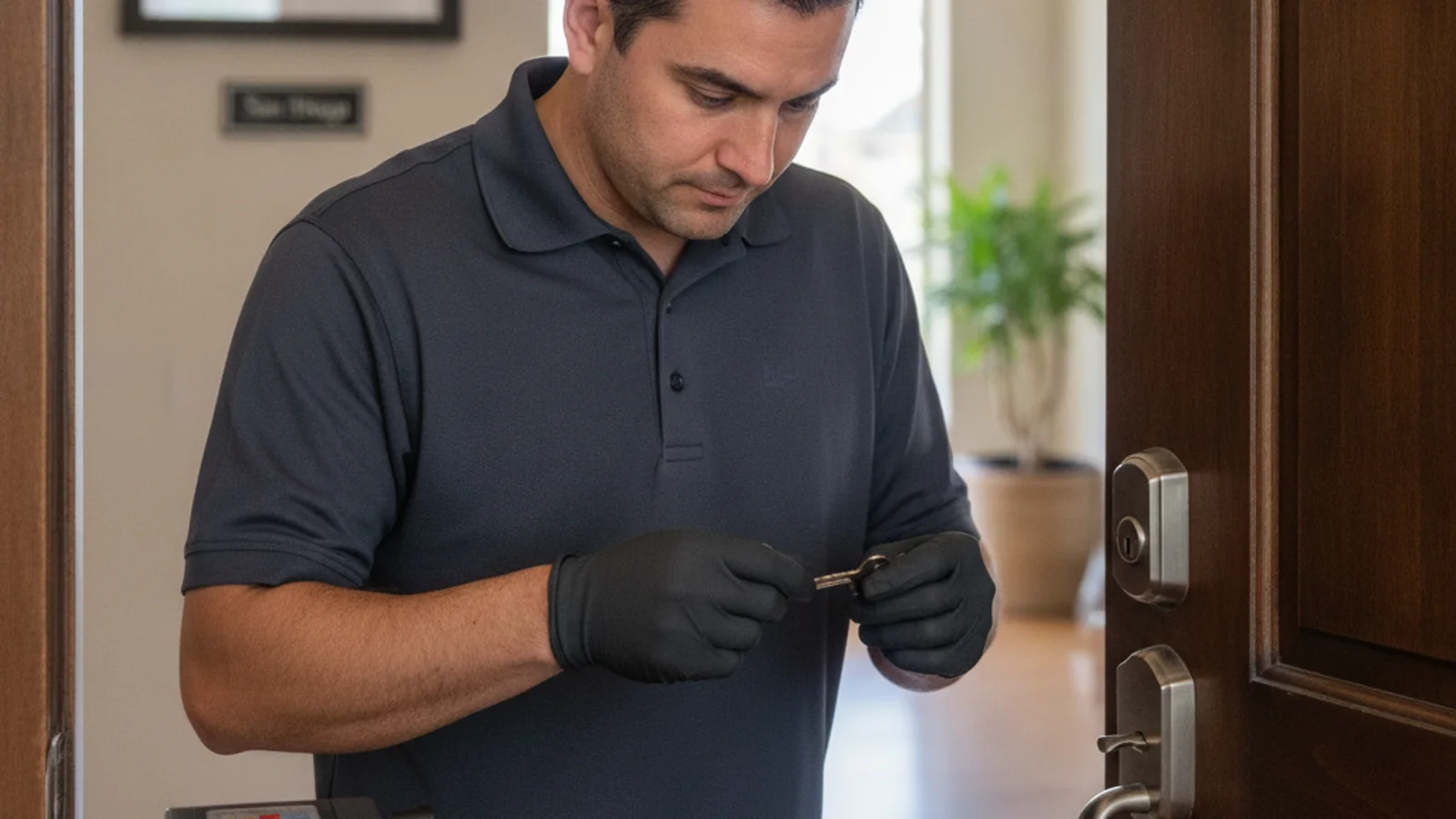
Yes, a locksmith can make a key directly from your lock with no original key. The process is called key origination, and it costs $50 to $150 for most house locks, $150 to $450 for car locks, and as little as $25 for simple padlocks or mailbox locks. Two main methods exist: impressioning, which works a blank in the keyway until the cuts reveal themselves, and decoding, which reads the pin depths either with a specialized tool or by disassembling the cylinder. Which method a locksmith chooses depends on the lock type, whether the lock is installed, and how quickly they need to work.

How impressioning works

Impressioning is the older of the two methods and requires no disassembly. The locksmith inserts a soft brass blank into the keyway and applies light turning pressure while working the blank up and down. Each driver pin leaves a faint mark on the blank’s surface exactly where a cut needs to be. The blank comes out, the marks are filed to the correct depth, and the process repeats until the key turns the cylinder.

A clean impression on a standard Schlage or Kwikset takes 15 to 30 minutes in skilled hands. It works best on locks that are still installed in a door, which is why it’s the go-to method when you’re locked out with no spare. The downside is that it’s technique-dependent. A worn lock with sloppy pin tolerances produces ambiguous marks and takes longer to read.

You don’t need to know which method your locksmith uses. What matters is that the finished key works.

Decoding and cutting by code

Decoding skips the impression step entirely by reading the pin depths directly. On a cylinder that can be removed from the door, the locksmith pulls the plug, measures each pin stack with a depth gauge, and uses those measurements to cut a key on their code cutter. This is faster and more accurate on modern locks with tight tolerances.

For locks that can’t be easily removed, a decoding pick reads the pin positions through the keyway without full disassembly. Either way, the result is a key cut to the lock’s exact specifications rather than a mechanical approximation.

Some car locks carry a bitting code on the door lock cylinder that matches the ignition and glove box. A locksmith with the right code database can decode the door lock and cut all matching keys from that one read. This is how key origination from a car door works when the ignition and door share a code, which most domestic vehicles do.

What key origination costs in San Diego

Lock typeMethodTypical cost
Standard house lock (Kwikset, Schlage)Impressioning or decoding$50 to $90
High-security residential (Medeco, Mul-T-Lock)Decoding, if authorized$100 to $150
Padlock (basic)Impressioning or disassembly$25 to $50
Filing cabinet / desk lockDecoding$35 to $65
Car door lock (domestic)Decode + cut + program transponder$150 to $300
Car door lock (European, luxury)Decode + cut + program$250 to $450
Mailbox / cluster boxDecode or USPS rekey$35 to $75

For comparison, copying a key you already have costs $5 to $15 for a basic house key and $75 to $150 for a transponder car key duplicate. Origination always costs more because you’re paying for the diagnostic work on top of the cutting.

When rekeying wins instead of origination

This is the honest conversation most locksmiths will have with you before starting: sometimes originating a key isn’t the right answer.

Rekey if you moved into a new home. You don’t know how many copies of the existing key are floating around. Even if origination is easy, rekeying the cylinders costs about the same or less and eliminates the unknown-copies problem entirely. You get a new key AND security peace of mind in one step.

Rekey if you’re locked out due to a lost key. A locksmith can open your door and rekey the lock in the same visit. The new key costs less than originating to the old code, and again, the lost key is now useless.

Originate if the lock itself is staying and there’s a legitimate reason you need a key that works the current bitting. Examples: landlord needs a key to a tenant’s unit without changing the tenant’s key, replacing a lost spare for a lock under warranty, or needing a working key for a unit in a rented property where you can’t rekey without the owner’s permission.

If the lock is old, worn, or damaged, neither originating a key nor rekeying is the right call. Replace the hardware. A worn cylinder produces a key that works intermittently, which is worse than no key.

Car locks are a different situation

Car key origination is more involved than house key origination for two reasons: the transponder chip and the ignition.

Most cars since the late 1990s require a transponder chip in the key head. The locksmith can decode your door lock and cut the blade shape, but without programming the chip to your car’s immobilizer, the blade won’t start the engine. Programming requires either a specialized key programmer matched to your vehicle make and year, or the locksmith pulling your car’s key code from a VIN database and cutting to code.

The door lock and ignition usually share the same bitting code on domestic vehicles. On some European models, the door and ignition are keyed differently, which makes origination more complicated and expensive.

A locksmith can typically handle this on-site for most makes without a tow to the dealer. The full process, including cutting and programming, runs $150 to $450 in San Diego depending on the vehicle. Our car key replacement page covers what we can originate on-site and what still requires a dealer visit.

For more on the cost and process breakdown by vehicle type, see our post on what to do when you’ve lost your car keys and have no spare in San Diego.

What we require for proof of ownership

Locksmiths who originate keys have a legal and professional obligation to confirm you have the right to access the lock. We ask for the following before starting any origination job:

  • Residential locks: government-issued photo ID with an address matching the property, or a lease agreement plus ID for renters. If your ID shows a different address, a utility bill, lease, or deed in your name works as supporting documentation.
  • Car locks: vehicle registration or title in your name, plus photo ID. We’ll verify the VIN on the vehicle matches the registration.
  • Business and commercial locks: documentation showing you’re an authorized representative of the business at the address.
  • Padlocks and portable locks: a receipt, box, or registration in your name if the lock isn’t attached to a property we can confirm.

We don’t document proof of ownership for simple key duplication when you hand us a working key. The origination requirement kicks in specifically when there’s no key present to duplicate.

This isn’t bureaucracy. It’s the reason you can trust that your locksmith won’t open your neighbor’s door for a stranger who claims to live there.

For a broader look at what to do when you’ve lost all copies of your house keys, see our guide on lost house keys and what to do next in San Diego.

Frequently asked questions

Can a locksmith make a key without the original?

Yes. That’s exactly what key origination is: creating a new key from the lock itself with no original present. Using impressioning or decoding, a locksmith reads the lock’s internal pin configuration and cuts a key to match. You don’t need any existing key for this to work.

How much does it cost to make a key from a lock?

For standard residential locks in San Diego, expect $50 to $90 for origination. High-security residential locks run $100 to $150 if the locksmith is authorized for that keyway. Car key origination with transponder programming costs $150 to $450 depending on make and model. Simple padlocks and cabinet locks are usually $25 to $65.

Can a locksmith make a car key from the door lock?

Yes, on most vehicles. The locksmith decodes the door lock cylinder to get the bitting code, cuts a key blank to that code, and then programs the transponder chip to match the car’s immobilizer. The door and ignition typically share the same bitting on domestic vehicles, so one decode covers all locks on the car. Full on-site service is available for most makes without a dealer tow.

How long does it take to make a key from a lock?

Impressioning a standard house lock takes 15 to 30 minutes. Decoding is often faster, 10 to 20 minutes for a residential cylinder. Car key origination with programming typically takes 45 to 90 minutes on-site. High-security or uncommon locks can take longer if the bitting is complex.

Is it cheaper to originate a key or rekey the lock?

For house locks, the costs are close enough that rekeying often makes more sense. Rekeying a single cylinder runs $25 to $40, and origination runs $50 to $90. If there’s any security reason to change the key code (moved in, lost keys, unknown copies), rekeying is the better investment. Origination makes sense when you specifically need the existing key code preserved. See our full breakdown of key duplication costs and when each option applies.

What locks can’t be originated by a locksmith?

Restricted keyways require authorization from the manufacturer or the key holder of record. A locksmith who isn’t an authorized dealer for Medeco or Mul-T-Lock can’t legally cut those keys and usually can’t physically cut them either since the blanks aren’t available outside the authorized channel. If you have a restricted keyway and need a new key, contact the authorized dealer who installed the system. That’s by design.


Need a key originated in San Diego? Swift Key San Diego handles residential, commercial, and automotive key origination across San Diego County. We’ll assess your lock, confirm ownership, and give you a flat quote before we start. Call (858) 925-5546 or find us through our key duplication service page.