Half the key is in your hand, and the other half may be inside the ignition. Stop turning the remaining piece, don’t insert anything, and keep every part you can find. A licensed locksmith or the vehicle’s dealer should confirm the extraction and replacement plan.
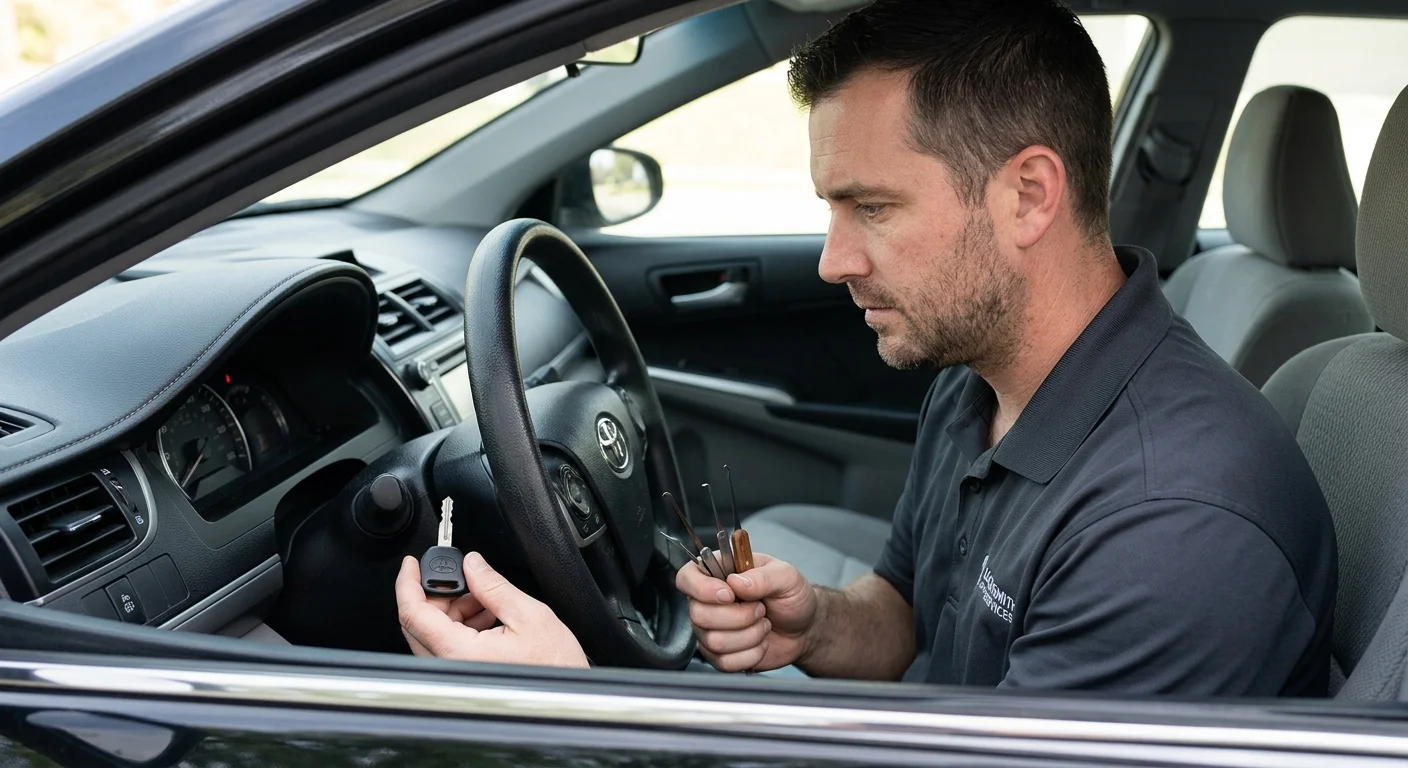
Stop turning the remaining key or ignition
Leave the broken key and ignition in their current positions. Don’t twist any piece that still protrudes. Don’t push the fragment inward or try another turn to see what happens. Repeated testing can change the situation before a professional examines it.
Secure the vehicle using its normal controls if you can do so without touching the broken key. Follow the vehicle owner’s manual. If the car is stopped in an unsafe place, address the traffic risk first. Contact the roadside or public safety service appropriate for that location.
Avoid household tools, adhesives, and lubricants. They can complicate the professional’s assessment. Advice from a video may also assume a different key or ignition design. The appearance of the opening alone doesn’t confirm which method fits your vehicle.
Your location within San Diego County matters when explaining the situation. A vehicle in a downtown parking structure may have access restrictions. A roadside stop in East County presents a different access problem. A driveway in Chula Vista or Oceanside may be easier to describe and reach. Give the exact setting without assuming every service can be completed there.
Tell the locksmith or dealer whether the engine is running, off, or unknown. Also mention whether the steering wheel, shifter, or other controls are in an unusual position. Report only what you can observe. Don’t force any control to create a more convenient position.
Locate the broken fragment without forcing it
Look at the ignition from outside the opening. Normal light or a phone light can help you see without inserting anything. Note whether metal is visible, flush with the opening, or out of sight. Don’t touch the fragment to improve the view.
Take a clear photo if you can do that safely. A straight view of the ignition and a photo of the piece in your hand may help the professional understand your description. Keep the detached portion in a small container or envelope. Don’t file, bend, tape, or glue it.
Check the seat, floor, and nearby console for loose pieces. This search shouldn’t involve disturbing the ignition. If you can’t find a fragment, don’t assume the full blade came out. Say that you aren’t sure where the missing portion is.
A key fragment stuck in the ignition calls for assessment before another key goes in. Don’t test a spare while part of the broken blade may remain. Broken car key extraction and replacement are separate parts of the job, and the professional should confirm whether both are needed.
Describe what you see in plain terms. “Part of the blade is visible” is more useful than guessing that the ignition is damaged. If nothing is visible, say that directly. The matched independent locksmith or dealer can then decide what information or inspection is needed next.
Separate key damage from an ignition problem
A broken key and a failed ignition aren’t the same diagnosis. The blade may have snapped during a turn, but that event alone doesn’t identify why it happened. It also doesn’t prove that replacing the key will resolve every symptom.
Describe the sequence before the break. Mention whether the key had been turning normally, felt difficult to move, or was already bent. Note whether it snapped while entering, leaving, or turning the ignition. Don’t recreate the motion to answer these questions.
An intact key that won’t come out is a different situation. Read our guide to a key that is stuck but still intact if that better matches what happened. Our comparison of ignition repair and replacement also explains how to discuss those two possible scopes without choosing one yourself.
Ask the professional to consider the key, trapped fragment, and ignition separately. The first question is whether a fragment remains and can be removed. The next is whether the ignition works normally after assessment. The final question is what replacement key is compatible with that vehicle.
Modern vehicles may use electronic key systems that require programming. That doesn’t mean every broken key needs the same service. The matched locksmith or dealer must confirm compatibility, programming needs, and the work that can be completed at your location. Don’t rely on the key’s outer appearance as the final answer.
Gather the vehicle and ownership details
Have the vehicle’s year, make, model, and exact location ready. If the professional requests the vehicle identification number, copy it carefully from the vehicle or its documents. Ask which ownership and identity documents they need before sending personal information.
Describe the key without diagnosing it. Say whether it has a separate remote, buttons built into the head, or no visible controls. Mention any spare key you have, but don’t insert it while the ignition may contain a fragment. Tell the professional whether every broken piece has been found.
Share the sequence in a few sentences. Explain where the vehicle was parked, what you were doing, and when the key snapped. Include any earlier difficulty you noticed. A photo of the broken pieces may support that description, but it doesn’t replace an inspection.
Use a precise San Diego County location. “San Diego” can mean the central city or the wider county in casual conversation. Give the municipality, neighborhood, nearest signed exit, or parking facility name. Mention gate access, parking structure clearance, or roadside conditions when relevant.
Don’t assume a locksmith can handle every vehicle at its current location. The independent professional or dealer must confirm access, vehicle compatibility, and scope. These details help that conversation, but they don’t create an arrival or completion promise.
Keep your account factual. If you don’t know whether the ignition is damaged, say it hasn’t been confirmed. That answer is more useful than choosing a repair based on the sound, angle, or appearance of the broken key.
Confirm extraction and replacement scope
Before authorizing work, ask the independent professional to explain the proposed scope. Broken car key extraction may be one part. A replacement key, electronic programming, or ignition work may be separate. Only an inspection can confirm which items apply.
Request the total price directly from the professional before agreeing. Ask what the quoted work includes and what findings could change it. Swift Key San Diego doesn’t set prices, perform locksmith work, or provide warranties. The customer contracts with and pays the independent locksmith directly.
Confirm these points in plain language:
- Whether a fragment remains inside the ignition
- Whether extraction is included in the proposed work
- Whether the ignition needs separate assessment
- Whether the replacement key needs electronic programming
- Whether the work can be completed at the vehicle’s location
- Whether the vehicle must go to a dealer or another facility
Not every vehicle can be handled on location. Compatibility, available procedures, and final scope must be confirmed by the matched locksmith or dealer. Our car key replacement service explains how we connect callers with licensed local professionals.
California locksmiths are regulated through the Bureau of Security and Investigative Services. You can check a company or individual through the state’s license search. Match the listing to the professional or company you’re considering before authorizing the work.
If the plan changes after inspection, ask for an updated explanation and price. Don’t approve ignition work merely because the key broke there. The professional should identify what was confirmed, what remains uncertain, and which work you are authorizing.
When to call us
Call when a fragment remains in the ignition, the condition is unclear, or a compatible replacement may be needed. Swift Key San Diego is a referral service and doesn’t perform the physical work. Call us at (858) 400-4082 and we’ll connect you with a licensed local locksmith.