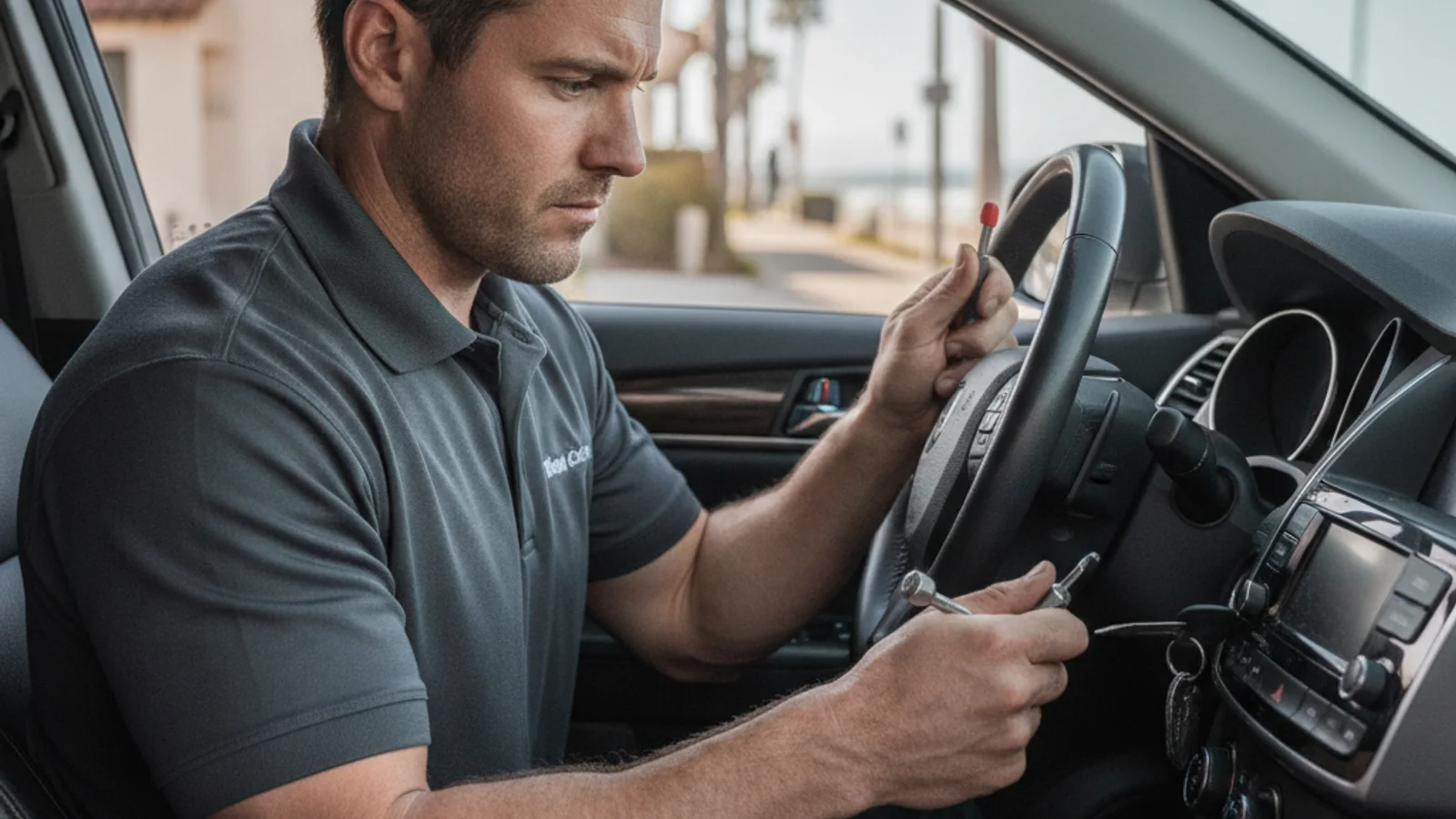
If your key goes in but won’t rotate, start with the steering-wheel lock. Apply gentle side-to-side pressure to the steering wheel while simultaneously turning the key. Do not treat that as a timed or free result. It is the first check, not a published success rate.
This problem is not the same as a key trapped in the ignition. A trapped key won’t come out; a key that won’t turn goes in fine but the cylinder refuses to rotate. If yours is stuck and won’t pull out, our separate guide on car key stuck in the ignition covers that scenario. Here we focus on keys that are fully seated but feel frozen when you try to crank them.
There are six things to try before calling anyone. Work through them as a checklist, not as a ranked epidemiology of which cause is most common.
Ignition locked and the key won’t turn: start with the steering wheel lock
Modern cars lock the steering column automatically when you remove the key. It’s a theft deterrent, and it’s so effective that it also catches drivers off guard. When the column locks, it applies tension to the ignition cylinder, and that tension is enough to prevent rotation.
You’ll know this is the issue if the steering wheel feels rigid, like it’s held in place. To release it, insert the key and apply light turning pressure while you rock the steering wheel from side to side. Don’t jerk it. Steady moderate pressure on the wheel, steady moderate pressure on the key, and you’ll feel a small give as the column releases. The key will then turn normally.
This is more common when you’ve parked on a slope in neighborhoods like Point Loma or Mission Hills, because the front wheels naturally settle against the lock after you cut the engine. It’s also common after parallel parking where the wheels are angled at the curb.
The gear selector isn’t fully in Park
Automatic transmissions have a safety interlock that prevents the key from turning unless the shifter is confirmed in Park. The catch is that you can push the lever into what feels like Park and have the shifter sit just slightly short of engaging the sensor.
Push the brake pedal and firmly move the gear selector into Park, making sure it clicks home. Then try the key again. If that doesn’t work, cycle through the other positions, Drive, Neutral, Reverse, then back to Park, pressing down firmly each time. On some vehicles this resets the sensor.
This step takes ten seconds and is worth doing before anything else mechanical.
A dead key fob battery on vehicles with a proximity check
Some newer vehicles, particularly push-to-start cars that also have a traditional key slot as a backup, require the key fob to broadcast a signal before the cylinder will allow rotation. If the fob battery is dead, the car sees the key blade but doesn’t get the expected transponder response.
Try holding the fob physically against the ignition cylinder or the start button while you turn. Many manufacturers build in this fallback specifically to handle a dead fob. If the car starts that way, replace the CR2032 or CR2025 battery in the fob and you’re done.
This scenario is more common on late-model vehicles. If you’re not sure whether your car has a proximity check on the backup cylinder, check the owner’s manual under “starting the vehicle with a dead key fob.”
A worn key blade (try the spare)
Key blades wear with use. The cuts get shallower, the tip rounds off, and after years of daily friction the blade no longer precisely aligns the wafers inside the cylinder. The key goes in fine because the gross profile still fits, but it can’t push the internal wafers to the right depth to allow rotation.
If you have a spare, try it now. A spare that was cut from the same code and kept in a drawer will have sharper edges than your daily driver key. If the spare turns the ignition easily, you have your answer: the original key is worn out and needs to be replaced. Ask the locksmith which path they can quote after they see the key and cylinder: a new cut from the original code, or decoding the cylinder.
Don’t try to compensate for a worn key by forcing it. The wafers inside the cylinder are small and brittle. A worn key that “almost” works and gets muscled through will eventually shear a wafer, turning a simple blade cut into a car key replacement plus cylinder work.
A worn ignition cylinder (jiggle history matters)
If the spare key also won’t turn, or if you notice the cylinder has felt progressively stiffer over several months, the cylinder wafers themselves may be worn. Wear over time can happen on many vehicles. Do not treat any named make as a logged mileage reputation.
A worn cylinder usually presents with a history of intermittent stiffness before it becomes a hard failure. You may recall needing to wiggle the key slightly for the past few weeks before it would catch. That’s the cylinder telling you the wafers are getting sloppy.
A locksmith can disassemble the cylinder, replace the worn wafers, and rekey it to your existing key when that is the work they quote after inspection. Ask them whether wafer work is enough or whether you need a new unit. For a deeper look at that decision, see ignition repair vs. replacement in San Diego.
A seized cylinder: use graphite, not WD-40
Debris inside the cylinder, salt air corrosion along the coast from La Jolla to Coronado, or grit from driving unpaved areas near Otay or Ramona can cause the cylinder to seize. The key turns partially and stops, or simply won’t budge at all.
The fix sounds simple: lubricate the cylinder. But the product you choose matters a lot.
Do not use WD-40. WD-40 is a water displacer and light solvent. It will loosen a seized cylinder temporarily, but it leaves behind an oily residue that attracts dust and dirt. Within a few weeks the cylinder will be stickier than before. The same applies to 3-in-1 oil and most household lubricants.
Use dry graphite lubricant or a dedicated lock lubricant (often sold as Teflon-based dry spray or graphite powder). These leave no residue. Insert the nozzle into the keyhole, apply a short burst, then work the key in and out several times to distribute the lubricant through the wafer stack. Give it a minute, then try to turn.
If a proper lubricant application doesn’t clear it, the seizure is mechanical, not just friction-related, and the cylinder needs professional attention.
Locksmith vs. mechanic: who handles what
This is worth being direct about, because the wrong call can add a tow and a diagnostic visit. Ask each shop who should handle the symptom before you authorize that visit.
| Symptom | Likely culprit | Who to call |
|---|---|---|
| Key turns partially then stops | Worn or seized lock cylinder | Auto locksmith |
| Key won’t turn at all, spare also fails | Worn cylinder wafers | Auto locksmith |
| Key turns cylinder but engine won’t start | Electrical ignition switch or transponder issue | Mechanic or dealership |
| Grinding sound when turning key | Broken cylinder or key fragment | Auto locksmith |
| Key turns, engine starts but dies immediately | Immobilizer or ECU issue | Mechanic or dealership |
| Steering wheel won’t release, key won’t turn | Steering column lock | Auto locksmith |
The ignition assembly has two parts: the lock cylinder (the mechanical barrel you insert the key into) and the electrical ignition switch behind it (the part that signals the starter and fuel system). A locksmith handles the cylinder. A mechanic handles the switch and everything downstream from it. When you describe your symptoms over the phone, any reputable shop will tell you honestly which side of that line the problem falls on.
What it costs to fix
Ignition cylinder work is quoted from the vehicle and how far the damage goes.
A rekey or wafer replacement on a cylinder that’s still intact and removable is at the lower end. A full cylinder replacement with a new key cut to code is toward the middle. Vehicles with a tilt or telescoping steering column, or with a column-integrated immobilizer ring, sit at the higher end because access takes longer.
If the root cause is a worn key and nothing else, a new blade cut from code is the lightest path. A transponder key or proximity fob is heavier. See the car key replacement page for specifics by vehicle type.
A dealership typically wants the car in a bay. A mobile locksmith may come to you if they accept the job, whether you’re in a parking structure in Mission Valley, a driveway in Santee, or on the side of the 5 near Oceanside. Compare both quotes on the same key type. The matched professional confirms tools, access, and whether a tow is needed.
Frequently asked questions
Why won’t my key turn in the ignition?
The most common first check is a locked steering column. Rock the steering wheel side to side while applying light pressure to the key. Other checks include the gear selector not fully in Park, a worn key blade, worn cylinder wafers, a seized cylinder, or a dead key fob battery on proximity-check vehicles.
How do I unlock my steering wheel?
Insert the key into the ignition and apply gentle turning pressure in the start direction. At the same time, apply steady left-right pressure to the steering wheel. You don’t need force, just consistent pressure in both directions simultaneously. You’ll feel a small release as the column lock disengages. The key will then rotate normally.
How much does it cost to fix an ignition that won’t turn?
If the cause is the steering wheel lock or gear position, the locksmith should quote only the visit, since no parts are needed. If the cylinder needs rekeying or wafer replacement, that is a parts-and-labor line. A full cylinder replacement with a new key is heavier. A new key cut from code, when that’s the only issue, is the lightest path.
My spare key turns the ignition but my regular key won’t. What does that mean?
Your original key is worn. The spare has sharper cuts and engages the wafers correctly; your daily key has worn down to the point where it can’t. Replace the worn key before it gets worse. A locksmith can cut a new one from your vehicle’s key code so it matches exactly.
Can I drive the car if the key only turns with a lot of jiggling?
Not for long. A key that requires jiggling to turn is showing early cylinder wear or a key that’s close to failing. It will get worse, and the failure mode, whether the key breaks in the cylinder or the cylinder stops responding entirely, will leave you stranded. Get it diagnosed before it becomes an emergency.
Is this a locksmith job or a mechanic job?
If the problem is the key, the cylinder, or the steering column lock, it’s a locksmith. If the key turns the cylinder but the engine won’t start or dies immediately, the problem is in the electrical ignition switch, the immobilizer, or the fuel system, and that’s a mechanic. When in doubt, describe the exact symptoms and both shops will tell you honestly who should handle it.
If the key turns fine but the door itself is the problem, that is a different failure: see car door lock stuck troubleshooting.
Call us for help
If you’ve worked through the checks above and the ignition still won’t turn, the cylinder or key needs professional attention. Swift Key San Diego is a referral service. It does not perform the work, set the price, or provide a warranty. You contract with and pay the independent locksmith. That professional confirms tools, access, and whether a tow is needed.
Call (858) 400-4082 to connect with a licensed local locksmith. That locksmith quotes.