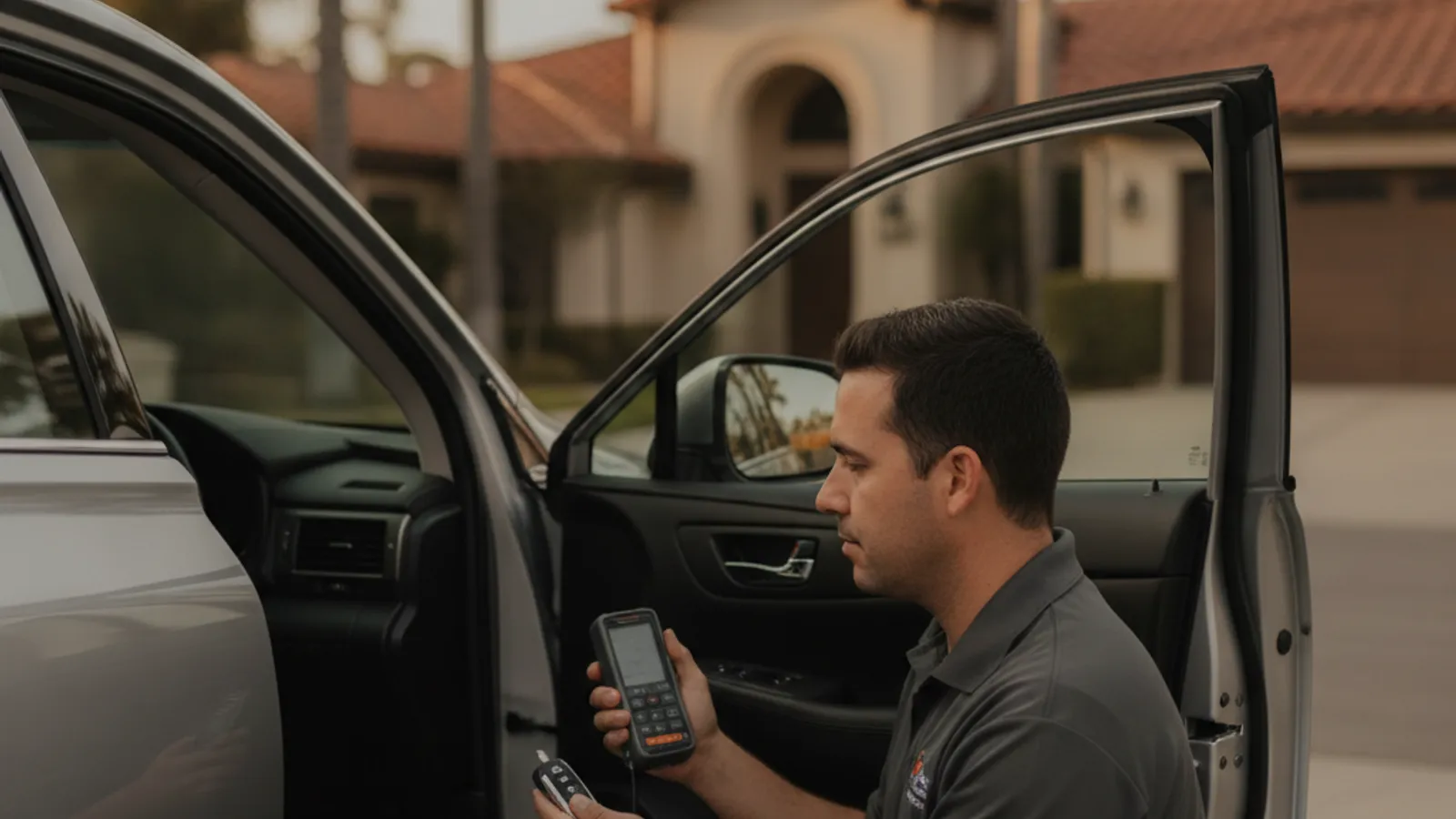
Lexus key replacement in San Diego costs $180 to $450 at a mobile locksmith, and $320 to $700 or more at the dealer, depending on whether your Lexus uses an older transponder key or a Smart Access proximity fob. Here’s the part most locksmith sites won’t tell you: because Lexus is Toyota’s luxury division and shares much of its parts-bin electronics, most mobile locksmiths who carry Toyota programming support can also handle Lexus, on-site, without a tow. That puts Lexus in a different category than BMW or Mercedes, where newer models often require dealer-only programming. This guide breaks down what you’ll actually pay and why.
Lexus key cost by type and era
Lexus has used two main key technologies since the brand launched in the U.S. in 1989. Which one your car has depends on the model year, not the trim level, which makes this simpler than some brands.
| Key type | Vehicles | Locksmith | Dealer estimate |
|---|---|---|---|
| Transponder key (metal blade, chip in head) | Most 1990-2006 ES, GS, LS, RX, IS | $180 - $280 | $320 - $450 |
| Smart Access proximity fob (push-button start) | Most 2006+ ES, GS, RX, IS, LS, NX, GX, LX | $280 - $450 | $450 - $700+ |
These are ranges, not quotes. Your exact price depends on the model year, whether you have a working spare, and current key blank availability. Call with your year, model, and VIN for a firm number.
A working spare lowers the cost. If one key still functions, a duplicate runs 20 to 30 percent less than an all-keys-lost replacement, because the locksmith can program from the existing key instead of starting from zero. If your current fob works but the buttons feel unresponsive, check key fob not working: troubleshooting guide before booking a full replacement.
Why Lexus is more locksmith-friendly than most luxury brands
This is the detail that actually changes your options. Lexus launched as Toyota’s luxury brand in 1989, and the two still share deep platform and electronics overlap. The Lexus ES rides on the same platform as the Toyota Avalon. The RX shares architecture with the Highlander. The NX shares components with the RAV4.
That overlap extends to key systems. Lexus transponder and Smart Access immobilizer architecture tracks closely with Toyota’s, including the shift to Toyota’s AES-encrypted “H” chip on most models built from roughly 2010 onward. Professional-grade automotive locksmith equipment that supports Toyota programming generally supports Lexus too, with the correct blanks and software license.
What that means practically. Unlike a 2018+ Mercedes or BMW, where dealer-only programming is common, a qualified mobile locksmith can usually cut and program a Lexus key entirely on-site, including full all-keys-lost jobs, without a tow. There are exceptions on the newest platforms as manufacturers roll out updated security, so it’s worth a quick call to confirm before you assume either way. See how this compares to a related brand in our Toyota key replacement guide, since the two share so much under the skin.
Smart Access: what it is and why it costs more
Lexus introduced its Smart Access proximity system around 2006, starting with the LS460, and expanded it across the lineup through the following decade. By the mid-2010s, nearly every new Lexus sold used it as standard equipment.
The fob stays in your pocket or bag. Sensors in the door handles detect it when you reach for the handle, unlocking the car automatically. Inside, you press the brake and push the start button rather than turning a key. The fob itself never touches the ignition.
Programming a Smart Access fob costs more than an older transponder key for two reasons: the hardware inside the fob is more complex, and pairing it to the vehicle’s smart key receiver takes a few extra steps beyond standard transponder programming. It’s still a routine job for a locksmith who carries Lexus support, just a longer one than cutting a basic blade key. If your original fob still works but needs a backup paired to it, that’s a standalone job through our key fob programming service, not a full replacement.
All keys lost: what the process looks like
Losing every Lexus key is more involved than a duplicate, but on most model years it’s still a same-visit job.
The locksmith connects a professional programming tool to the OBD port under the dashboard, reads the vehicle’s immobilizer configuration, and cuts a new key blank to match your car’s code using a portable cutting machine. For a transponder key, that’s most of the job. For a Smart Access fob, the tech also pairs the new fob to the smart key receiver, which typically adds a short learning cycle where the system confirms the new key before accepting it.
Expect 45 to 90 minutes on-site for most transponder jobs, and 60 to 120 minutes when a proximity fob is involved. The car stays parked exactly where it is. You watch the work happen and confirm it starts before the tech leaves.
If you’re not sure yet whether your situation is a true all-keys-lost scenario or something simpler, lost car keys in San Diego: what to do if you have no spare walks through how to tell the difference.
What to have ready before you call
Whether you call a locksmith or the Lexus dealer, having this ready speeds things up:
Your VIN. The 17-character number on the sticker inside the driver’s door jamb, or visible through the lower corner of the windshield. Key blanks are cut to the VIN, so nobody can proceed without it.
Current registration. Must match the name you’re calling with.
Government-issued ID. Driver’s license matching the registration address.
Your key type, if you know it. A metal blade key with a plastic head is the older transponder style. A flat fob with no blade, or a small blade that folds out, is Smart Access. That distinction, plus your model year, tells the locksmith which programming procedure applies before they arrive.
No locksmith or dealer will cut a key without verifying ownership first. It’s the same theft deterrent built into the immobilizer itself.
Lexus ownership skews toward San Diego’s coastal and inland-luxury neighborhoods, so a lot of these calls come from La Jolla, Del Mar, and Rancho Santa Fe. Wherever you are in the county, the process and pricing above hold the same.
Locksmith vs. dealer: when each one wins for a Lexus
| Situation | Better option | Why |
|---|---|---|
| Locked out, key inside the car | Locksmith | Fast, mobile, no dealer involvement needed |
| Broken key in door or ignition | Locksmith | Extraction is a locksmith job |
| Lost all keys, most model years | Locksmith | Toyota-shared architecture makes on-site programming routine |
| Newest current-year models | Dealer (check first) | Tool support may lag on brand-new platforms |
| Warranty covers the key | Dealer | Always use warranty when it applies |
Locked out with the key visible on the seat? That’s not a key replacement job at all. Call for a car lockout and you’ll be back in within the hour, no cutting or programming required.
For how Lexus stacks up against other makes on price, see the car key replacement cost guide by vehicle type. And if you’re not sure whether your issue is the key itself or just the remote fob, our transponder key vs. smart key explainer breaks down the difference in plain terms.
Frequently asked questions
How much does it cost to replace a Lexus key in San Diego?
A mobile locksmith charges $180 to $280 for older transponder keys and $280 to $450 for Smart Access proximity fobs, depending on your model year. The Lexus dealer typically charges $320 to $700 or more for the same key, and an all-keys-lost job at the dealer usually requires a tow since the car has to be present at their facility. Our car key replacement service covers both key types on-site.
Can a locksmith really program a Lexus key without going to the dealer?
Yes, on most model years. Lexus shares deep platform and electronics overlap with Toyota, including closely related immobilizer and transponder architecture. Professional automotive locksmith equipment that supports Toyota programming generally supports Lexus as well. That makes Lexus meaningfully easier to service than European luxury brands, where dealer-only programming is common on recent models. Call with your year and model and we’ll confirm before you book.
What is Lexus Smart Access?
Smart Access is Lexus’s proximity entry and push-button start system, introduced around 2006 and standard across nearly the entire lineup by the mid-2010s. The fob stays in your pocket; sensors in the door handles detect it and unlock the car when you reach for the handle. Inside, you press the brake and the start button instead of turning a key. Replacing a Smart Access fob costs more than an older transponder key because of the added hardware and pairing steps.
Do I need to tow my Lexus to the dealer if I’ve lost all my keys?
Usually not, if you call a mobile locksmith instead. Because Lexus programming tracks so closely with Toyota’s, most all-keys-lost jobs are handled entirely on-site with a professional OBD programming tool, no tow required. Towing only becomes necessary if you specifically choose the dealer route, where the car has to be physically present at their facility before they’ll program a key.
How long does a Lexus key replacement take?
Most transponder key jobs take 45 to 90 minutes on-site. Smart Access proximity fob jobs run slightly longer, typically 60 to 120 minutes, because the fob has to be paired to the smart key receiver in addition to standard programming. Either way, the car stays parked where it is and you confirm the key works before the technician leaves.
Is a Lexus key replacement cheaper than a BMW or Mercedes?
Generally, yes. Lexus’s Toyota-shared architecture means locksmiths can service more model years on-site without dealer involvement, which keeps both the price and the timeline down compared to German luxury brands, where newer models frequently push you toward dealer-only programming. See our BMW key replacement and Mercedes key replacement guides for a direct price comparison.
Lost your Lexus key or locked out anywhere in San Diego County? Call us at (858) 400-4082 and give us the year and model. We’ll tell you straight whether it’s an on-site job and what it’ll actually cost before you commit to anything.