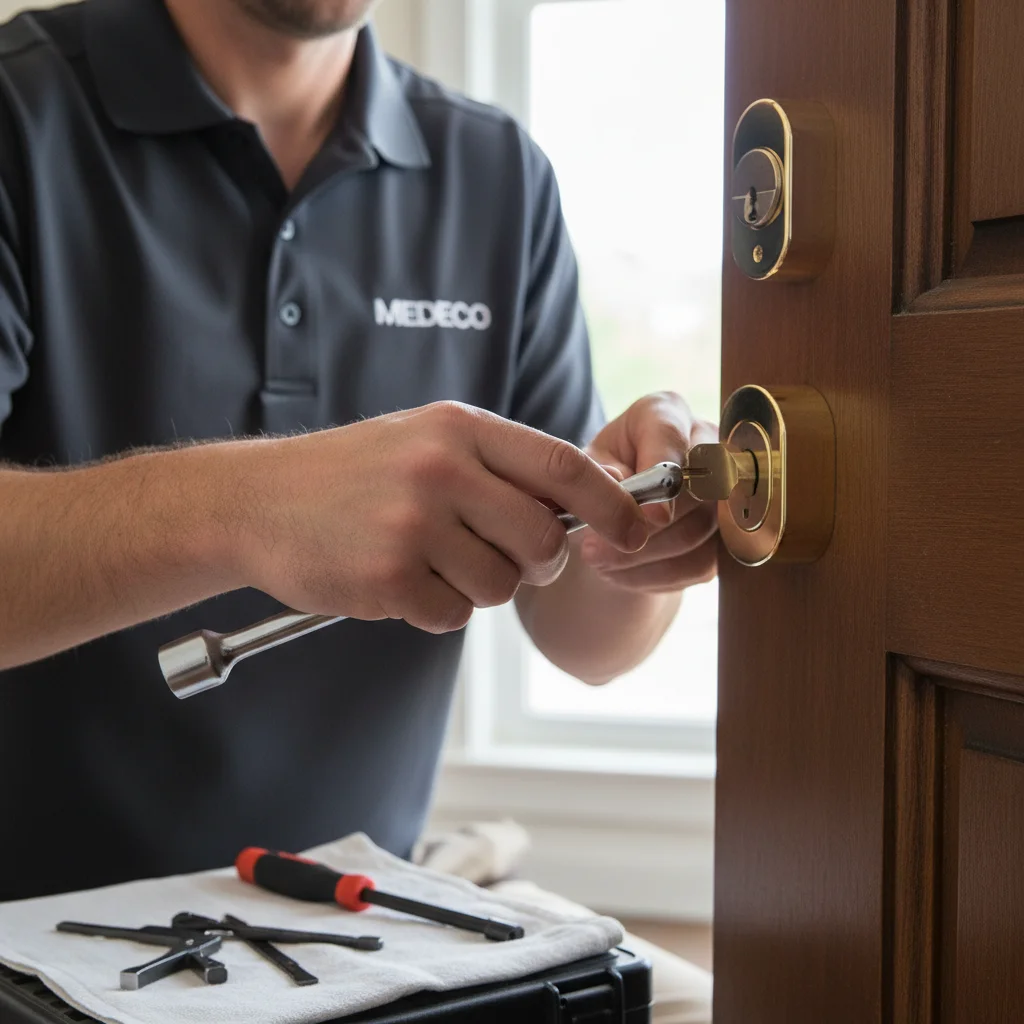
Deciding on the right lock for your front door feels like a major security decision, because it is. You’ve probably seen a dozen deadbolts at the hardware store, but then you hear about “high-security locks” and wonder if your standard lock is leaving your home vulnerable. For most San Diego homeowners, this question boils down to a simple cost-benefit analysis: is the extra protection worth the significant extra price?

The answer isn’t a simple yes or no. It depends on your specific situation, your property, and your peace of mind. We’ll break down what high-security locks actually are, how they work, and help you decide if they’re the right investment for your home.

What ‘high-security’ actually means

The term “high-security” gets thrown around a lot in marketing, but in the locksmith world, it has a specific meaning. It doesn’t just mean a lock is heavy or looks tough. A true high-security lock is a piece of precision engineering designed to resist covert and forced entry in ways that standard locks are not.

These locks are defined by several key features:

  • Patented Key Control: The keys are protected by patents, meaning they can’t be legally duplicated by anyone other than the original manufacturer or an authorized dealer. You are given a specific card with a code, and without that card, no copies can be made.
  • Complex Pin Systems: Instead of a single row of pins like a standard lock, high-security cylinders use multiple locking mechanisms. Brands like Medeco use angled cuts on the key that rotate pins, while Mul-T-Lock uses a unique “pin-in-pin” telescopic design. Abloy cylinders use a system of rotating discs instead of pins altogether.
  • Resistance to Manipulation: They are built with features specifically designed to defeat common bypass techniques. This includes special security pins to resist lock picking and design elements that make lock bumping ineffective.
  • Durability and Drill Resistance: The cylinders are made from hardened, heavy-duty materials. They often feature hardened steel inserts and ball bearings strategically placed to destroy drill bits that try to attack the lock cylinder.

When we talk about high-security brands, we’re referring to names like Medeco, Mul-T-Lock, Abloy, and ASSA. These aren’t typically found on the shelf at your local big-box store. They represent a different class of hardware, built to a standard of resilience, not just a price point.

How they resist picking, bumping, and drilling

A lock’s primary job is to keep unauthorized people out. High-security locks achieve this by making the three most common methods of forced entry incredibly difficult, if not impossible for the vast majority of criminals.

Resisting Lock Picking

Lock picking involves manipulating the internal pins of a lock into the correct position to open it without a key. Standard locks have simple pins that are relatively easy for a skilled person to “read” and set. High-security locks use a variety of specialized pins, like spool pins, serrated pins, and mushroom pins, that give false feedback. When a picking tool pushes on them, they bind up the cylinder in a way that feels like it’s set, but it isn’t. Brands like a Medeco lock add another layer of complexity: their pins must not only be lifted to the correct height but also rotated to the correct angle. This turns a simple one-dimensional puzzle into a complex three-dimensional one, requiring specialized tools and immense skill. For a burglar looking for a quick entry, it’s a non-starter.

Preventing Lock Bumping

Lock bumping is a fast, low-skill attack where a specially cut “bump key” is inserted into the lock and tapped, causing the pins to jump. For a split second, the pins align, allowing the cylinder to turn. It’s quiet and can open a standard deadbolt in seconds. High-security locks are designed to be virtually bump-proof. Their complex pin-in-pin or rotating disc systems don’t rely on a single shear line that can be exploited by the kinetic force of a bump key. Sidebars and other secondary locking mechanisms won’t engage unless the key is legitimate, making this popular attack method useless. This is a primary reason people seek out a pick proof deadbolt.

Defeating Drilling

A brute-force attack involves drilling through the lock cylinder to destroy the internal pins and turn the mechanism. High-security locks anticipate this. Their cylinders are constructed with hardened steel far tougher than standard brass. They also strategically embed hardened steel ball bearings and anti-drill plates at key points. When a drill bit hits one of these components, it can’t get a purchase and will often dull, break, or skid off target, protecting the core mechanism.

Cost vs. standard Grade-1 deadbolts

This is where the decision gets real for most homeowners. There’s a significant price difference between a good quality standard lock and a true high-security lock.

First, let’s set a baseline. A standard residential deadbolt might cost anywhere from $30 to $80. A step up from that is a commercial-grade, ANSI/BHMA Grade 1 deadbolt. These are heavy-duty, well-made locks that offer excellent resistance to force. You can learn more about what makes them a solid choice in our guide to choosing a Grade-1 deadbolt. A good Grade 1 deadbolt typically costs between $100 and $200 for the hardware alone.

High-security locks from brands like Medeco or Mul-T-Lock residential models start at around $250 and can easily go up to $400 or more per lock for the hardware. When you factor in professional installation, which is crucial for these systems to perform correctly, the total cost for a single door can be three to five times that of a standard Grade 1 deadbolt installation.

So, is the extra cost justified? The key is to understand you’re not just buying a stronger lock; you’re buying a system that addresses a wider range of threats, especially covert entry (picking, bumping) and unauthorized key duplication. A Grade 1 deadbolt is fantastic at resisting someone trying to kick your door in, but it doesn’t offer the same level of protection against more sophisticated attacks.

Key control: why duplication restrictions matter

One of the most valuable and often overlooked benefits of high-security locks is strict key control. Think about how many people might have a key to your home: family members, a dog walker, a house cleaner, or a contractor you hired for a project. With a standard key, any of them could walk into a hardware store or kiosk and make a copy in minutes, without your knowledge or permission.

High-security lock systems solve this problem completely. Their key blanks are patented, making it illegal for other companies to manufacture them. The only way to get a new key is to go to an authorized locksmith who sold you the system.

Here’s how it works:

  1. When you have a high-security lock installed, you’re issued a unique authorization card that looks like a credit card.
  2. This card contains the specific code needed to cut a new key for your locks.
  3. To get a copy, you must present this card and often show ID to verify you’re the owner. The locksmith keeps a record of every key duplicated.

This creates a clear audit trail. You know exactly how many keys to your home exist and who has them. If a key is lost, you know it can’t be copied and used later. For homeowners with frequent guests, rental properties (like an ADU in North Park), or anyone who relies on service professionals, this provides an unparalleled level of security and peace of mind. It ensures that when you part ways with a contractor or tenant, you don’t have to wonder if there are rogue keys floating around. This single feature can make the entire investment worthwhile.

When the upgrade pays off, and when it doesn’t

Let’s be honest: not every home in San Diego County needs a Medeco or Mul-T-Lock on the front door. It’s about matching the security level to your specific risk profile. High-security locks offer tremendous value, but there are diminishing returns if the rest of your home isn’t secured to a similar level.

The upgrade absolutely pays off if you:

  • Store high-value items: This includes art, jewelry, firearms, expensive electronics, or collectibles. If your home contains assets that are particularly attractive to thieves, a high-security lock is a wise investment.
  • Have a home-based business: If you keep sensitive client data, expensive equipment, or valuable inventory at your house, protecting it from both brute force and covert entry is critical.
  • Are a public figure or have specific privacy concerns: Individuals who may be targeted for personal reasons benefit from the advanced protection and key control.
  • Have had a sophisticated break-in before: If you’ve been a victim of lock picking or bumping, upgrading to a lock that defeats these techniques is a logical next step.
  • Use many service providers: If you have a regular stream of people (cleaners, nannies, contractors) who need keys, the absolute key control is a game-changer.

It might be overkill if:

  • You have vulnerable windows or patio doors: A $400 lock is defeated by a $5 rock through a pane of glass. Your security is only as strong as your weakest point. Before investing in high-security locks, ensure your windows have working locks, consider security film, and make sure your sliding glass doors are properly secured.
  • Your door or door frame is weak: A high-end deadbolt installed in a flimsy, hollow-core door or a rotted frame provides a false sense of security. The frame will fail long before the lock does.
  • Your primary concern is simply preventing a kick-in: A professionally installed Grade 1 deadbolt with 3-inch screws is exceptionally effective at preventing forced entry. For many typical homes in neighborhoods from Chula Vista to Oceanside, this level of security is more than adequate.

Installation considerations in older San Diego homes

San Diego has a wonderful variety of homes, from historic Craftsman bungalows in Mission Hills to mid-century moderns in Clairemont. Installing a high-security lock in these older properties requires more than just swapping out the hardware. The lock is only one part of the door’s security system.

Older wooden doors and frames may have settled over the years, leading to alignment issues. They may also have been weakened by previous hardware installations, weather, or termites. A precision-engineered high-security lock needs a solid and stable foundation to work properly.

Here’s what a professional locksmith will look at during a deadbolt installation:

  • Door Integrity: Is the door solid core wood or metal? A hollow-core door offers very little security and should be replaced. We’ll check the door’s thickness and condition to ensure it can support the new hardware without splitting.
  • Frame Reinforcement: This is the most common failure point. We’ll assess the door jamb and strike plate area. For maximum security, we use heavy-duty strike plates secured with long, 3-inch screws that bite deep into the wall stud behind the jamb, not just the thin door frame.
  • Proper Alignment: High-security locks have tight tolerances. The deadbolt must extend smoothly and fully into the strike plate without any friction. A misaligned installation can cause the lock to jam or fail to secure properly.

Attempting a DIY installation on a high-security lock, especially in an older home, can easily compromise its effectiveness. This is a job where professional lock replacement is essential. A licensed locksmith, verifiable through the BSIS website, has the tools and expertise to properly prep the door and frame, ensuring your investment provides the protection it was designed for.

Frequently asked questions

How much does a high-security lock cost installed in San Diego?

Brands like Medeco and Mul-T-Lock start at $250 to $420 for the hardware alone, and professional installation adds another $130 to $180, putting the total for a single door at roughly $380 to $600. That’s three to five times the cost of a Grade-1 Schlage B60, so the decision comes down to whether key control and covert-entry resistance justify the premium for your property.

Can a high-security lock be picked or bumped?

A true high-security cylinder from Medeco, Mul-T-Lock, or Abloy is engineered to defeat standard picking and bumping attacks. Medeco’s biaxial pins require both the correct height and the correct rotation angle, turning a simple picking attack into a three-dimensional puzzle that takes highly specialized tools and skill most burglars simply don’t have.

What brands count as genuinely high-security?

Medeco, Mul-T-Lock, Abloy, and ASSA are the recognized tier. These aren’t available at hardware stores and are built to resist drilling, picking, and bumping at a level standard Grade-1 deadbolts don’t match. If you’re unsure whether a lock qualifies, ask to see independent ANSI or UL listings, not just marketing language.

Do high-security locks make sense for San Diego ADUs or rental properties?

Yes, especially if you rely on service providers or rotate tenants. The key control system means no one can duplicate a key without your authorization card, so when a tenant or contractor leaves you don’t have to rekey the entire lock. Over time that savings can offset part of the higher upfront cost.

Does a high-security lock help if my door or frame is weak?

No. A precision cylinder installed in a hollow-core door or a thin frame with short strike-plate screws can still be defeated by a simple kick. The lock performs best when paired with a solid-core door, a reinforced strike plate, and 3-inch screws anchored into the structural framing.

When to call us

Deciding on the right level of security for your home can be overwhelming. If you’re considering an upgrade to a high-security lock system or simply want to ensure your current deadbolts are installed for maximum effectiveness, our experienced technicians can help. We provide honest advice tailored to your specific property and security needs, never upselling you on hardware you don’t need.

Call us at (858) 925-5546 for a same-day estimate.