Fingerprint door locks open with a fingertip scanner on the lock or deadbolt, instead of lining up a key. You enroll prints during setup, then use the sensor the way that model’s manual describes. Check whether that unit also has a keypad and a physical key. The deadbolt and strike still do the force work. Compare fingerprint, keypad, and keyed bolts by how the household actually uses the door, then have a locksmith quote hardware and labor.
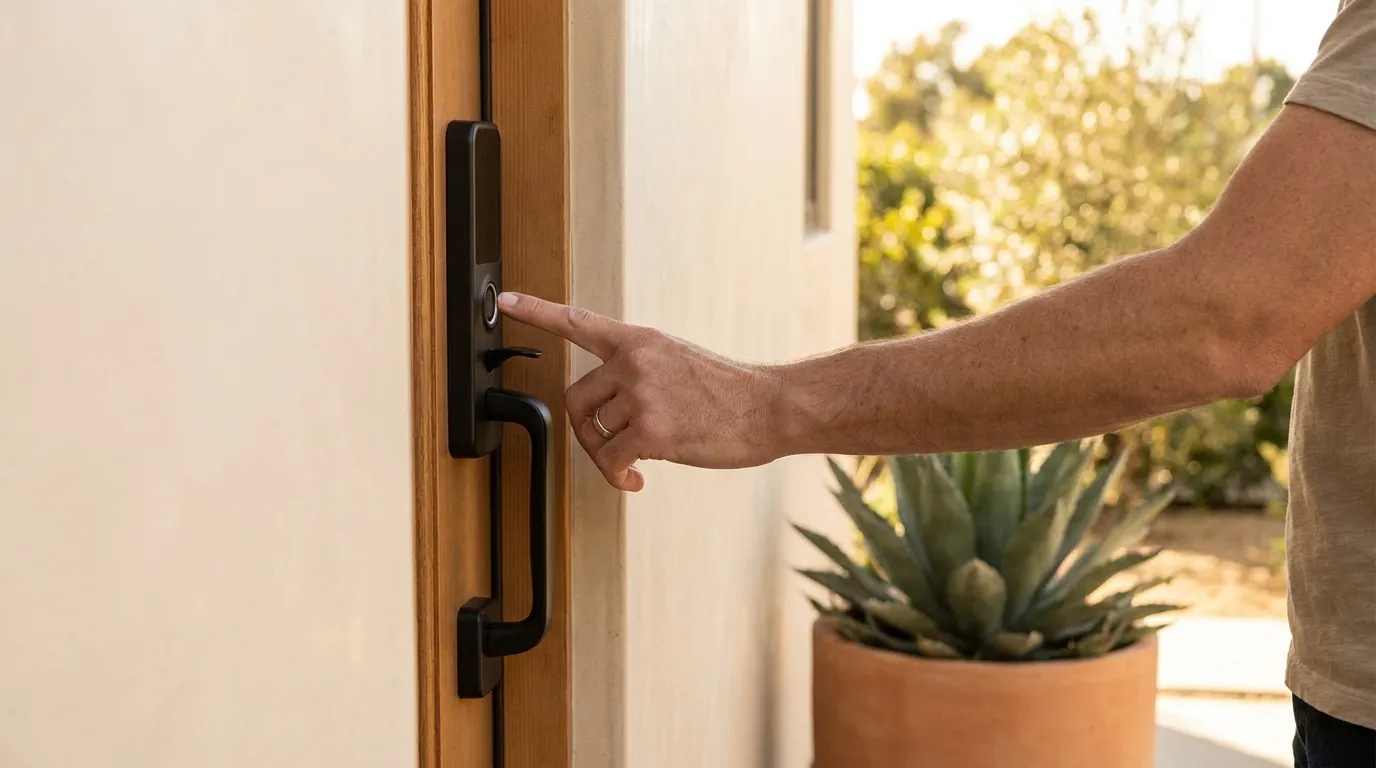
What is a fingerprint door lock and how does it work?
A fingerprint door lock is a lock that reads a fingerprint to decide whether to retract the bolt. The scanner sits on the outside face, usually on a smart deadbolt or a lever set.
Setup means enrolling each print by pressing it on the sensor the way the instructions say. After that, a match retracts the bolt and a miss leaves the door shut. Ask the locksmith or the manufacturer where that model stores fingerprint data, and whether you can delete a print when a roommate leaves. Also ask whether the same unit has a keypad code and a mechanical keyway. Those backups are model-specific. If you want one fitted and enrolled on your door, smart lock installation is how we connect you with locksmiths across San Diego County.
Are fingerprint door locks safe and secure?
Treat the scanner as access control and the bolt as the part that has to survive force. A fingerprint head does not make a weak strike or a thin bolt into a strong door.
Ask the locksmith what grade the bolt is, and whether the strike and screws match that door. Do not treat this page as a pick-resistance test or a movie-trick rating. For product comparison, see whether high-security locks are worth it and smart lock vs deadbolt: which is safer. Those pages still send the quote to the locksmith.
How much does a fingerprint door lock cost in San Diego?
There is no brand price matrix here. Hardware with a fingerprint scanner plus a keypad sits at the lighter end of the shelf relative to Wi-Fi, app control, auto-lock, and voice support, which push the lock itself up. Installation is simpler on a door that already has a standard deadbolt bore. A new hole or off-center prep is a bigger job. The locksmith quotes hardware and labor separately. See smart lock installation cost in San Diego for the quote lines to ask for. For several doors or an older entry that never had a deadbolt, lock replacement is the right service to request.
Do fingerprint locks work in San Diego’s coastal climate?
Salt air and afternoon sun are inspection questions, not a pass-or-fail map of the county.
Homes in Encinitas, Coronado, Point Loma, and other beach neighborhoods see salt-laden air and strong sun on west-facing doors. Ask whether that lock is rated for outdoor or weather-exposed use, what finish it uses, and whether an overhang or storm door would help the sensor. A sensor in full sun can misread until it cools, so shade is worth asking about. Inland cities such as Escondido and El Cajon are still in the service area. Climate alone does not prove a lock will last. For coastal hardware questions, see smart locks and coastal corrosion in San Diego.
Fingerprint lock vs keypad vs traditional deadbolt: which should you choose?
Choose by how the door is used.
A fingerprint reader is useful when the same people come and go and you would rather not share a code. A keypad is useful when you need access you can change later, such as a cleaner or a contractor, which is why rentals often prefer codes. A traditional keyed deadbolt has no batteries and no firmware, so it stays the simplest hardware if you do not want electronics on the door. Many households want fingerprint for the family and a keypad for guests. Ask the locksmith whether one unit actually does both, and what bolt sits behind it. If a rental is what you’re outfitting, smart locks for Airbnb and vacation rentals covers the code-management side. Model roundups live in best smart locks for 2026.
Who should get a fingerprint lock, and who should skip it?
Fingerprint locks fit households that want keyless entry without managing codes. They are a poor fit for high-turnover rentals or anyone who wants zero electronics on the door.
They make less sense on a short-term rental where you’d rather text a rotating code than enroll each guest’s finger, or on a rarely used side gate where a simple padlock does the job. Children’s fingerprints can change as they grow. Ask whether that model lets you delete and re-enroll a print. There is no published interval on this page. If you’re weighing the whole setup, deadbolt installation is how we connect you with a locksmith who can inspect the bore, the strike, and the head you picked.
Frequently asked questions
Do fingerprint door locks still work if the power or battery dies?
Check that model’s manual. Ask whether it runs on batteries, how it warns you, and whether a keypad, a physical key, or another backup is part of that unit. Do not assume a jump method from this page.
Can someone copy my fingerprint to break in?
This page does not rate spoofing methods. Ask the manufacturer how that sensor treats photos and lifted prints. Forced entry and a weak bolt remain the physical questions to plan for with the locksmith.
How many fingerprints can a fingerprint lock hold?
Capacity is model-specific. Read the listed print count for the lock you are buying, and confirm you can delete a print when someone leaves. Do not use a household range from this page.
Are fingerprint locks good for a San Diego rental property?
They can be, but a keypad code is usually easier to manage for guests and tenants because you can change it without enrolling anyone’s finger in person. Many landlords run a fingerprint-plus-keypad lock so the owner uses a print and guests get a code that rotates between stays.
Should I put a fingerprint lock on every exterior door?
Not usually. Put the scanner on the door you actually use. Back and side doors are often better served by a keyed or keypad deadbolt, since fewer people need daily access there.
Who installs fingerprint door locks in San Diego?
Swift Key San Diego is a referral service. We connect you with local locksmiths who install and program fingerprint and smart locks across San Diego County. The locksmith inspects the bolt, the strike, and enrollment. That is their job, not a result we promise.
When to call us
If you want a fingerprint, keypad, or keyed bolt quoted for a San Diego door, call (858) 400-4082. Swift Key San Diego is a referral service. We match you with a licensed independent locksmith. That locksmith quotes hardware and labor. Swift Key does not quote.