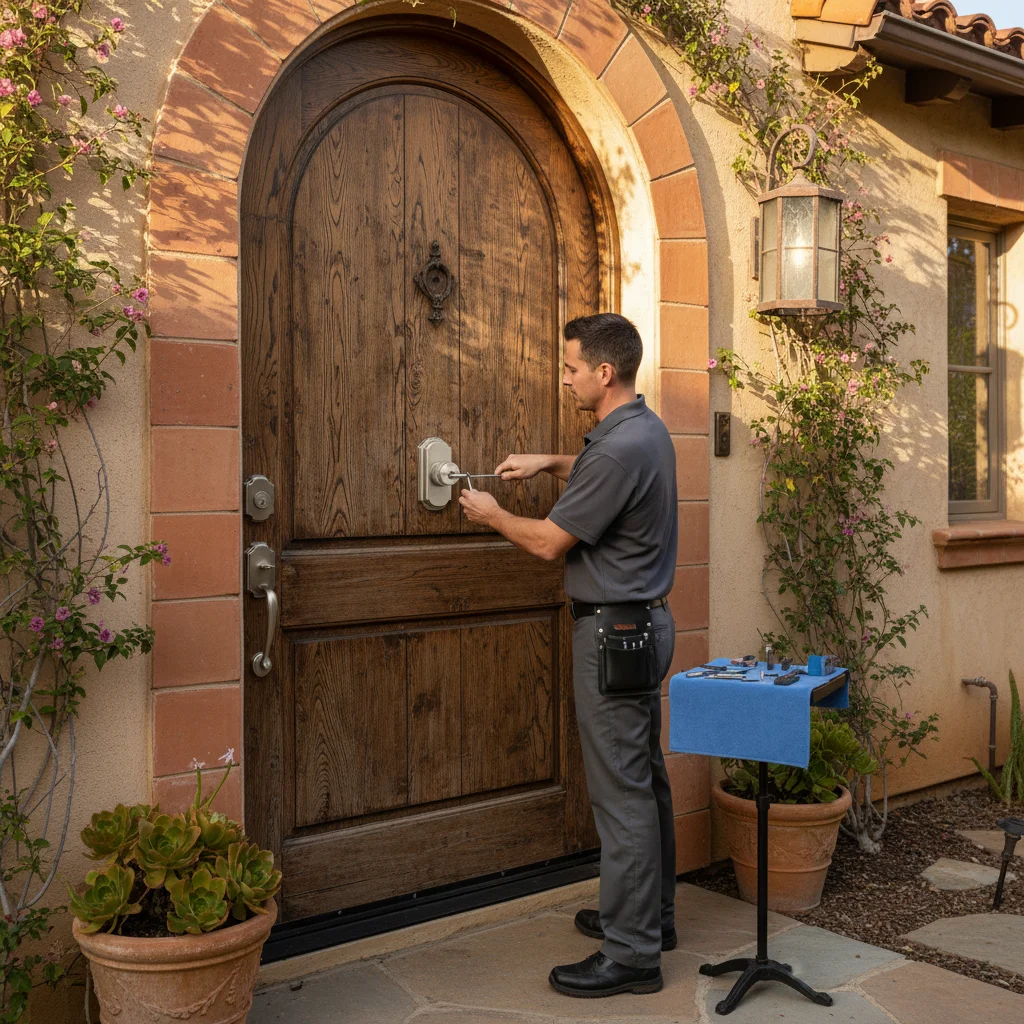
Your front door is more than just an entryway. It’s the primary barrier protecting your family, your privacy, and your property. While many San Diego homeowners invest in alarm systems, they often overlook the simple, mechanical weaknesses of the door itself.
Improving your front door security doesn’t have to be complicated or excessively expensive. It’s about creating layers of defense that work together to deter and prevent a forced entry. The five steps below cover hardware upgrades and simple habits that cost you nothing.
Start with the lock: upgrading to a Grade-1 deadbolt
The single most important piece of hardware on your door is the deadbolt. It’s the component that does the real work of keeping the door locked. The knob or handle latch is designed for convenience, not security. If your door only has a locking handle, your front door security is critically low.
Locks are graded by the American National Standards Institute (ANSI) and Builders Hardware Manufacturers Association (BHMA) on a scale of 1 to 3. Grade 3 is basic residential security, Grade 2 is better, and Grade 1 is the highest of those three labels. For an exterior door, start with a Grade 1 deadbolt on the main entry.
A Grade 1 deadbolt features:
- A one-inch throw bolt: The bolt extends a full inch into the door frame, making it much harder to pry or force open.
- Hardened steel construction: The bolt contains hardened steel inserts that resist sawing or cutting.
- Tamper resistance: High-quality cylinders are designed to resist common attack methods like drilling and lock picking.
Choosing the right lock is just the first step. Proper installation matters. An improperly installed deadbolt can be loose, misaligned, and fail under pressure. A deadbolt installation referral is how you reach an independent locksmith for that work. Ask them to confirm the lock is seated correctly and that the bolt fully engages with the frame. If you’re unsure about the quality of your current hardware, we have a detailed guide on how to choose a Grade 1 deadbolt that can help you evaluate your options.
Reinforce the door frame and hinges
A top-tier deadbolt is only as strong as the door and frame it’s attached to. A common point of failure during a kick-in isn’t the lock itself, but the wood of the door frame splintering and giving way. Similarly, the hinge side of the door can be a significant weak point if not properly secured.
First, consider the door itself. A hollow-core door, which is common for interior rooms, offers almost no resistance and should never be used as an exterior entry point. Your front door should be made of solid-core wood, fiberglass, or steel for adequate front door security.
Next, look at your hinges. Most builders use the standard 3/4-inch screws that come with the hinge set. These screws only bite into the thin door jamb, which is typically a single piece of 1-inch thick pine. A few strong kicks can easily rip these short screws right out of the wood.
Here’s an effective and low-cost way to improve your door kick-in prevention:
- Remove one screw from each of your door’s three (or four) hinges.
- Replace it with a 3-inch or 3.5-inch long construction screw.
- Drive this long screw through the jamb and deep into the 2x4 wall stud behind it.
This simple upgrade anchors the door directly to the structural frame of your house, not just the flimsy trim. It makes it much harder to kick the door in on the hinge side. Ask the locksmith whether hinge screws are part of a lock replacement or security upgrade quote.
The role of strike plates in preventing kick-ins
Now that the lock and hinges are solid, we need to address the most common point of failure: the strike plate. The strike plate is the small metal plate on the door frame that the deadbolt extends into. It’s the component that takes the direct impact of a kick or a pry bar.
Unfortunately, the strike plates included with most locksets are little more than decorative. They are typically made of thin metal and secured with the same short, 3/4-inch screws as the hinges. When someone kicks a door, the force is concentrated on this small area, and the short screws easily pull out of the soft wood of the door jamb, causing the frame to split.
To truly secure your door, you need to upgrade to a heavy-duty, high-security strike plate. These reinforced plates have several key features:
- Heavy-gauge steel: They are much thicker and stronger than standard plates.
- Box construction: Many have a “box” design that cups the deadbolt, adding another layer of metal protection.
- Long anchor screws: They are installed with multiple 3-inch screws that, like the hinge screws, anchor the plate through the jamb and into the solid wall stud.
Installing a reinforced strike plate transforms the weakest part of your door assembly into one of the strongest. It distributes the force of an impact across the door frame and into the home’s structure. This single upgrade is one of the most effective methods of door kick-in prevention available. Ask the locksmith to confirm the new plate doesn’t impede the deadbolt.
Smart locks and security cameras as a second layer
Physical hardware is the foundation of front door security, but modern technology offers secondary layers of protection and convenience. Smart locks and video doorbells are tools many San Diego homeowners use to manage home access and watch the porch.
A smart lock combines the physical security of a deadbolt with the convenience of electronic access. You can lock and unlock your door from your phone, grant temporary access codes to guests or contractors, and receive alerts whenever the door is used. This eliminates the need for spare keys hidden under the doormat, a common security risk. However, it’s crucial to remember that a smart lock’s security still depends on its physical strength. Always choose a smart lock with at least a Grade 2 ANSI rating so the physical lock still has a published grade.
Video doorbells and security cameras can deter someone who notices them. Visible cameras signal that a property is monitored. They also provide you with real-time awareness of who is at your door, whether you’re at home in La Jolla or on vacation. In the event of a break-in or package theft, recorded footage can help law enforcement. You can even check the San Diego Police Department’s crime data to get a sense of activity in your neighborhood and determine what level of monitoring feels right for you.
Good habits that cost nothing
The best security hardware in the world can’t protect you if it isn’t used correctly. Developing good security habits is a free way to improve your front door security. These practices close the gaps that technology can’t always cover.
- Always lock your deadbolt. This sounds obvious, but a surprising number of burglaries happen through an unlocked door. Lock it when you leave, when you’re working in the backyard, and when you’re home for the evening. An unlocked door is an open invitation.
- Never hide a spare key outside. Intruders know to check under planters, fake rocks, and doormats. It’s far safer to give a spare key to a trusted neighbor or family member. Better yet, a smart lock with a keypad can eliminate the need for spare keys entirely.
- Verify before you open. Use your peephole or video doorbell to see who is at your door before you open it. Don’t open the door for unsolicited service people without verifying their identity by calling the company they claim to represent.
- Maintain your entryway. Overgrown bushes and poor lighting provide cover for someone trying to force a door. Keep landscaping trimmed back and ensure your porch light is working. A motion-activated light is an excellent and energy-efficient deterrent.
- Be a good neighbor. A community where neighbors look out for one another is a safer community. Keep an eye out for suspicious activity and don’t hesitate to report it.
These habits create an environment of awareness and deterrence. When combined with strong physical hardware, they form a security strategy that makes your home a harder target.
Frequently asked questions
How much does it cost to improve front door security in San Diego?
Ask the locksmith to price a Grade 1 deadbolt on the main entry, Grade 2 on back and side doors, reinforced strike plates with 3-inch screws, and one key for every exterior cylinder. A video doorbell or smart lock is a separate add. Hardware grade, door count, and strike work drive the quote, not a catalog bundle.
Will a better deadbolt stop a kick-in attempt?
A Grade-1 deadbolt with a reinforced strike plate and 3-inch anchor screws dramatically reduces kick-in risk. The 3-inch screws are the critical part because they reach through the door trim and into the structural stud, so the force of a kick is distributed into the house frame rather than splitting the thin jamb. Without that screw upgrade, even a high-end deadbolt can fail quickly under repeated kicks.
Does my door type matter as much as my lock?
Yes. A solid-core wood, fiberglass, or steel door paired with a Grade-1 deadbolt is far more secure than a hollow-core door with the same lock. The lock controls access; the door absorbs force. If your front door feels light when you open it, it’s likely hollow-core and should be replaced before investing heavily in a premium deadbolt.
Can I install a smart lock without sacrificing security?
You can, as long as you choose a smart lock rated ANSI Grade 2 or better. Ask the locksmith to install it so the strike lines up. A misaligned strike plate makes the motor work harder, drains batteries faster, and reduces the bolt’s engagement depth. A smart lock installation referral includes asking for strike plate alignment and a full function test.
What are the free security habits that make the biggest difference?
Locking your deadbolt consistently, including when you’re home, is the single highest-impact habit. Visible lighting and trimmed landscaping remove cover for someone trying to work on your door unobserved. Not hiding a spare key outside closes a common entry point that burglars know to check. None of those cost anything.
When to call us
If there is glass in or beside the door, a thumbturn is reachable through it. Double cylinder deadbolts: what to know first covers the fire-exit tradeoff of a keyed inside cylinder. Some security habits are simple. Hardware upgrades are a job for the locksmith you hire. Verify the LCO at search.dca.ca.gov and ask that locksmith about strike screws.
For installation of high-security deadbolts, reinforced strike plates, and smart locks in San Diego County, we’ll connect you with a licensed independent locksmith.
Call (858) 400-4082 to connect with a licensed independent locksmith. That locksmith quotes. Swift Key does not quote.