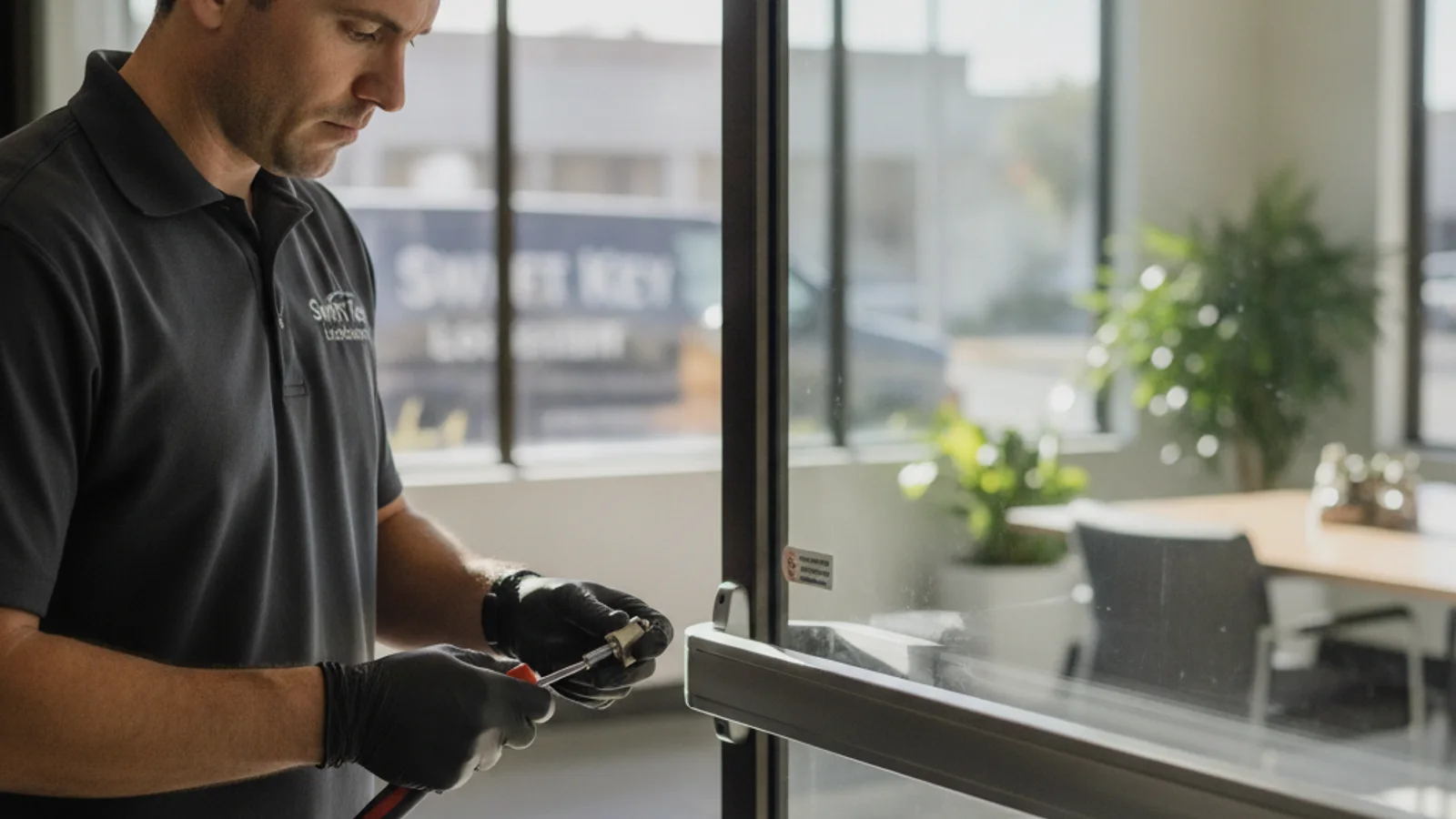
In California, panic hardware (also called exit devices or crash bars) is generally required on any egress door serving an assembly occupancy with an occupant load of 50 or more, and on certain educational and high-hazard occupancies regardless of load. The specific threshold that applies to your building depends on its occupancy classification, your local jurisdiction, and how your space is actually used. This post covers what most commercial tenants and property owners need to understand at a general level. It is not code consultation. Verify the requirements that apply to your specific building with your local fire marshal or Authority Having Jurisdiction (AHJ) before making changes.

When panic hardware is generally required

California adopts the International Building Code (IBC) as the basis for the California Building Code (CBC). The IBC’s egress rules around panic hardware follow a consistent pattern that most commercial building owners should know.

The primary trigger is assembly occupancy with 50 or more people. Restaurants, bars, theaters, auditoriums, gyms, event spaces, and any venue where people gather for a common purpose typically fall into this category. Once the occupant load of a room or space hits 50, egress doors from that space generally must be equipped with listed panic hardware.

The second major category is educational occupancies (schools, daycares). Exit doors serving educational spaces often require panic hardware at lower occupant loads, sometimes regardless of count depending on the specific CBC section in effect.

High-hazard occupancies (laboratories, certain industrial spaces, locations with flammable materials) are a third category where panic hardware is commonly mandated.

For most standard office, retail, and warehouse uses in San Diego, panic hardware is not automatically required unless the space is reclassified, the occupant load crosses the assembly threshold, or specific conditions make the space higher risk. That said, a tenant finishing out a space or changing its use can trigger a reassessment. A restaurant taking over a former office is a common scenario where new panic hardware becomes a requirement mid-tenancy.

The core enforcement agency is typically the local fire marshal working in coordination with the building department. San Diego City, San Diego County, and each incorporated city (Chula Vista, El Cajon, Escondido, National City, and so on) can have local amendments layered on top of the CBC. When in doubt, call the fire marshal’s office for the jurisdiction where your business operates.

The universal egress principle

Even if your occupancy type doesn’t require panic hardware specifically, one rule applies everywhere: egress doors must open from the inside with a single motion, without requiring a key, special knowledge, or extra effort. This principle is baked into every version of the building and fire code.

A door with a simple thumb-turn deadbolt on the inside still meets this standard because one motion (rotate the thumb-turn) opens it. A door with a single-cylinder deadbolt that requires a key from the inside does not meet this standard. Neither does a door with a keyed knob plus a keyed deadbolt if both must be operated to exit.

This is the rule that catches the most businesses off guard. An owner installs a secondary deadbolt for after-hours security without realizing it converts the exit into a code violation. The fix is usually straightforward, but it has to happen before the next inspection.

What gets businesses cited

These are the most common violations fire marshals find on commercial egress doors in California:

Double-cylinder deadbolts on exit doors. A lock requiring a key on both sides is illegal on any required egress door. Period. It traps people inside if they don’t have the key. Replacing it with a single-cylinder (key outside, thumb-turn inside) resolves the violation.

Chained or padlocked exits. Any chain, padlock, or similar device securing a required exit from the inside is an immediate violation. This shows up most often in nightclubs, warehouses, and religious assembly spaces.

Non-listed hardware on required egress doors. Panic devices must be listed (tested and certified) to recognized standards such as ANSI/BHMA A156.3. A cheap surface bolt or a residential-grade lever set on an assembly exit doesn’t qualify, even if it operates freely.

Thumb-turn locks added to panic-required doors. Adding a keyed or non-listed secondary device to a door that already has panic hardware undermines the single-motion exit rule. The panic bar itself should be the only thing needed to exit.

Obstructed egress. Storage, furniture, or display fixtures blocking the path to a required exit or making the door hard to reach. Not a hardware issue, but often cited in the same inspection.

Fire-rated door modifications. Drilling or cutting a fire-rated door assembly improperly (to add a viewer, change hardware, or install signage) can void the door’s listing and create a citation on the door and the hardware.

Device types and typical installed costs

Panic hardware comes in several configurations. The right device depends on the door type, the required fire rating, and how the door is used from the outside.

Device typeBest fitTypical installed cost (San Diego)
Rim exit deviceHollow metal or wood doors, surface-mount latch$300 to $550 per door
Mortise exit deviceHeavy commercial doors, integrates with mortise lock body$450 to $900 per door
Concealed vertical rod devicePairs of doors (double doors), rods engage top and bottom$500 to $950 per door pair
Surface vertical rod deviceSimilar to concealed, rods visible on face of door$400 to $800 per door pair
Alarmed exit deviceAny door where a local alarm is desired or required$500 to $1,100+ per door

These ranges reflect quality commercial-grade hardware (Von Duprin, Falcon, Dorma, Sargent) plus labor for a straightforward installation on an existing door. Fire-rated assemblies, doors with electrified hardware, or doors requiring new prep work run higher.

Outside trim options matter if the door needs to function as an entry from the exterior as well. Most panic devices are free egress only by default (anyone can push out, no one gets in without a key). Adding a keyed cylinder, card reader, or lever trim on the outside converts it to an entry-function exit device, which is the most common setup for employee-entry rear doors. Expect $75 to $200 more per door for outside trim, depending on the hardware grade and keying.

What to do if you get a fire marshal citation

A citation for missing or non-compliant exit hardware is a correctable violation, not a fine-only situation. The typical enforcement path looks like this:

  1. You receive a Notice of Violation with a compliance deadline. Common deadlines are 30 to 60 days, though immediate-hazard violations (chained exits, blocked egress) may require same-day correction.
  2. Call a commercial locksmith that day. Most panic hardware installations take two to four hours per door and can be scheduled within a day or two. Waiting until the deadline passes risks a re-inspection failure and escalation.
  3. Get a receipt and keep documentation. The fire marshal will want proof of correction at the re-inspection. A work order showing the device model, listing number, and installation date is useful to have.
  4. Verify the device is listed. Ask your locksmith to confirm the hardware carries an ANSI/BHMA listing and, for fire-rated assemblies, a UL label. Installing unlisted hardware to clear a citation only sets up a second citation.
  5. Schedule the re-inspection. Most jurisdictions allow you to request a follow-up inspection once corrections are made. Getting it done quickly closes the loop and stops any accruing penalties.

The hardware itself is fixable quickly. The citations that drag out are the ones where building owners wait on getting a quote or assume the violation is less serious than it is.

Maintenance: what to check and when

Panic hardware is mechanical equipment. It wears out. Most commercial locksmiths recommend a simple annual inspection on any panic device that sees regular use.

Dogging feature. Many panic devices include a hex-key dogging mechanism that holds the latch retracted, converting the door to a push-to-open configuration for daytime use. The dogging feature must be released (latches re-engaged) whenever the building is closed or unoccupied. A device left permanently dogged defeats the security purpose of the latch. Confirm staff know how to dog and undog the device correctly.

Latch function. The latch should retract cleanly when the bar is depressed and spring back fully when released. Any grinding, sticking, or partial retraction means the mechanism needs adjustment or lubrication. A latch that doesn’t spring back creates a door that can be pushed open without operating the bar.

Bar alignment and mounting screws. Vibration from heavy door use can loosen the mounting hardware. A slight sag in the bar can cause it to bind against the door face. Check the screws annually and retighten.

Strike and frame condition. The strike plate on the frame takes the latch impact on every close. Over time the screw holes elongate and the strike loosens. A loose strike produces a rattling door that may not latch securely.

Electrified devices. If your exit device has an electric latch retraction (EL) or electrified outside trim, test the function quarterly. These tie into your access control or alarm system and failures can mean either an unsecured door or a door that won’t release during a power event.

Most commercial locksmiths can do a multi-door inspection in a single visit. For businesses with access control systems integrated into their exit devices, that inspection should include the electrical connections as well.

Fire-rated door pairings and ADA considerations

Panic hardware on a fire-rated door assembly must be part of a listed combination. The door, frame, hardware, and closer must all carry listings compatible with the door’s fire rating (typically 20-minute, 45-minute, 60-minute, or 90-minute). You cannot install non-listed panic hardware on a fire door and expect the assembly to remain code-compliant, even if the device operates correctly.

Fire-rated assemblies also require a door closer to ensure self-closing and positive latching. If you replace panic hardware on a fire door and the closer is worn out or missing, the whole assembly is non-compliant. Factor the closer into any quote on a fire-rated door.

On the ADA side, egress force requirements are relevant here. The maximum force to operate a door in the path of egress (including the panic bar itself) is generally 5 pounds for interior doors and 15 pounds for exterior. Worn or binding panic hardware that requires significant force to operate may create an ADA accessibility issue in addition to the code concern. These limits are especially relevant for doors serving restrooms, corridors, or areas accessible to the public.

Frequently asked questions

Does my business need a panic bar in California?

Generally yes, if your space has an assembly occupancy with 50 or more people, or if it’s an educational or high-hazard occupancy. Standard offices, small retail stores, and light industrial tenants with occupant loads under the assembly threshold often don’t require panic hardware specifically, but all required egress doors must still allow single-motion exit without a key. Check with your local fire marshal to confirm what applies to your specific space.

Can I have a deadbolt on my exit door?

A single-cylinder deadbolt (key outside, thumb-turn inside) is generally acceptable on most exits because it allows single-motion, no-key exit from the inside. A double-cylinder deadbolt (key required on both sides) is not allowed on a required egress door in California. If your current setup requires a key to exit, that needs to change.

How much does panic bar installation cost in San Diego?

Expect $300 to $600 installed for a standard rim exit device on a single commercial door. Mortise and vertical rod devices run $450 to $950 per door. Alarmed exit devices or doors requiring outside entry-function trim are on the higher end. Fire-rated door assemblies that also need closer replacement or frame work will add to the total. Call us at (858) 925-5546 for a same-day estimate on your specific doors.

What happens if I ignore a fire marshal citation for missing panic hardware?

Repeated non-compliance can escalate to fines, a stop-occupancy order, or both. Most fire marshals start with a correction notice and a deadline. The correction itself is quick and inexpensive relative to the escalation risk. Most commercial locksmiths can schedule the work within one to two business days.

Can I install panic hardware myself?

Technically you can purchase and install a panic device, but there are reasons to use a licensed commercial locksmith. Listed hardware must be installed per the manufacturer’s instructions to maintain its listing. Fire-rated assemblies require careful hardware selection. And a citation correction typically carries more weight at re-inspection when performed by a licensed professional who can document the work. For most businesses, the labor cost is worth the confidence that the installation is correct.

What’s the difference between a panic bar, a crash bar, and an exit device?

They all refer to the same category of hardware. “Panic bar” and “crash bar” are informal terms. “Exit device” is the industry and code term. Within exit devices, the type varies by mounting style: rim, mortise, concealed vertical rod, or surface vertical rod. The terminology your locksmith or fire marshal uses may vary, but they’re all talking about the horizontal bar mechanism that releases the latch when pushed.

When to call us

If you’ve received a citation, are planning a build-out that will change your occupant load, or just want to know whether your current exit hardware passes, a quick walkthrough with a commercial locksmith takes less than an hour and answers those questions concretely. We work on commercial exits throughout San Diego County, from restaurant rear doors in North Park to warehouse egress in Otay Mesa.

Call Swift Key San Diego at (858) 925-5546 for a same-day assessment. You can also read more about our commercial locksmith services, or see how panic hardware fits into a broader business security picture after hours.