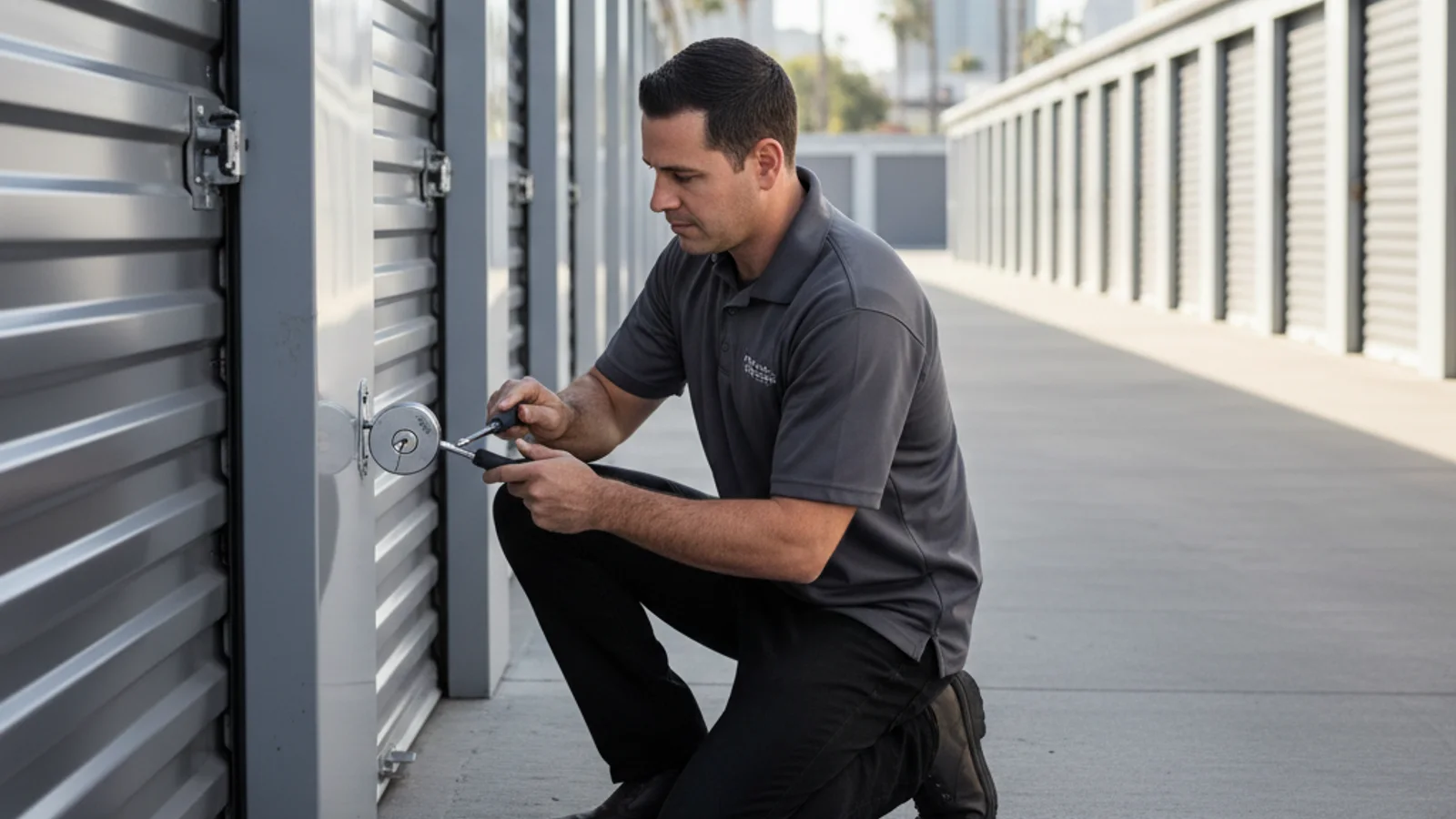
Start at the facility office, not with a locksmith. If you’ve lost your storage unit key or forgotten your combination, the fastest path is a visit to the facility manager with your ID and your account number. Most San Diego facilities handle this in-house, either cutting the lock themselves or walking you through their vendor process. A locksmith can help, but only after the facility has confirmed your account and authorized third-party access. Ask the office for their cut fee. An outside locksmith quotes the visit and the replacement lock separately.
That’s the short version. Below is how it actually works, step by step.
Why nobody legitimate opens a storage unit on your word alone
This comes up in almost every storage lockout call, and the answer is worth understanding rather than just accepting.
A storage unit is rented space inside a facility. The facility has a duty to every renter to keep unauthorized people out of every unit, including yours. If a locksmith arrived and opened your unit just because someone said “I rent this one,” that same technique would work for any thief who walked in and said the same thing.
So the authorization chain matters. The facility manager holds records: your name, your ID at signup, your account number, your payment history, and your unit number. When you show up and prove you’re the account holder, they can verify your right to access before anything is cut. A locksmith working in that ecosystem operates with the facility’s blessing, not around it.
This is the same logic behind why locksmiths ask for ID proof at residential lockouts. Authorization protects you far more than it inconveniences you.
The facility process, step by step
Most San Diego self-storage facilities follow a process like this. Yours may vary slightly, so call ahead if you’re not sure.
1. Go to the office in person. Call ahead to confirm hours. Don’t try to handle this over the phone or send someone else without your prior written authorization. The manager needs to see you and your documents.
2. Bring photo ID and your account information. Your government-issued ID needs to match the name on the account. If you share the unit with someone else and your name isn’t the primary account holder, you may need to bring that person or show authorization in writing.
3. The manager verifies your account. They’ll confirm the unit number, the account status, and that you’re current on rent. If the account is delinquent, access may be held until payment is made.
4. The facility decides who cuts the lock. Some facilities do it themselves with bolt cutters or angle grinders on simple padlocks. Others have a preferred locksmith vendor they call for disc locks or cylinder locks that require more skill to remove without damaging the door. A few facilities will allow you to call your own locksmith, but they’ll want to be present during the cut.
5. You provide the replacement lock. Most facilities require a specific lock type (usually a disc lock), and many sell them in the office. Ask what they charge for a basic disc lock if you need one on the spot.
6. The cut fee. Check your rental agreement. Many facilities include a lock-cut provision with a fee. That’s separate from what you pay if they bring in an outside locksmith.
Disc locks vs padlocks: what you’re actually dealing with
The type of lock on your unit shapes how it gets opened and what the office or locksmith quotes. Most San Diego facilities now require disc locks (also called puck locks) because they’re significantly more resistant to bolt cutters. If you’re paying for storage somewhere that lets you hang a standard padlock on a hasped door, you’re getting less security than you might expect.
| Lock type | How it’s removed | Who typically does it | What drives the bill |
|---|---|---|---|
| Standard padlock | Bolt cutters or angle grinder | Facility staff | Often in the cut fee |
| Disc lock (no key) | Angle grinder on the shackle, or pick/decode if accessible | Locksmith or facility vendor | Labor plus replacement lock |
| Disc lock (damaged or seized) | Angle grinder | Locksmith | More labor than a clean cut |
| Cylinder lock (built-in door lock) | Drill-out or pick | Locksmith | Method and door damage risk |
| Combination padlock (forgotten combo) | Manufacturer reset (if you have proof), or cutting | Facility staff or locksmith | Reset vs cut |
The angle grinder approach is fast and effective on disc locks but destroys the lock. That’s fine if you’ve lost the key, since you’d need a replacement anyway. A skilled locksmith can sometimes pick or decode a disc lock without cutting, which is quieter and quicker, but it depends on the specific lock model and condition.
For comparison: opening a standard padlock with bolt cutters takes about thirty seconds. Opening a quality disc lock by grinder takes four to eight minutes. That’s why facilities push disc locks, and it’s also why the labor cost is higher when you lose the key.
When a locksmith is actually the right call
A locksmith fits into this picture in a few specific situations.
The facility uses a locksmith vendor. If the facility calls their preferred vendor and that person happens to be an independent locksmith, great. The facility authorizes, the locksmith shows up, the locksmith cuts.
The facility allows you to call your own locksmith. Less common but not unheard of, especially at independently owned facilities. Confirm with the manager first. They’ll typically want to be present while the work is done.
The lock is a cylinder lock or a complex disc lock. If the unit has a built-in door lock rather than a hasp, the facility may not have the equipment to open it cleanly. A locksmith with the right picks or drill bits is the better option.
You need a key made for your new lock. Once the old lock is off and you’ve bought a replacement disc lock, you may want to have a duplicate key made for the new lock before putting it in service. That’s straightforward. See our key duplication service for what that process looks like.
You’re managing multiple units or commercial storage. If you rent several units for business inventory or a commercial operation and need lock management beyond a single lockout, our commercial locksmith services can help with rekeying, master key setups, and ongoing access management.
What a locksmith can’t do is substitute for facility authorization. Independent locksmiths in this network will not open a storage unit for someone who hasn’t gone through the facility first. The manager’s verification is the authorization step. Without it, the visit would be helping someone break in.
What about delinquent units and the lien process?
If your account is behind on rent, the path to your unit runs through paying the balance first. California has a self-storage lien law process that facilities must follow before they can sell or dispose of your belongings, but that’s the facility’s process to manage, not yours to race against. The straightforward answer: call the facility, find out the balance, pay it, and then request the lock-cut assistance.
If you believe there’s a dispute about the balance or you’ve had payment processing issues, sort that out with the facility manager or their corporate office before asking anyone to cut locks. A locksmith showing up to a unit in lien dispute territory creates a complicated situation for everyone.
Prevention: what to do before you lose the key
The easiest storage lockout to handle is the one that doesn’t happen. A few habits that help.
Photograph your key code. Many disc locks and padlocks have a key code stamped on the key itself or on a card that came with the lock. That code lets a locksmith cut a replacement key without any cutting or drilling. Take a photo of both sides of your key and save it in a cloud folder or email it to yourself. A clear photo against a plain background with a ruler for scale works well. This is the same habit that works for any key you’d hate to replace, as covered in our key duplication guide.
Keep one spare key somewhere that isn’t the keyring you carry to the unit. Your home key drawer or a trusted family member works. The spare should live somewhere other than the key collection you’re most likely to lose.
Keep your spare off the same ring. If your storage key is on the same keyring as your car and house keys and you lose the whole ring, you’ve lost everything at once. A separate small keyring with storage-specific keys is a better setup.
Write down your combination. For combination locks, keep the combination somewhere you’ll actually be able to find it, not just “I’ll remember it.” A password manager, a secure note in your phone, or a physical slip of paper in a consistent safe spot.
Know your lock’s brand and model. If your lock has a key code, most manufacturers will cut a replacement if you contact them with proof of purchase or the code. Some disc lock brands have dealer networks. Knowing what you have before you need help makes the process faster.
Frequently asked questions
Can a locksmith open my storage unit?
Yes, with facility authorization and your account documentation. A locksmith can’t arrive and open a unit on your word alone, the facility manager needs to verify your account and authorize the work first. Once they’ve confirmed you’re the renter, either they’ll do the cut themselves or you can arrange a locksmith visit with their permission.
How much does it cost to cut a storage unit lock?
Ask the office for their cut fee. It is usually in the rental agreement. An outside locksmith quotes the visit plus a replacement lock if you need one. Disc locks take more labor to remove than standard padlocks.
What happens if I lost my storage unit key?
Go to the facility office in person with your photo ID and account information. The manager verifies your account and walks you through their lock-cut process. Most San Diego facilities handle this routinely. You’ll likely pay a cut fee per your rental agreement and then purchase a replacement lock. Call ahead to confirm office hours and whether they handle this in-house or call a vendor.
What if I forgot my storage unit combination?
Same starting point: facility office with your ID and account details. For combination locks, some manufacturers offer a reset or replacement service if you can provide the lock’s model number and proof of purchase. The facility can advise based on the specific lock type. If no reset option exists, the lock gets cut.
Will a locksmith open a storage unit without going through the facility?
A legitimate one won’t. The facility holds your lease agreement and is responsible for unit security on behalf of all renters. A locksmith who bypasses that process has no way to confirm you’re the renter, which makes them liable if something goes wrong. If a locksmith offers to open your unit without any facility involvement or account verification, that’s a red flag about their practices.
What kind of lock should I use for my storage unit?
Most San Diego facilities require or strongly recommend disc locks. They’re significantly more resistant to bolt cutters than standard padlocks. A disc lock with a hardened steel body and a short, recessed shackle is the practical standard. Keep the key code card that comes with the lock somewhere separate from the key itself.
Lost your storage unit key in San Diego? Start with the facility office first, then call Swift Key San Diego at (858) 400-4082 if they need outside help or if you need a replacement key made for your new lock. Swift Key is a referral service. You contract with the locksmith. See our commercial locksmith services page for the job types we match.