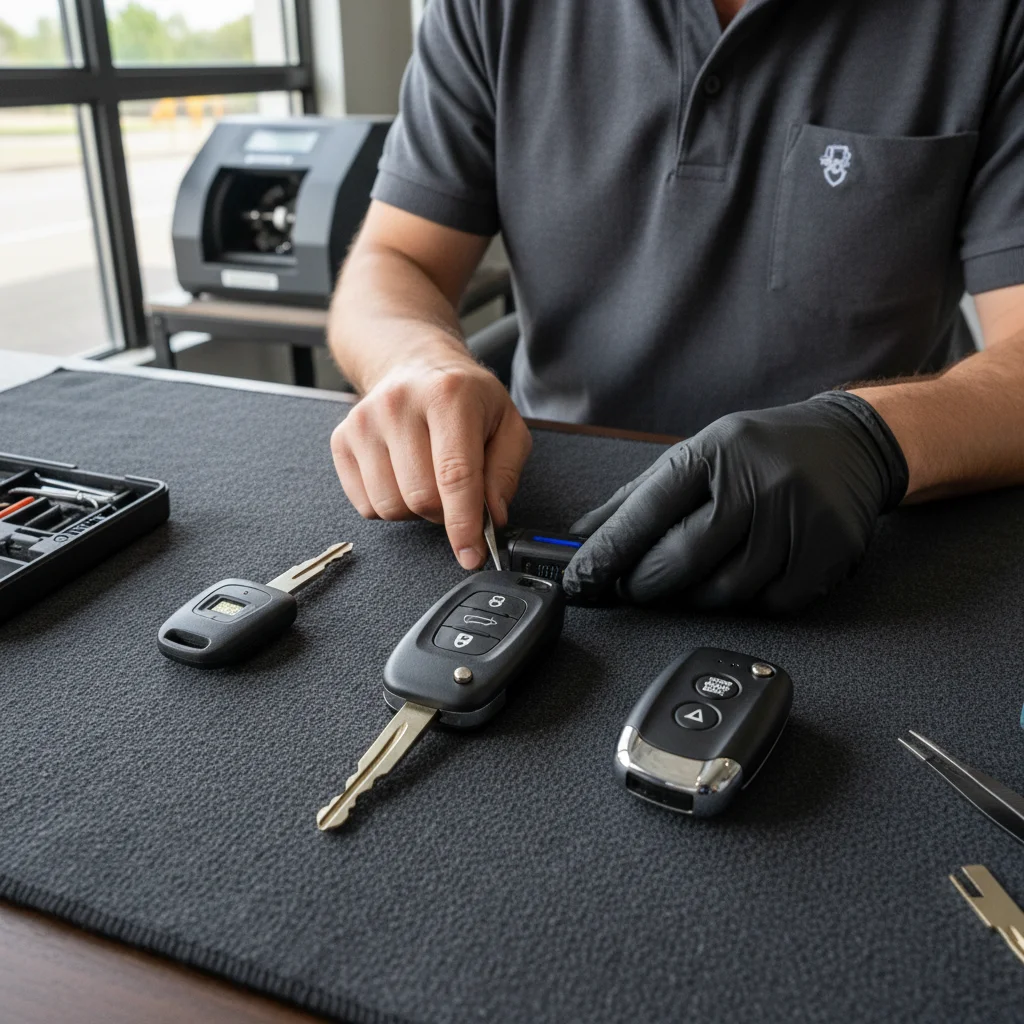
You reach into your pocket or purse and feel that familiar, sinking void. The car key is gone. After the initial panic, the practical questions start. What kind of key did I even have? And what’s it going to cost to get back on the road in San Diego?

Most drivers don’t think about their car key’s technology until it’s lost or broken. The terms can be confusing, transponder, remote, fob, smart key, and they all mean different things for the replacement process and your wallet. Let’s clear up the confusion and explain exactly what’s in your pocket.

Transponder, remote head, and proximity smart keys explained

Car key technology has evolved significantly since the simple metal-blade keys of the past. Today, nearly every key contains some form of electronics. Understanding the three main types is the first step in knowing what you need.

The transponder key

This is the foundation of modern car key security. A transponder key has a plastic head that looks solid, but it contains a tiny glass or carbon chip. This chip, called a transponder, doesn’t need a battery. It’s powered wirelessly by a signal from your car’s ignition when you insert the key. If you have a car from the late 1990s or 2000s with a plastic-headed key and no buttons, you likely have a basic transponder key. They were a massive leap forward in anti-theft technology.

The remote head key

Think of this as a transponder key with added convenience. A remote head key combines the transponder chip for starting the car with remote buttons for locking, unlocking, and maybe popping the trunk or activating a panic alarm. It’s an all-in-one unit. The transponder chip part works just like the basic version, while the remote functions are powered by a small battery inside the key’s head. These became common on vehicles from the mid-2000s to the mid-2010s.

The proximity smart key

Often just called a “key fob” or “smart key,” this is the technology behind push-to-start ignitions. A proximity key doesn’t need to be inserted into the ignition at all. You just need to have it with you, in your pocket, in your bag, for the car to recognize its presence. The car has antennas that detect the key’s unique signal, allowing you to unlock the doors by touching the handle and start the engine with the push of a button. Most new cars sold in San Diego today come with some form of proximity key.

How each one talks to your car

The communication method between your key and your car is what truly separates these technologies. It’s a digital handshake that verifies you’re the legitimate owner before the engine will turn over.

A transponder key uses Radio-Frequency Identification (RFID). When you put the key in the ignition and turn it, the car sends out a low-frequency signal. This signal energizes the chip in the key, which then transmits a unique alphanumeric code back to the car. If the car’s computer recognizes the code, it allows the engine to start. If the code is wrong or absent, the immobilizer stays active, and the car won’t start, even if the key blade is cut correctly.

A remote head key uses two different systems. For starting the car, it uses the same RFID transponder system as the basic key. For the remote functions (lock/unlock), it uses a separate radio frequency (RF) transmitter. Pushing a button sends a rolling code signal to the car’s receiver. This is why the remote part can stop working if the battery dies, but you can still use the key to manually unlock the door and start the engine.

A proximity smart key is the most complex. It constantly emits a low-power radio signal. When the key gets close to the car, antennas in the car’s body panels pick up this signal. The car and key then perform a secure, encrypted challenge-and-response sequence to verify the key’s identity. If the handshake is successful, the doors will unlock, and the push-to-start button will be enabled. It’s a continuous, two-way conversation that happens in milliseconds.

Why smart keys cost more to replace

The price difference between replacing a basic transponder key and a new smart key can be significant, often hundreds of dollars. The higher cost comes down to three main factors: hardware complexity, programming requirements, and manufacturer control.

First, the hardware itself is more advanced. A smart key isn’t just a chip; it’s a miniature computer with multiple antennas, a more powerful transmitter, and more sophisticated encryption. The manufacturing cost for these components is simply higher. They are designed to be durable, but the internal electronics are far more intricate than a simple RFID chip.

Second, the programming is more involved. While a basic transponder key requires programming, the equipment and software needed for a modern smart key are highly specialized and expensive. Automotive locksmiths and dealerships must invest thousands in diagnostic tools and maintain costly software subscriptions to be able to perform key fob programming for the latest vehicle models. This overhead is factored into the replacement cost.

Finally, vehicle manufacturers often maintain tighter control over the supply and programming protocols for their newest smart keys. This can limit the availability of aftermarket options and drive up the price of original equipment manufacturer (OEM) fobs. The complexity also means the labor time can be longer, especially in an “all keys lost” scenario where the car’s security system may need to be reset.

Programming: what dealers and locksmiths can do

When you lose a key, you have two primary options for replacement: the dealership or a licensed automotive locksmith. Both can get you a new key, but the experience and cost can be very different.

A dealership can, of course, replace any key for the brand they sell. They have direct access to manufacturer key codes and programming tools. The downside is typically cost and convenience. You’ll almost always have to get your car to them, which means a tow truck if you’ve lost your only key. You’ll also be subject to their service department’s schedule and labor rates, which are often the highest in town.

A qualified automotive locksmith, on the other hand, is a mobile service. We come to you, whether you’re stranded at Mission Beach or in your own driveway in Chula Vista. This saves you the time, hassle, and expense of a tow. Reputable locksmiths invest in the same high-end programming equipment as dealers, allowing us to cut and program transponder keys, remote head keys, and most smart keys on the spot. For a deeper dive into this choice, you can read our comparison on dealer vs. locksmith for lost car keys.

It’s crucial to hire a licensed professional. In California, locksmiths are licensed by the Bureau of Security and Investigative Services (BSIS). You can verify any locksmith’s license on the BSIS search website. A licensed locksmith ensures accountability and expertise.

Battery life and what fails first

With electronics come potential points of failure, and batteries are the most common culprit.

For basic transponder keys, there is no battery, so you don’t have to worry about it dying. The chip is incredibly durable and rarely fails on its own. The most common failure is physical damage to the key itself, the plastic head cracking or the blade breaking.

For remote head keys, the battery only powers the lock/unlock buttons. If the battery dies, you’ll have to unlock your door manually with the key blade, but the transponder chip will still work to start the car. The physical buttons on the remote can also wear out over time, becoming unresponsive even with a fresh battery.

For proximity smart keys, the battery is essential. A dead battery means the keyless entry and push-to-start features won’t work. Most cars will display a “Key Fob Battery Low” warning on the dash for weeks before it dies completely. And don’t worry, you won’t be stranded. Every smart key has a hidden physical emergency key blade inside, and there’s a hidden keyhole on your car (usually on the driver’s door handle). There’s also a spot in the car (often the center console or steering column) where you can hold the “dead” fob to start the car via a backup system.

What to do when you only have one

If you’re down to your last key, you’re living on borrowed time. Misplacing that one key instantly turns a minor inconvenience into an expensive, trip-canceling emergency. The cost and complexity of generating a new key when no existing key is present (an “all keys lost” situation) is always higher than simply duplicating a key you already have.

Think of a second key as the cheapest insurance policy you can buy. Having a spare made is a straightforward process. A mobile locksmith can meet you at your home or office and typically create a duplicate, fully programmed key in under an hour. This gives you a backup for emergencies and a spare to give to a family member.

Don’t wait until you’re stranded and facing a tow bill on top of a replacement fee. If you only have one key for your vehicle, getting a spare should be at the top of your to-do list. It provides peace of mind and saves you significant money and stress down the line. Investing in a car key replacement on your own terms is far better than being forced to do it in a crisis.

Frequently asked questions

How much does it cost to replace a transponder key vs. a smart key?

Transponder key replacement typically runs $150 to $250 through a locksmith in San Diego, covering the key blank, cutting, and programming. A proximity smart key replacement is significantly more, usually $250 to $450, because the hardware is more complex and the programming equipment and software subscriptions required are more expensive. Dealer pricing for both runs higher, and you’ll likely need a tow if you have no working key. See our car key replacement cost guide for a breakdown by vehicle make.

Can a locksmith program a smart key, or do I have to go to the dealer?

A qualified automotive locksmith can program most smart keys on-site. We carry the same high-end diagnostic tools and software as dealerships, which means we come to you instead of the other way around. The exception is a small number of late-model vehicles where the manufacturer has restricted programming access to their own dealer network, but that applies to a minority of vehicles on San Diego roads.

What happens if my proximity smart key battery dies while I’m out?

You won’t be stranded. Every proximity key has a hidden physical blade inside the fob. There’s also a backup tap point, usually in the center console or on the steering column, where you can hold the dead fob to start the car via a short-range signal. Your car will typically warn you for weeks before the battery fully dies, so replacing a $5 CR2032 battery at the first warning is the easier path.

Is it worth getting a second smart key made before I lose the first one?

Yes, and it’s meaningfully cheaper to do it now. Duplicating a key you already have is straightforward. An “all keys lost” replacement, where the car’s security system has to be reset before any new key can be programmed, always costs more in both time and money. If you’re down to one smart key, a car key replacement while you still have the original is the cheapest insurance you can buy.

Why does my remote head key lock/unlock the car but not start it?

The remote functions and the transponder chip use separate systems. If locking and unlocking work but the car won’t start, the transponder chip is the likely problem rather than the battery. The chip could be damaged, the antenna ring around the ignition could be failing, or the car’s immobilizer may need to be recalibrated. A locksmith can run a quick diagnostic on-site to identify which component has failed.

When to call us

Whether you’ve lost your only smart key, need a transponder key duplicated, or your remote head key has stopped working, we can help. Swift Key San Diego provides fast, mobile service across the county. Call us at (858) 925-5546 for a same-day estimate.