A Yale door lock not working after a battery change is not a dead pack sitting in the door. The cells are already new, and the keypad, motor, or bolt still will not finish the job. On a San Diego entry, the useful next step is to name the exact Yale model and write down what still works, before anyone tries a reset they cannot undo.
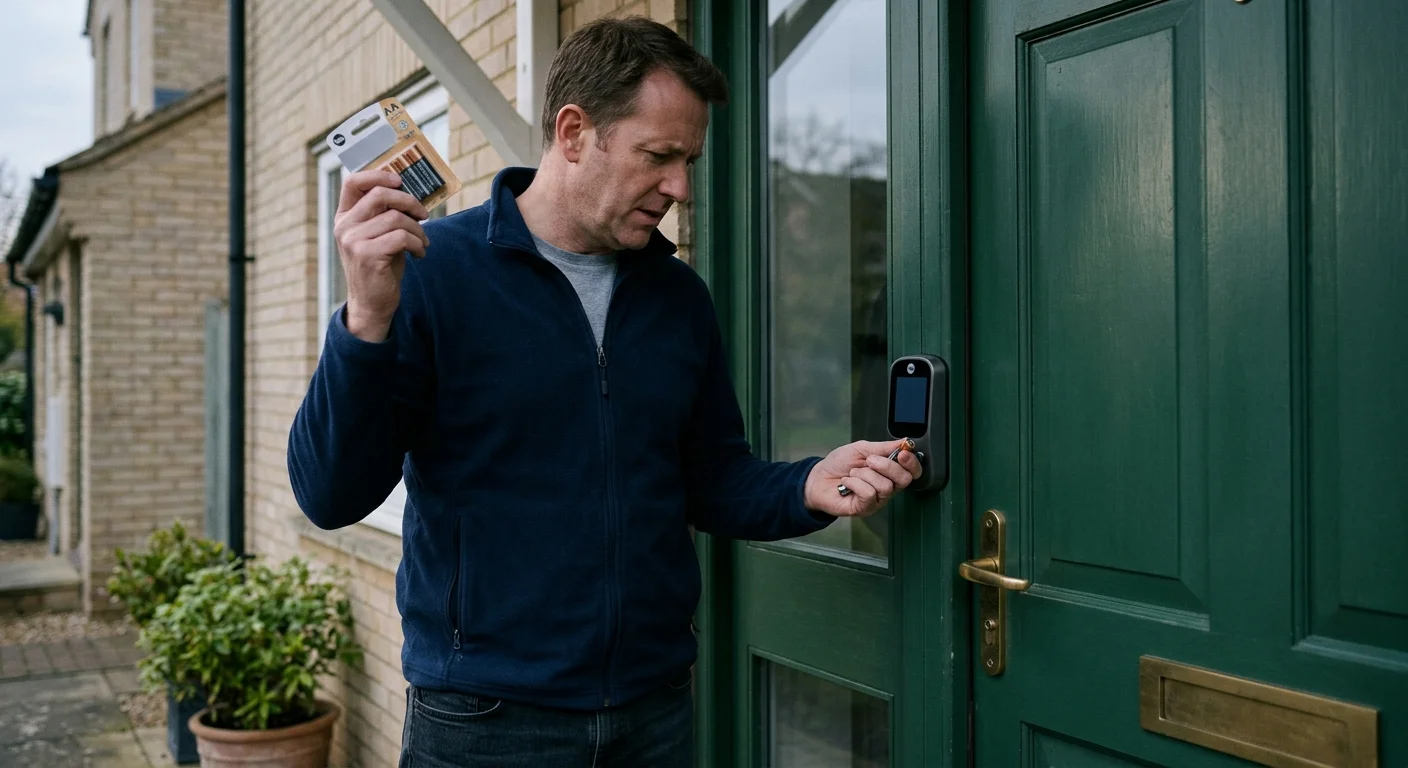
Confirm the Yale model and what still works
The interior housing is the source of truth. Open the battery cover only if you are already inside. Read the model line stamped or printed on the case. Yale Assure, Yale Assure Lock 2, and older Yale units do not share one tray, one keypad, or one keyway. A key-free slim lock and a keyed touchscreen can sit on the same block in North Park and fail in different ways.
Do not guess the hardware from an app icon. The Yale Access app can control more than one generation. Match the metal on the door. Photograph the interior label. That photo is what a matched locksmith will ask for later.
Then list what still works, in this order. Keypad wake: a tap or a palm on the pad, then light, no light, or a flash that dies. Code: accepted, rejected, or silence. Motor: quiet, a short whir, or a grind. Bolt: fully thrown, stuck mid-travel, or free only with the door open.
If you are inside, the interior thumbturn is the mechanical check. When that turn moves the bolt and the keypad does not, the electronics are the problem. When the thumbturn is stiff with the door closed and easy with the door open, the door and strike are the problem. Fresh batteries will not fix a bolt that cannot enter the plate.
On coastal doors in Pacific Beach, Ocean Beach, and Imperial Beach, note white crust or green on the tray contacts. Salt air gets inside the pack. Inland in El Cajon, Santee, and Escondido, note whether the door face sits in afternoon sun. Heat can make a new set sag in a day. That is still a battery story. It is not the same as a dead motor.
This page is the after-swap failure. A pack that died with no spare key is a different night, covered in Yale lock dead battery, no spare key. Broader keypad and app faults sit in Yale Assure lock problems and fixes.
Use only Yale’s documented battery steps
Use the PDF or printed guide that matches the model number you just read. Yale does not publish one battery method for every lock it sells. A single 9V exterior contact, reset press, or tray layout could not be confirmed for every current Yale smart lock. If your guide does not show a 9V jump, do not hold a 9V against the keypad and hope. If it does not show a reset pinhole, do not press random holes.
If you are inside, replace the full set as a set. Do not mix leftover cells with new ones. Match the plus and minus marks in the tray. Seat the cover so the contacts actually touch. Then wake the lock the way that model’s guide says to wake it.
If the guide names a battery type, use that type. A random rechargeable pack can sit at a voltage the board will not accept. That looks like a failed lock. It is often just the wrong cells.
Do the swap with the door open if you can. That keeps you from testing a fresh pack from the porch. If you are already outside, and the interior pack was already changed, you are past DIY. A home lockout is the path, not a teardown on the stoop.
Do not remove the lock from the door. Do not drill. Do not pull the cylinder. Those steps are locksmith work. In California, installing, repairing, and opening locks is locksmith work under Business and Professions Code section 6980. The people we connect you with are independent locksmiths licensed through the Bureau of Security and Investigative Services. You can verify a license before anyone touches the hardware.
Skip any tip that starts with taking the unit apart. If the step is not in the current Yale guide for that SKU, it does not belong on this door.
Separate a weak battery from a failed lock
A weak cell can light a pad and still fail under load. The motor that throws a deadbolt draws more than a backlight. You tap the pad, you see digits, you enter a code, and the bolt never moves. That can still be the pack if the cells are mixed, off-brand, or heat-soaked on a west wall in Chula Vista.
A failed lock looks different once the pack is known-good. The pad never lights, even with a fresh set seated on the marks. The motor runs and the bolt does not travel, with the door open. The bolt travels with the door open and jams the moment the door is closed. That last one is alignment.
About 49.6% of homes in the city of San Diego were built before 1978. Those doors sag, take paint in the strike, and swell in marine air. A Yale smart lock on that slab can look electronic and be mechanical. The same bind shows up on sun-baked East County doors that shrink by afternoon and swell after a damp night.
Other failed-lock signs: a gritty interior thumbturn that stops short, corrosion in the tray that a dry cloth will not lift, and a code that worked yesterday and will not finish a throw today. Do not factory-reset to see if that helps unless the current Yale guide for that model tells you to, and you accept that codes and settings can wipe. A reset is not a battery test.
If the lock is on a vacation rental in Pacific Beach or a condo downtown, write down who holds the remaining codes before anyone resets anything. A wiped lock is a lockout for every guest on the calendar.
Sun, salt, and a binding door are the three San Diego reasons a Yale Assure lock after a battery change still acts dead. The fourth is a board or motor that is done. That last one is not a home part swap.
Check the mechanical key if the model has one
Some Yale smart locks have a keyway. Some do not. Slim key-free units have no cylinder and no key to try. If you do not see a keyhole, stop looking for one.
If there is a small cover over a keyway, use the mechanical key that model shipped with. Do not force a house key from another lock. Do not spray a random lubricant down the hole as a first move. If the key will not insert, the cover may not be fully open, or the cylinder is packed with grit from beach sand and stucco dust.
If the key turns and the bolt moves, the mechanical side still works. The electronics are the failure. You can get in, then decide on repair or a smart lock installation of a replacement, done by a matched locksmith.
If the key turns and the door stays shut, the latch or bolt is not lining up with the strike. That is a door problem. It shows up on older City Heights and North Park slabs, and on doors that baked through an East County summer.
If the key will not turn, stop. Forcing it snaps keys and ruins cylinders. That is how a battery complaint becomes a lockout with a broken key in the lock.
Keep the spare where you can reach it from outside. A smart lock without a working keypad and without a spare on site is the same night as any other smart lock battery lockout, even when the pack inside is brand new.
When a locksmith should inspect the door
Call for a locksmith inspection when the documented battery steps are done and the lock still fails, or when you cannot get inside to do those steps.
The inspection is of the door, the strike, the bore, and the lock as a unit. A matched independent locksmith can tell you whether the Yale unit is bound, corroded, or dead, and whether the door needs work before another smart lock goes on. Swift Key San Diego does not repair locks, does not install hardware, and does not hold a locksmith license. We connect you with licensed local pros. The pro does the work. You contract with them.
Ask to see the pocket license, then confirm it at the state license search. California locksmiths are licensed by BSIS, not the contractors board.
Inspection is the right call when you are locked out after the swap, the thumbturn binds with the door closed, or the keypad is dark on a known-good pack. It is also the right call when corrosion will not clear without taking the unit down, or the lock sits on a warped exterior door that never sat square.
You may need the unit replaced, not cheered back to life. Replacement and a clean install belong under smart lock installation, done by the locksmith. Do not pull an old unit yourself on a load-bearing exterior door.
Bring the model photo, the battery type you installed, and a short list of what still works. That cuts the guesswork on the porch.
When to call us
When a Yale smart lock is still dead after a proper battery change, or you are standing outside with a dark keypad, you need a licensed locksmith on the door, not another undocumented reset. Call us at (858) 400-4082 and we’ll connect you with a licensed local locksmith.