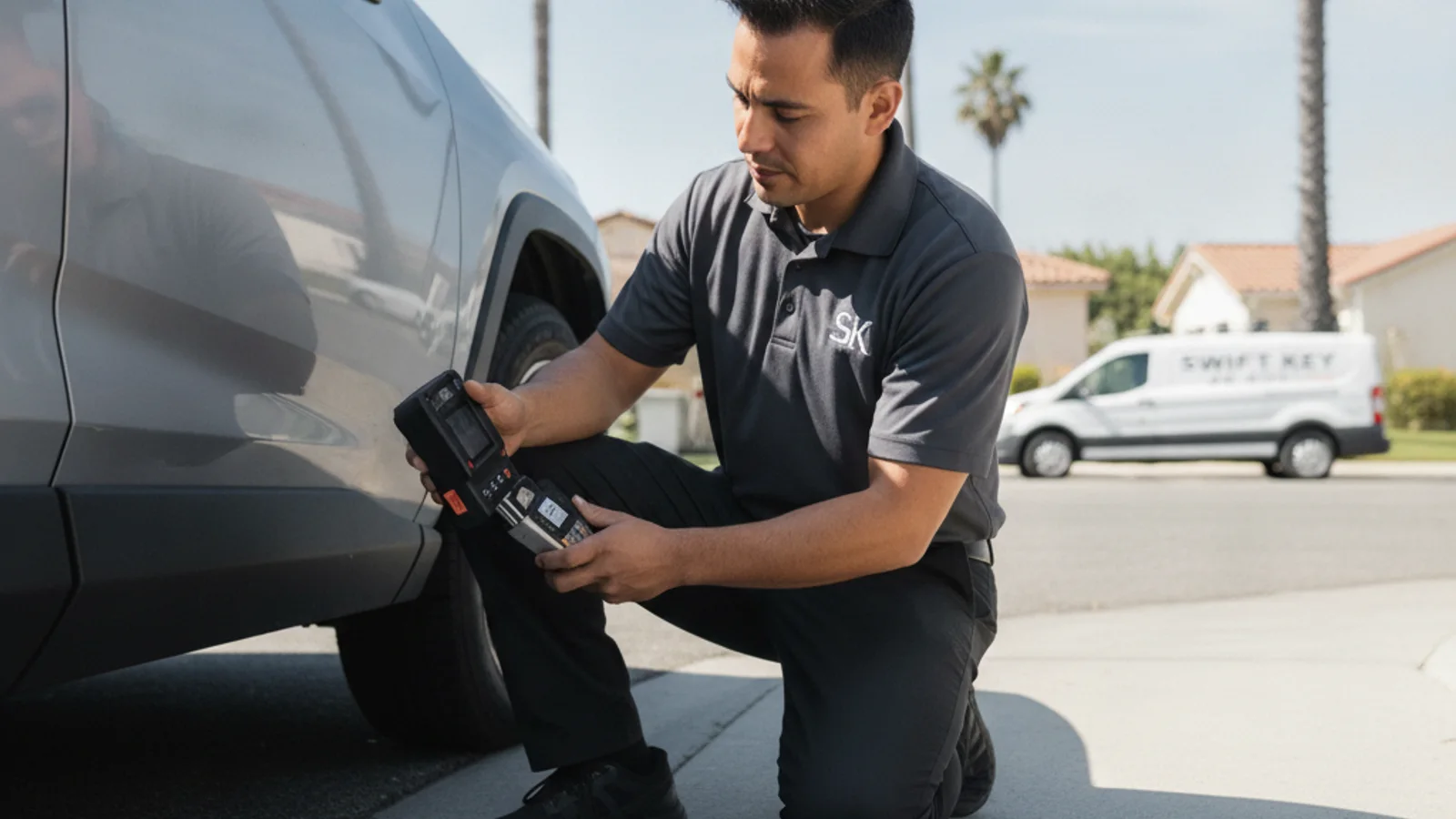
Toyota key replacement in San Diego depends on which key your vehicle uses, not on a generic brand price. Older transponder keys, remote head keys with lock buttons in the head, and proximity fobs for push-button start are different jobs. The dealer programs at the service department and usually needs the car on the lot. A mobile automotive locksmith, if their tools cover your year and trim, can cut and program at the car.
Swift Key San Diego is a locksmith referral service. Independent licensed locksmiths confirm whether they can program your Toyota, set the price, and quote before they start. Call (858) 400-4082 to get matched.
Toyota is common on San Diego County roads. Many automotive locksmiths carry blanks and programming support for Camry, Corolla, RAV4, Tacoma, Tundra, and Highlander, but coverage still depends on the exact immobilizer generation.
Toyota key types
The electronics inside the key drive the work more than the model name.
| Key type | How to identify | What the locksmith is doing | What to confirm |
|---|---|---|---|
| Transponder key (metal blade, chip in head) | Separate metal key with a thicker plastic head housing the chip | Cut blade, program chip through OBD | VIN and immobilizer generation |
| Remote head key (transponder plus lock/unlock buttons) | Key head with lock and unlock buttons built in | Cut, program immobilizer and remote | VIN, trim, and remote frequency |
| Smart proximity fob (push-button start) | Keyless entry and push-button start, no blade to turn | Pair fob to smart receiver plus immobilizer | VIN, trim, and smart key system name |
Some model lines crossed technologies mid-cycle. A 2015 Camry LE may use a remote head key while a 2015 Camry XSE uses a proximity fob. Year, model, and trim all matter. VIN lookup is the cleanest way to confirm the blank and chip.
Dealer vs mobile locksmith
Both can produce a working Toyota key. The differences are logistics and who owns the quote.
Dealer. OEM parts channel, factory software, and a service-bay schedule. If you have lost every key, the car generally has to be at the facility. That means a tow if it cannot be driven. Dealer labor and parts markups are set by the store, not by Swift Key.
Mobile locksmith. The car stays where it is. The locksmith connects a programming tool to the OBD port, cuts a blank to the vehicle code, and registers the chip. Toyota’s immobilizer architecture is widely supported on professional tools for most models on the road here. Very new platforms can still be dealer-only until aftermarket software catches up. The locksmith should say that before they come out.
Towing. A dealer all-keys-lost job often includes a tow from a driveway, a Mission Valley garage, or a remote lot in Ramona or Fallbrook. A locksmith who can program on-site avoids that extra vendor. Confirm capability first.
For a wider brand comparison, see lost car keys: dealer vs locksmith and the car key replacement cost guide by vehicle for quote factors, not published dollar ranges.
All keys lost vs a spare from a working key
You still have a working key. The locksmith cuts a duplicate and programs it alongside the existing one. On many Toyota systems that is a shorter programming session than generating a first key from scratch.
You have lost every key. The locksmith generates a key without an existing one to clone. They read the immobilizer through OBD, cut to the vehicle code, and register the new chip. Ownership documents still come first.
If the car uses a proximity fob and you only need a spare paired to a working original, key fob programming is the narrower job.
What to have ready
- Year, make, model, and trim
- VIN (door-jamb sticker, windshield plate, or registration)
- Driver’s license matching the registered owner
- Current registration or title
- Exact location of the car
If the title is still in transit, a bill of sale plus matching ID is often acceptable. The locksmith confirms what they will accept.
How on-site Toyota programming usually works
Toyota’s immobilizer uses a chip in the key. When you turn the ignition, the car challenges the chip. A matching response lets the engine run. A correctly cut blade without a programmed chip will not start the car.
Typical steps on supported models:
- Connect a professional OBD tool under the dash.
- Read the key database and immobilizer configuration.
- Cut a blank to the vehicle’s key code.
- Register the new chip.
- On some systems, leave ignition ON briefly so the car accepts the new key.
- Test start and remote functions before leaving.
Push-button models also pair the fob to the smart key receiver. That is extra programming on the same visit when the tools cover the platform.
Frequently asked questions
How much does Toyota key replacement cost in San Diego?
The independent locksmith sets the price after year, trim, and whether any working key remains. Ask for an itemized quote covering blank, cutting, programming, and any after-hours premium. Swift Key does not publish or set those numbers.
Can a locksmith make a Toyota key without the original?
Often yes, on models their programming software supports. That is an all-keys-lost job: OBD read, cut, program, test. You still show ID, registration, and VIN before a key is cut.
Do I have to tow my Toyota to the dealer?
Only if you choose the dealer, or if the locksmith tells you the platform is dealer-only. On supported Toyotas the car can stay in the driveway or lot.
Is a spare cheaper than replacing a lost key?
Usually yes, because programming from a working key is simpler than resetting from zero. See car key replacement for the process.
Does push-button start make replacement harder?
It is a longer pairing job, not a different category of magic. The higher quote, when you get one, reflects fob hardware and extra programming steps, not a guarantee that only the dealer can do it.
Which Toyota models use which key type?
The key type depends on the immobilizer generation, not the model name alone. A transponder key has a metal blade with a chip in the head. A remote head key adds lock and unlock buttons to the key head. A proximity fob goes with push-button start and has no blade to turn. Trim level and option packages can change which system a given vehicle uses, even within the same model year. Give the locksmith the VIN and the key type name from the table above so they can confirm the blank and programming method.
If you have lost Toyota keys in San Diego County, or you want a spare while one key still works, call (858) 400-4082. Swift Key matches you with an independent locksmith who confirms Toyota coverage for your VIN. You contract and pay that locksmith directly.
Drive a Lexus? The brands share a lot of key architecture. See Lexus key replacement. For hardware differences, read transponder key vs smart key.