When you need a locksmith in Alpine, plan on 45 to 65 minutes from central San Diego dispatch via I-8. That’s the honest window. A standard residential lockout runs $85 to $150 during the day, $130 to $195 after 10 p.m., plus a rural trip-charge add-on for the longer drive. For non-emergency project work like coordinated multi-structure keying, we schedule a dedicated visit rather than routing a reactive dispatch out here.

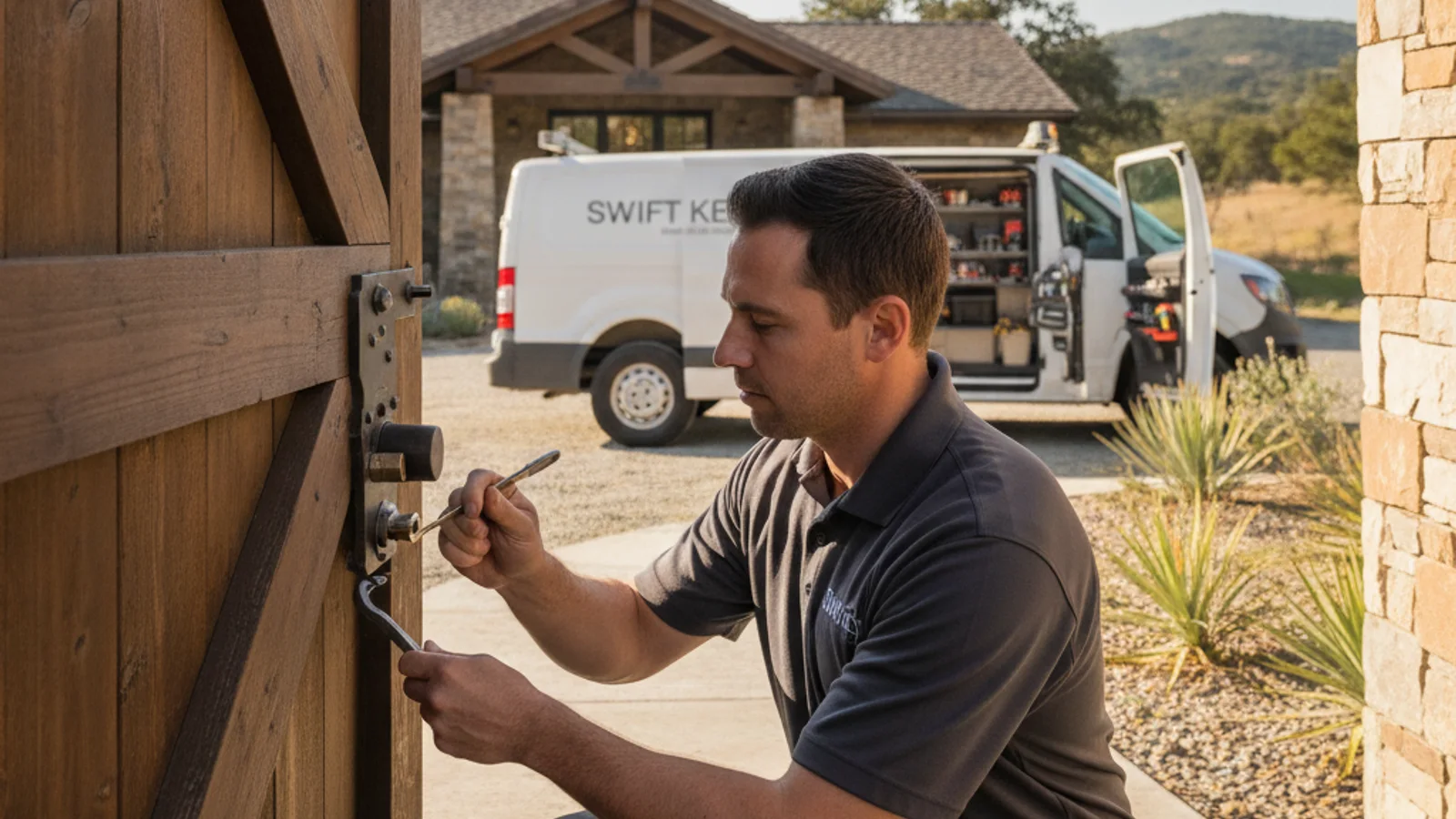
Mobile locksmith in a lavender polo rekeying a gate cylinder at a multi-acre Alpine custom home with oak-covered foothill terrain in the background

What makes Alpine locksmith work different

Alpine is not urban San Diego. It sits in the East County foothills off I-8, roughly 30 miles east of downtown, and the property patterns here are fundamentally different from anything in Mission Valley or North Park.

Most Alpine homes sit on multi-acre lots. A substantial share have multiple structures: main residence, garage, workshop or equipment storage, guest cottage or pool house, and at minimum a driveway gate. Properties with horses add stable access, tack room, and pasture gates to that list. None of that scope fits a standard urban residential rekey where you hand off three keys and you’re done.

The other defining feature is the wildfire-zone context. Alpine sat in the burn path of the 2003 Cedar Fire, which destroyed hundreds of homes across the community. Much of the current housing stock is post-fire rebuild, built to modern construction standards and often upgraded with better hardware than the original pre-fire homes had. Rebuild-era properties frequently include Grade 1 deadbolts, restricted-keyway cylinders, and reinforced strike plates as part of the original build spec. When owners later add an outbuilding, expand a workshop, or add a gate, they need those additions brought into the same coordinated keying scheme.

The combination of larger lots, multiple structures, wildfire-zone awareness, and post-Cedar-Fire rebuild history shapes nearly every project call we get from Alpine.

Coordinated keying for multi-structure Alpine properties

The most common Alpine project is coordinated keying across a full property: main residence, attached or detached garage, workshop, equipment storage, any outbuildings, and all gates, designed so one master key opens everything and separate sub-keys give access to specific areas.

A typical setup for an Alpine custom home with main residence, garage, workshop, guest cottage, and two gates runs eight to fifteen cylinders. The owner holds the master key that opens all of them. Family members hold keys that open the residence and garage. A contractor or service vendor gets a key that opens only the gate and the relevant storage area. Nobody gets access they are not supposed to have.

The first step is an on-site consultation where we walk the property and map every access point. We note what hardware is already installed, what condition it is in, and what access requirements actually exist for each person who uses the property. From that walk we design the keying scheme, then return for installation day to re-pin or replace cylinders across all structures and gates, cut all keys, and hand over written key control documentation.

Lock rekey is usually the right call on existing cylinders that are in good working order. It re-pins the cylinders to fit a new key without replacing the hardware. For worn cylinders or any cylinder that is catching or not turning cleanly, replacement makes sense before it becomes an entry problem.

Fire-zone reinforced hardware and what it actually does

The most-discussed security upgrade in Alpine is the reinforced strike plate, and it is worth explaining why it matters here specifically.

Standard residential strike plates come with 3/4-inch screws that go into the door jamb but not into the wall framing behind the jamb. Under a kick-in attack, those screws pull out of the soft jamb material quickly. The door pops open without much force even if the lock itself is a Grade 1 deadbolt. The lock only helps if the door frame holds.

A reinforced strike plate replaces those short screws with 3-inch screws that go all the way through the jamb and into the structural framing behind it. That makes kick-in attacks substantially harder, which matters for Alpine homes during wildfire evacuations when properties can sit empty for days at a time.

The install is straightforward: remove the existing strike plate, drill out the screw holes to accept longer fasteners, install the reinforced plate, drive the 3-inch screws through into framing. Per-door cost typically runs $40 to $80 including parts. Most Alpine homeowners add reinforced strikes to every entry door as a matter of course, especially on rebuild-era homes that came with upgraded deadbolts but not always upgraded strike hardware.

For properties that went through the Cedar Fire rebuild and have restricted-keyway cylinders or Grade 1 deadbolts on the main residence, safe opening and full security assessments are also available for owners who inherited the rebuild hardware and want to understand what they have.

What heat and dust do to lock hardware in Alpine

Alpine’s elevation (roughly 1,700 to 2,600 feet depending on where you are on the slopes) gives it hot dry summers with temperatures that routinely hit the mid-90s to above 100 in July and August. Dust levels are high relative to coastal San Diego. Both affect hardware over time.

Dust accumulates in cylinder pins and can make a cylinder feel stiff before it actually fails. Lubricating with a dry graphite or PTFE lubricant (not WD-40, which leaves a residue that attracts more grit) once or twice a year clears most dust accumulation. If a key is starting to require more force to turn than it used to, that is worth addressing before the cylinder binds completely.

Heat cycling on exterior hardware expands and contracts metal fittings over time. Gates and outbuilding doors with hardware that is directly sun-exposed tend to show wear faster than interior cylinders. For Viejas-adjacent properties on the eastern Alpine slopes where summer temperatures run highest and wind-blown dust off the Viejas valley floor is a factor, annual hardware checks are worth building into a maintenance schedule.

For any hardware that has reached the point of not turning reliably, home lockout response is available 24 hours if it gets to that point.

Lockout and automotive service for Alpine

Standard Alpine lockout service covers residential, commercial, and automotive. We dispatch for active lockouts and get there as fast as I-8 traffic allows. The honest arrival window is 45 to 65 minutes depending on where you are on the mountain and what the freeway looks like that day.

Viejas-adjacent calls, particularly during the weekends when Viejas Casino traffic on Willows Road and Japatul Road is heavy, can add 10 to 15 minutes on top of the base drive from the freeway. We factor that in when we quote you an ETA, not after we get there.

Cost breakdown for common Alpine service calls:

ServiceTypical range
Residential lockout$85 to $150
Residential lockout (after 10 p.m.)$130 to $195
Lock rekey (per cylinder)$25 to $40
Lock replacement (entry door, installed)$85 to $250
Car key replacement$150 to $450
Safe opening$150 to $600

Rural trip-charge applies to Alpine, Ramona, and other East County foothill addresses. We build it into the quoted total upfront, not as a surprise line item on arrival.

For automotive key work, programming on post-2000 vehicles with transponder keys or proximity fobs is available on-site. The locksmith El Cajon guide has more on East County automotive key ranges if you want a comparison.

Scheduling project work vs. calling for emergencies

For an active emergency, call and we dispatch. For project work, the math is different.

Because the drive from central dispatch to Alpine runs 45 to 65 minutes each way, a reactive trip for a 45-minute project leaves a lot of windshield time billed to your project. Scheduling a dedicated visit for non-emergency project work means we come prepared with the right hardware for your specific scope, give you a confirmed arrival window, and spend the drive time productively on your project rather than making two round trips for something that should have been one.

For property managers or owners handling multiple Alpine-area addresses, we batch service stops into single trips when possible. Call and we will coordinate a visit schedule that covers the full scope in one shot.

The Ramona locksmith guide covers similar scheduling logic for another East County foothill community, if Ramona is also in your service area.

Frequently asked questions

How long does a locksmith take to reach Alpine CA?

Typical response from central San Diego dispatch to Alpine is 45 to 65 minutes via I-8. Traffic on the freeway and your specific location on the Alpine slopes both affect actual arrival time. Viejas-adjacent addresses on Willows Road and Japatul Road can add 10 to 15 minutes during weekend casino traffic. We quote an honest ETA when you call, not a optimistic one.

My Alpine property has a main house, workshop, storage, and multiple gates. Can you key it all together?

Yes. Multi-structure coordinated keying for Alpine custom homes is regular work. We design systems integrating main residence, all outbuildings (workshop, equipment storage, guest cottage, pool house if applicable), all gates (driveway, service, and any pasture or perimeter gates), and any other access points under a single master-key scheme with appropriate tiers for owners, family, and service. Typical Alpine project runs eight to fifteen cylinders at $1,200 to $3,500 depending on scope and hardware grade.

What is a reinforced strike plate and do I need one?

A reinforced strike plate replaces the standard 3/4-inch screws that anchor your strike into the door jamb with 3-inch screws that go into the wall framing behind it. Under a kick-in attack, framing-anchored screws hold where jamb-only screws pull out. For wildfire-zone properties that can sit empty during evacuations, it is one of the highest-value low-cost security upgrades available. Per-door install typically runs $40 to $80 including parts.

My home was rebuilt after the 2003 Cedar Fire. Can you expand the existing security system?

Yes. Post-Cedar-Fire rebuild and security expansion is regular work in eastern and northern Alpine. If your rebuild included Grade 1 deadbolts, restricted-keyway cylinders, or reinforced strike plates on the main residence, we can extend that hardware and keying scheme to cover new outbuildings, gates, or perimeter access you have added since the rebuild. Typical expansion project runs six to twelve cylinders at $1,000 to $3,500.

What does Alpine lockout service cost?

Standard residential lockout during daytime hours runs $85 to $150. After 10 p.m., plan on $130 to $195. A rural trip-charge add-on applies to Alpine addresses and reflects the longer drive from central dispatch. Automotive lockout runs $150 to $450 for key replacement depending on vehicle make and year. We quote the full amount when you call so there are no surprises.

Do you handle safes for Alpine homeowners?

Yes. Safe opening, combination changes, and lockouts are available as part of standard residential service. If you have inherited a safe with an unknown combination or a safe with a dead battery in an electronic lock, those are common and typically resolvable without drilling. Our types of home safes we open post covers what to expect by safe type and weight class. Opening typically runs $150 to $600 depending on safe type and method required.


For locksmith service in Alpine, call us at (858) 925-5546. We dispatch for active emergencies and coordinate scheduled visits for project work. Honest arrival windows, rural trip-charge disclosed upfront, written documentation provided on all keyed systems.