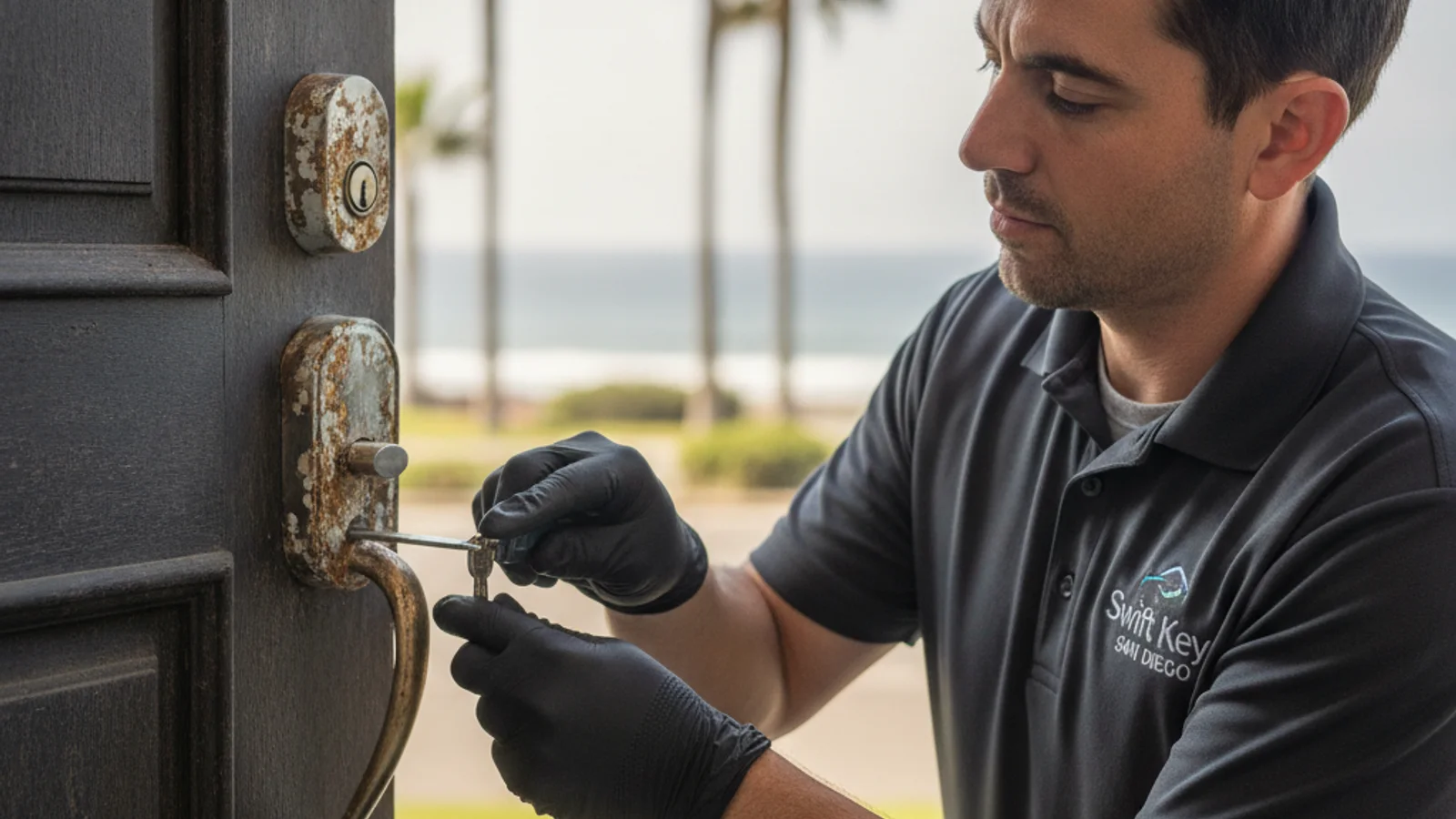
A smart lock on an oceanfront property typically lasts 3 to 5 years before the electronics fail, even when the mechanical deadbolt underneath is still solid. The best options for beach-house use are locks with IP65-rated housings, satin nickel or marine-grade stainless finishes, and fully sealed keypad membranes. For properties within half a mile of the water, expect to maintain them more aggressively than the manufacturer’s generic guidance suggests.
Here’s what the salt air is actually doing to your smart lock, what to look for when you buy, and how to keep one running at the coast.
How salt air fails smart locks differently than mechanical locks
A traditional deadbolt corrodes slowly and predictably. The finish pits, the cylinder stiffens, and eventually the key starts dragging. You can usually see it coming.
Smart locks fail differently, and often faster. The electronics create multiple new failure points that don’t exist in a mechanical lock.
Keypad membrane degradation. The rubber or silicone membrane over the keypad buttons absorbs salt particles from the air. Over time, the membrane hardens, cracks at the edges, and develops micro-perforations that let moisture reach the circuit board underneath. Once moisture reaches the board, keypad failures become erratic, buttons stop registering, and the lock starts behaving unpredictably.
Battery contact oxidation. Battery contacts are typically made from thin steel or brass with a light nickel plating. Salt air attacks the plating, and what’s underneath corrodes quickly. Oxidized contacts create resistance, which drains batteries faster and causes the lock to report low battery even with fresh cells. In bad cases the connection becomes intermittent, and the lock locks itself mid-cycle or won’t respond at all.
Connector and terminal corrosion. The internal wiring harness, motor terminals, and any exposed board contacts are all vulnerable. Even if the housing looks intact, chloride ions in the air work through seams and gaskets. Motor failures are the most common result. The motor physically moves the bolt, so a corroded motor terminal means the lock actuates sluggishly or stops mid-throw.
Housing seam failure. Most smart lock housings are injection-molded plastic with a metal face. The seam between the plastic and the metal, and any seam between front and back housing halves, are entry points for salt-laden moisture. Marine-grade designs solve this with thicker gaskets and sealed screws. Budget locks cut corners here and pay for it in coastal environments.
The result is a lock that may look fine on the outside while the electronics inside are quietly failing. That’s what makes coastal smart lock failure more insidious than mechanical lock corrosion.
What to look for when buying a smart lock for a coastal home
Not all smart locks are built for salt air. Here’s what actually matters, and what marketing language to ignore.
| Feature | Why it matters at the coast |
|---|---|
| IP65 or higher housing rating | IP65 means dust-tight and protected against low-pressure water jets from any direction. Anything below IP54 will struggle within half a mile of the water. |
| Sealed keypad membrane | Look for a one-piece molded membrane without exposed seams. Separate rubber button caps are a failure point. |
| Satin nickel or marine-grade stainless finish | See the finish section below. The housing metal matters, not just the color. |
| Marine-grade internal components | Some manufacturers (Schlage, in particular, on their higher-end Encode models) use treated internal components. Check the spec sheet, not the marketing copy. |
| Physical key backup cylinder | When the electronics fail, a quality Grade-1 mechanical cylinder is what keeps you from being locked out. Don’t buy a lock without one. |
| Wi-Fi vs. Z-Wave vs. Bluetooth | Irrelevant to salt air resistance. Don’t let connectivity features distract from housing quality. |
Finishes and what they mean at the coast. This is where a lot of buyers get confused by aesthetics versus function.
Satin nickel holds up better than polished nickel at the coast. The satin texture scatters light rather than reflecting it, which matters because satin finishes typically have a thicker, more uniform plating than polished versions. Polished nickel is achieved partly by buffing, which thins the plating in high spots.
Oil-rubbed bronze is a lacquered finish over brass or zinc. The lacquer provides some initial protection, but it scratches and chips, and once it’s compromised, bare brass or zinc corrodes quickly in salt air. For oceanfront properties, oil-rubbed bronze requires more maintenance than satin nickel and has a shorter finish lifespan.
Matte black is typically a powder-coat or PVD finish over the base metal. PVD (physical vapor deposition) is significantly more corrosion-resistant than powder coat. If a lock lists “matte black” without specifying PVD, assume powder coat and expect finish degradation within a few years oceanfront.
Marine-grade stainless (316 alloy) is the most durable option available. It’s also the least common in consumer smart locks. A few commercial-grade smart locks use it; for most residential buyers, IP65 satin nickel is the practical ceiling.
For a comparison of the leading smart lock options available in San Diego right now, including how Schlage, Yale, and Kwikset stack up on hardware quality, see our 2026 smart lock comparison.
Maintenance schedule for coastal smart locks
Generic smart lock maintenance advice is written for inland homeowners. The coast needs a different schedule.
Every 3 months:
- Wipe down the exterior housing with a slightly damp cloth, then dry immediately. Salt accumulates on the surface and works into seams over time.
- Inspect the keypad membrane for cracks, stiffening, or lifting at the edges. If the edges are starting to peel from the housing, reseal with a thin bead of silicone.
- Check the battery bay cover seal. The rubber gasket around the battery door compresses over time. If it looks flattened or cracked, replace it before it fails.
Every 6 months:
- Replace batteries regardless of the reported level. Salt-corroded contacts give you false readings. Fresh batteries every six months cost a few dollars and prevent a lot of inconvenience.
- Apply a thin coat of silicone spray (not WD-40, which attracts dust) around the housing seams and the keypad perimeter. Silicone repels water without damaging plastics.
- Test the physical key cylinder. Insert and turn the key. If there’s any drag, apply graphite lubricant to the keyway. The cylinder is your backup if the electronics fail; it needs to work.
Annually:
- Inspect all visible battery contacts for white or green oxidation. If you see it, clean the contacts with a cotton swab dipped in isopropyl alcohol, then let fully dry before reinstalling batteries.
- Check the mounting screws. Salt air oxidizes screw heads and can cause them to seize. Loosen and re-tighten each screw, and apply a drop of anti-seize compound if the heads are showing corrosion.
- Review your lock’s firmware. Smart lock manufacturers release updates that can address motor efficiency and battery management. An up-to-date lock runs more efficiently and lasts longer.
For context on how these maintenance practices fit into the broader picture of lock lifespan, see how long a lock should last in San Diego.
Distance bands and honest expectations
Location from the water is the single biggest variable in coastal hardware lifespan. Typical expectations across San Diego County look like this.
Oceanfront (under 0.5 miles from the water)
This covers homes in Coronado directly on the bay, Imperial Beach, the bluff-side streets of Encinitas and Solana Beach, and beachfront properties in Del Mar, Carlsbad, and Oceanside.
Standard smart locks from big-box stores typically show keypad and battery contact failures within 2 to 4 years here. The marine layer is heavy, direct salt spray is possible on windy days, and humidity stays elevated year-round.
With IP65-rated locks, sealed membranes, and the 6-month maintenance schedule above, you can reasonably expect 5 to 8 years. Marine-grade hardware from commercial suppliers can push 10-plus years, but it comes at a significant cost premium and requires installation by someone familiar with it.
Near-coastal (0.5 to 2 miles from the water)
This covers the majority of Encinitas, most of Carlsbad, inland Solana Beach, La Jolla, Pacific Beach, and similar neighborhoods. The salt load is meaningfully lower than the oceanfront tier, but it’s still present.
Standard smart locks usually last 5 to 7 years here before electronics begin failing. IP65 locks with annual maintenance can reach 8 to 12 years. This is the tier where most San Diego homeowners can get reasonable life from a consumer smart lock if they maintain it.
Inland San Diego (2+ miles from the water)
Escondido, El Cajon, Santee, Poway, and similar inland communities see standard smart lock lifespans of 7 to 10 years, consistent with manufacturer expectations. The main environmental challenge here is thermal cycling rather than salt, which mainly affects plastic parts over very long timescales.
For more detail on how the coastal corrosion gradient affects conventional deadbolts and hardware across San Diego, see our guides on coastal home locksmith service in Encinitas and coastal home locksmith service in Carlsbad.
When to repair vs. replace a failing coastal smart lock
Not every failure means a full replacement. Here’s how to triage.
Repair is worth attempting when the failure is isolated to battery contacts, a loose housing screw, or a deteriorated membrane seal. Those are small hardware-store parts and a few minutes of work. If the mechanical deadbolt is solid and the electronics are the only issue, cleaning the contacts or resealing the housing can buy another year or two.
Replacement makes more sense when the motor fails (the lock won’t actuate), the circuit board has visible corrosion damage, or the keypad has become consistently unreliable. At that point, ask the locksmith to compare a repair quote against a full replacement. You may be putting repaired electronics into a housing that’s already been compromised by the environment.
Upgrade when replacing. If your existing lock lasted 4 years oceanfront, replacing it with an identical model is likely to produce the same result. Use the replacement as an opportunity to move up to an IP65-rated lock with a sealed membrane. A Schlage Encode-class housing costs more at retail than a basic Kwikset smart lock. The extra years on the Encinitas or Coronado side of the county are usually the reason people pay it.
The smart lock installation page is how we connect San Diego County callers with licensed independent locksmiths. Ask that professional to look at your distance from the water and the door’s exposure before you buy. Swift Key does not inspect doors or pick the hardware for you.
If your smart lock has failed to the point where you’re locked out, or if the mechanical cylinder has also seized, that’s a lock replacement situation. The matched locksmith quotes the work.
Frequently asked questions
Do smart locks hold up near the ocean?
They can, but only with the right hardware and regular maintenance. Consumer smart locks sold at home improvement stores are not built specifically for salt air and will typically show electronics failures within 3 to 5 years at oceanfront properties. IP65-rated locks with sealed keypad membranes and satin nickel or marine-grade finishes hold up significantly better, especially with a 6-month maintenance routine.
How long does a smart lock last at the beach?
At oceanfront properties (under 0.5 miles from the water), plan on 3 to 5 years for a standard consumer smart lock before electronics fail. An IP65-rated lock with consistent maintenance can reach 5 to 8 years. Near-coastal properties 0.5 to 2 miles out will see 5 to 7 years from standard hardware and 8 to 12 from well-rated options.
What finish is best for coastal door hardware?
Satin nickel is the most practical choice for most residential smart locks near the coast. It has thicker, more uniform plating than polished nickel and holds up better than oil-rubbed bronze (which is lacquered brass) or standard matte black (which is usually powder coat). If you can find a lock with PVD matte black or marine-grade stainless components, those are more durable, but they’re rare in consumer smart locks and carry a significant price premium.
Why are smart lock batteries dying faster at my beach house?
Oxidized battery contacts are usually the cause. Salt air corrodes the thin plating on battery contacts, creating electrical resistance that drains batteries faster and produces inaccurate low-battery readings. Clean the contacts with isopropyl alcohol and a cotton swab, switch to fresh batteries, and check whether the battery door gasket is still sealing properly. Switching to a 6-month battery replacement schedule regardless of reported level will prevent most battery-related lockouts.
Can I replace just the electronics on a corroded smart lock?
Some smart lock manufacturers sell replacement circuit boards or motor assemblies. In practice, by the time electronics are failing due to salt corrosion, the housing seams and gaskets have usually also been compromised, meaning new electronics in the same housing will corrode at a similar rate. A full lock replacement is usually the better investment at that point, especially if you upgrade to a better-rated housing.
Should I use a smart lock or a standard deadbolt at my beach house?
For a primary residence where the convenience of remote access and activity logs matters, a quality smart lock with the right housing rating is a reasonable choice if you’re willing to maintain it. For a vacation property or secondary entrance where you just need reliable, low-maintenance security, a Grade-1 mechanical deadbolt in marine-grade stainless or solid brass will outlast any smart lock at the coast with far less maintenance.
Questions about which smart lock makes sense for your property? Swift Key San Diego is a referral service. Call (858) 400-4082. You contract with the locksmith. That locksmith discusses hardware and quotes. Swift Key does not.