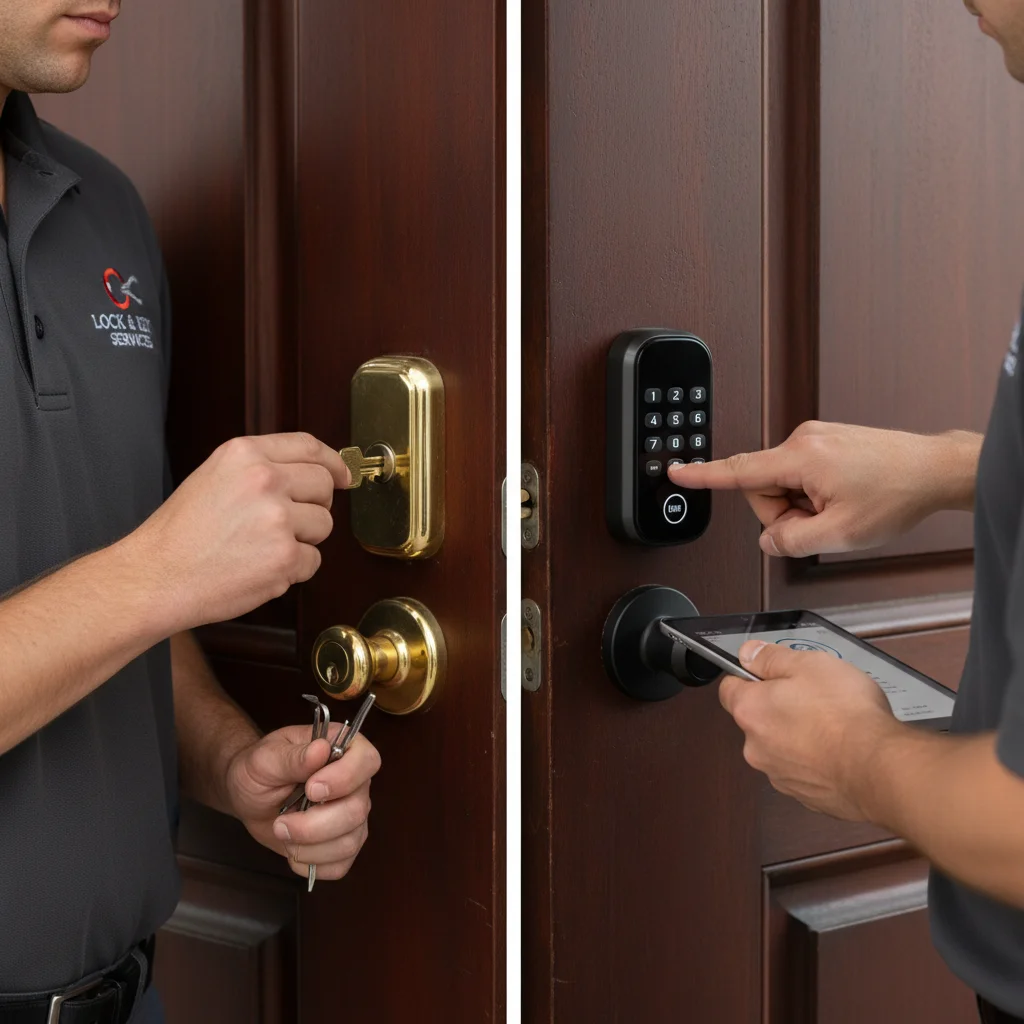
You’re replacing a lock and suddenly the options split in two directions. One path leads to a familiar deadbolt you’ve trusted for decades. The other leads to a keypad, an app, and a monthly subscription you didn’t expect. Both claim to be the safe choice. Here’s an honest look at how they actually perform when it counts.
How each lock type fails in real break-ins
Most forced entries aren’t subtle. According to SDPD crime statistics, the overwhelming majority of residential burglaries involve kicking a door in or breaking a window, not picking a lock. That matters a lot for this comparison.
A standard deadbolt fails at the door frame, not the cylinder. The bolt throws fine, but a single hard kick splits the door jamb if the strike plate is only held in by half-inch screws. Upgrading to a Grade 1 deadbolt with a reinforced strike plate and 3-inch screws into the stud changes the math entirely. The hardware itself rarely loses, the framing around it does.
Smart locks fail differently. The lock body is usually solid, but the attack surface is wider. Bluetooth sniffing, credential replay attacks, and brute-force PIN entry are all documented. More practically, a smart lock still mounts in the same door bore as a traditional lock, which means the same kick-in vulnerability applies unless the door frame is reinforced. The lock’s electronics don’t add structural resistance.
There’s also a failure mode that doesn’t involve criminals at all: a dead battery at midnight after a long shift. Deadbolts don’t have that problem.
Neither lock type is immune to physical attack. The question is which vulnerabilities matter most for your specific door, neighborhood, and habits.
ANSI grading explained without the jargon
ANSI/BHMA grading is the closest thing the lock industry has to an objective test. Three grades. Grade 1 is the highest. Here’s what the ratings actually mean for the hardware you’re buying.
Grade 1, tested to 250,000 open/close cycles and designed to withstand a 360-pound door strike force. This is the standard for commercial buildings and the one worth buying for a San Diego front door. Our guide to choosing a Grade 1 deadbolt goes deeper on what to look for on the packaging.
Grade 2, 150,000 cycles, lower strike resistance. Fine for interior doors or secondary entries with low foot traffic.
Grade 3, 100,000 cycles. The grade you’ll find on most builder-grade hardware. Replace it.
Here’s where smart locks get complicated: the grading applies to the mechanical components, not the electronics. A smart lock can carry a Grade 1 deadbolt mechanism while the keypad firmware is completely unaudited. When you’re comparing options, look for the ANSI grade on the bolt itself, then evaluate the software security separately. Some manufacturers publish third-party security audits. Many don’t.
Smart lock vulnerabilities buyers overlook
The convenience of a smart lock is real. Access logs, remote locking, temporary codes for housekeepers, these aren’t gimmicks. But a few weaknesses don’t get enough airtime in the marketing materials.
Bluetooth and Z-Wave range. Most smart locks communicate over Bluetooth LE or Z-Wave. Range is typically 30–100 feet depending on walls and interference. If your hub goes down or your phone dies, access falls back to a physical key or a keypad backup. Not a dealbreaker, but worth planning for.
Firmware and app security. Your lock is now software. Software has vulnerabilities. Unlike a deadbolt, which works exactly the same the day you install it as it will in 20 years, a smart lock depends on the manufacturer continuing to push security patches. Brands that get acquired, go quiet, or sunset their apps leave you with hardware that slowly becomes a liability.
Shared credentials. Handing a PIN to a contractor means that PIN exists forever unless you remember to delete it. Deadbolts require a physical key copy, that’s a friction point that actually protects you.
Power dependency. Most smart locks run on AA batteries and warn you when power is low. Still, a depleted battery during a late arrival is a real scenario. Our smart lock troubleshooting post covers battery and connectivity fixes, but prevention beats troubleshooting.
For a broader look at which models have held up in 2026, see our best smart locks 2026 roundup.
When a hybrid setup makes the most sense
The honest answer to “smart lock or deadbolt” is often: both, stacked.
Many smart locks are designed as deadbolt replacements, they occupy the same bore hole and throw a physical bolt. But you can also run a smart lock on one deadbolt and a traditional keyed deadbolt directly above or below it. That’s a common setup for San Diego homeowners who want app access for family members but don’t want their security depending entirely on a battery and a Wi-Fi connection.
A hybrid setup also makes sense when:
- You rent out a room or unit on a short-term basis and need to rotate access codes frequently
- You have older family members who don’t use smartphones and need a physical key backup
- Your door faces direct sun exposure, coastal and inland San Diego both see UV and heat that can degrade keypad surfaces faster than manufacturers suggest
- You’ve already had one break-in attempt and want layered deterrence (our post on the 24 hours after a break-in covers what to prioritize)
Two locks on one door look like more work to a burglar casing a street. That’s not a guaranteed deterrent, but it’s not nothing either.
A practical San Diego baseline
San Diego’s climate is generally mild, but salt air near the coast accelerates corrosion on exposed hardware. In neighborhoods like Ocean Beach, Mission Hills, or Pacific Beach, a deadbolt finish that holds up to humidity matters. Look for ANSI Grade 1 hardware with a satin nickel or stainless finish over polished brass.
For most single-family homes in San Diego County, a solid baseline is a Grade 1 deadbolt on every exterior door, not just the front. Side and garage entry doors are consistently where San Diego burglary data shows forced entry occurring. A smart lock on the primary entry is a reasonable add-on once the mechanical foundation is solid.
If you’re considering a smart lock, prioritize models with:
- A certified ANSI Grade 1 deadbolt mechanism
- Published security audit history
- Local Bluetooth access that doesn’t require cloud connectivity to function
- A physical key override
Don’t buy a smart lock because it looks good in the listing photos. Buy it because the access management features solve a real problem in your household.
The deadbolt installation page connects you with independent locksmiths who can quote single and double cylinder options with a reinforced strike. If you’re going the electronic route, smart lock installation is the matching page. Ask that locksmith to check existing door prep before they start.
Installation: DIY pitfalls vs. professional fit
Both lock types look straightforward on a YouTube tutorial. The part the video skips is the door itself.
Older San Diego homes, Craftsman bungalows in North Park, mid-century ranches in Clairemont, often have non-standard door prep. The bore hole diameter, backset distance, and door thickness all need to match the lock hardware exactly. A smart lock keypad that sticks out past the door edge because the backset is wrong won’t seat properly against the door stop. That creates a gap that weakens the throw.
Strike plate installation is the other area that goes wrong quietly. A properly installed Grade 1 deadbolt with a cheap strike plate screwed into the door casing (not the stud behind it) still fails on a kick. The lock is only as strong as its mounting. Reinforcing a door frame properly means removing the existing strike plate, chiseling a deeper mortise, and running 3-inch screws into the structural framing, straightforward if you know what you’re doing, a frustrating afternoon if you don’t.
Smart locks add a layer: the door needs to close and latch consistently for the auto-lock feature to work reliably. A door that’s slightly out of square, common in homes that have settled, will cause the bolt to bind. That’s a lock replacement scenario that could have been caught during installation.
The ALOA Security Professionals Association sets the training standards most licensed locksmiths follow. A licensed installer brings a level set on door prep, strike reinforcement, and hardware compatibility that a box-store install guide doesn’t cover.
Frequently asked questions
Can a smart lock be hacked or bypassed remotely?
Yes, in documented cases, though real-world frequency is low. Bluetooth sniffing, credential replay attacks, and brute-force PIN entry are all established attack vectors. The bigger risk in practice is a shared PIN that never gets deleted when a contractor or housekeeper stops coming around. A traditional deadbolt has no remote attack surface at all. If you go smart, prioritize models with a published third-party security audit and local Bluetooth access that doesn’t require cloud connectivity to function.
Does a smart lock make my door more resistant to being kicked in?
No. A smart lock mounts in the same door bore as a traditional deadbolt and adds no structural resistance to the door frame. Most break-ins in San Diego involve kicking the door jamb, not the lock itself. What matters is a Grade 1 deadbolt bolt paired with a reinforced strike plate using 3-inch screws into the stud behind the door casing. Neither a smart lock nor a standard deadbolt fixes a weak frame on its own.
What’s the best setup for a San Diego rental property or Airbnb?
A Grade 1 smart deadbolt on the primary entry. You get the structural security of a Grade 1 bolt plus the ability to rotate access codes between guests without a locksmith visit. For guests who don’t use smartphones, a keypad code is simpler than a physical key exchange. Keep a backup physical key override somewhere secure off-site.
Should I put a smart lock on every exterior door?
Most San Diego homes don’t need it on every door. The highest-value placement is the primary entry where access management matters most. Secondary doors like garage entries and side gates are adequately covered by Grade 1 traditional deadbolts. A locksmith can quote a reinforced strike on any door where you’re not going electronic. See deadbolt installation.
How does San Diego’s climate affect smart lock durability?
Salt air near the coast accelerates corrosion on exposed metal components and keypad surfaces. Homes within a mile of the water in areas like Ocean Beach, Mission Hills, and Pacific Beach should look for smart locks rated for outdoor or coastal exposure. Direct sun in inland areas like Santee or El Cajon degrades keypad backlighting faster than manufacturers suggest, so a UV-resistant finish rating matters there too.
Get a locksmith quote
You do not have to choose one outright: a smart deadbolt with a keyed backup keeps a physical cylinder for the day the batteries die. If you’re replacing an exterior lock, whether it’s a traditional deadbolt, a smart lock, or both, the installation details matter more than the hardware choice. A properly installed Grade 2 lock beats a poorly installed Grade 1 every time. Call (858) 400-4082 to connect with a licensed independent locksmith. That locksmith quotes. Swift Key does not quote.