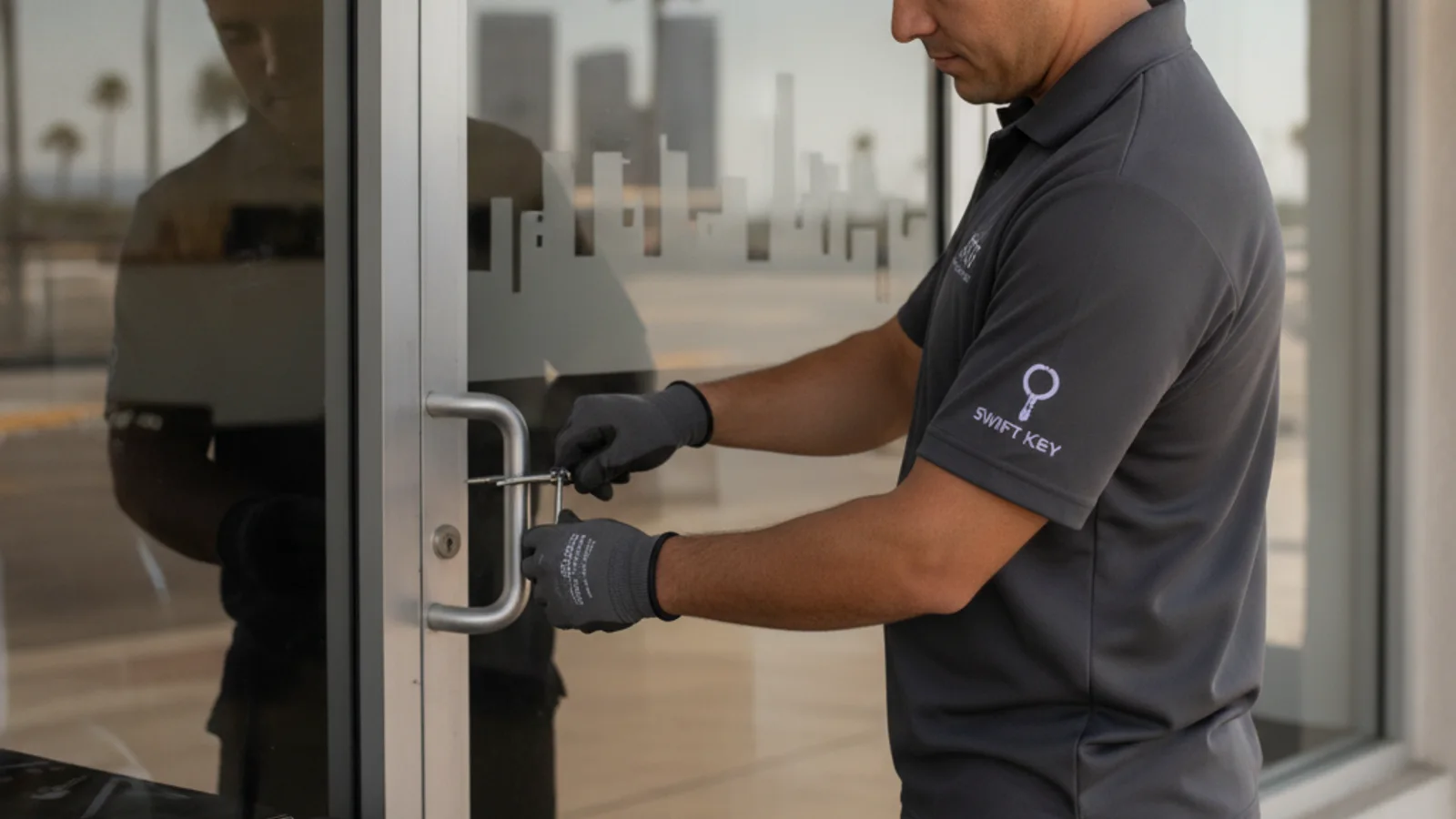
Most storefront door lock failures are straightforward to repair. You don’t usually need a new door, and you rarely need a new lock body. What you need is someone who understands the hardware family that lives inside aluminum and glass commercial doors, because it’s not the same as a residential deadbolt. The independent locksmith quotes parts and labor after they see the stile.
If you’re standing in front of your shop and the door won’t open or won’t latch, here’s what’s likely going on and what a repair actually looks like.
Your door’s hardware explained
Almost every retail strip in San Diego, from Hillcrest to Chula Vista, uses the same basic door format: a narrow-stile aluminum frame with a large glass panel. The frame is thin by design, which means there’s no room for a standard cylindrical lock body like you’d find on a home.
Instead, these doors use a mortise-style lock body that fits inside the door’s narrow stile. The most common hardware family is patterned after the Adams Rite design, which has been the storefront standard for decades. You’ll see these locks on everything from small sandwich shops to multi-unit professional suites.
Here’s how the system works at the owner level:
The lock body sits recessed inside the aluminum stile. It contains the latch mechanism and, if the door has a deadbolt function, a separate bolt as well.
The latch type matters. Storefront locks use either a deadlatch (a spring-loaded latch with a guard that prevents push-back attacks) or a hook bolt (a curved bolt that hooks into the strike rather than punching straight through). Hook bolts are common on sliding-style storefront doors; deadlatches are more common on swinging single doors.
Paddle handles connect to the latch through a cam or linkage inside the body. When you push the paddle down, it retracts the latch. When you let go, the latch springs back out.
The cylinder is a standard mortise-format cylinder that threads into the face of the lock body. This is the piece you put your key into. Because it’s a mortise cylinder, it rekeys the same way most commercial cylinders do: a locksmith removes it with a spanner wrench and changes the pin stack.
Exit devices and concealed rod systems handle the push-to-exit side on doors that need to meet egress code. The rod runs vertically inside the frame and connects to top and bottom latches. These are separate from the keyed entry cylinder.
Knowing this matters because the failure modes are specific to each component, and so are the repairs.
The five common failures
| Symptom | Likely cause | Typical repair |
|---|---|---|
| Latch won’t retract, door is stuck locked | Worn paddle cam or broken linkage inside the body | Paddle assembly or cam replacement |
| Door won’t stay latched, swings open | Hook bolt misalignment from door sag or worn pivot | Strike adjustment or pivot replacement |
| Key turns but nothing moves | Loose set screw letting cylinder spin freely | Cylinder reseat with new set screw |
| Key snaps inside the cylinder | Worn cylinder with tight tolerances and a fatigued key | Broken key extraction plus cylinder rekey |
| Door binds at the top or bottom and latch won’t line up | Threshold or floor pivot wear, door is dropping | Pivot adjustment or replacement |
A few notes: after-hours work is the locksmith’s surcharge to quote. If the door itself is bent from a break-in or a vehicle impact, the lock work is separate from the door or glass repair.
Repair vs. replace: the honest breakdown
The question owners usually ask is whether they should repair or replace the entire lock body. For most failures on a functional door, repair is the right call. Here’s when each makes sense.
Repair is usually right when:
- The door frame and body are structurally sound
- The failure is a single worn component (paddle cam, cylinder, pivot)
- The lock body itself isn’t cracked or missing pieces
- The door was working fine until a specific incident
Replacing just the deadlatch assembly or hook bolt is usually a parts-and-labor job, not a new door. That’s a fraction of what a new storefront costs.
Replacement of the lock body makes sense when:
- The body is cracked, corroded, or the mechanism is seized beyond repair
- You want to upgrade to a higher-security cylinder grade
- You’re changing key systems at a tenant turnover (see our guide on commercial lock rekey for tenant turnover)
- The hardware is original to a 30-year-old building and parts are hard to source
Door replacement is almost never needed for a lock failure. If someone tries to sell you a new door because the lock is broken, get a second opinion. Aluminum storefront doors are durable and the lock bodies are designed to be serviceable components.
One situation where the decision gets more complicated: if the lock body needs replacement and the door has an unusual stile width or older proprietary hardware, sourcing the right part takes more time. A locksmith familiar with storefront hardware will know what’s cross-compatible and what isn’t.
The morning lockout scenario
A common storefront hardware call is some version of the same thing: it’s 8 or 9am, a business owner or their first employee is standing outside, and the door won’t open.
Usually it’s one of three things. The latch mechanism failed overnight, often from a worn paddle cam that finally gave out. The door sagged enough that the hook bolt or latch is no longer hitting the strike correctly. Or someone locked a thumbturn deadbolt from inside before leaving through another exit, and now the key cylinder alone won’t retract it.
In all three cases, ask the locksmith what method they expect before they start. Opening without marking the stile is a goal, not a promise. Independent locksmiths often carry the most common Adams Rite-pattern replacement parts. If the paddle assembly is gone or the latch mechanism has seized, they should say whether they can finish on that visit or need a part.
If you’re locked out right now, call (858) 400-4082. Swift Key San Diego is a referral service. You contract with an independent locksmith. That locksmith quotes. Swift Key does not.
For more on commercial lockouts including after-hours situations, see our post on business lockouts after hours in San Diego.
Break-in response: the lock side of the work
After a smash-and-grab or a forced entry, the glass gets the most attention because it’s visible. But the lock work matters just as much.
When an entry door is forced, the lock body often takes damage even if it’s not obvious: a bent strike plate, a deadlatch that’s been pushed back past its stop, or a cylinder that was drilled or pulled. If you board up the glass and don’t address the lock, you don’t actually have a secured door.
Here’s how the work divides:
- The glazier or glass company handles the panel replacement and frame repair if the aluminum is bent.
- The locksmith handles the lock work: new cylinder, new latch mechanism if it was compromised, strike repair or replacement, and a function test before they leave.
These can often happen in the same window, especially if you call both trades at once. The locksmith can work around a glass crew without getting in each other’s way.
If the break-in happened overnight, call your glass emergency line and a locksmith at the same time. Don’t wait until the glass is fixed to address the lock. Swift Key can connect you at (858) 400-4082. The locksmith still quotes their own work. For a broader picture of what to do after a forced entry, see our post on the first 24 hours after a break-in.
Documenting the lock damage with photos before any repair is useful for insurance claims. The locksmith can note what was found and what was replaced in writing if you need it for your carrier.
Maintenance that prevents the 8am call
Storefront locks don’t need much, but a little attention goes a long way. Many of the failures below can be caught with basic periodic checks.
Closer adjustment is the most overlooked item. If your door closer is pulling the door shut too hard, or not holding it closed against wind pressure, the latch and strike are taking repeated impact stress. A closer that’s adjusted correctly extends the life of every component downstream.
Quarterly latch checks take two minutes. Push the paddle, watch the latch retract smoothly, and confirm it springs back fully when you release. If it’s sluggish or catches, that’s the paddle linkage starting to wear. A small amount of dry lubricant on the latch body and cam helps, but if it’s physically sloppy or loose, it’s time for service before it fails completely.
Pivot and hinge inspection twice a year catches door sag early. If you notice the door is harder to open in one direction, or if the top gap isn’t even, the pivot is wearing or the hinge is loosening. Catching it early is often a short adjustment. Waiting until the hook bolt can’t find its strike is a more involved job.
Cylinder care: if your key is getting harder to insert or feels tight in the cylinder, don’t force it. That’s a worn cylinder or a bent key. A cylinder rekey or replacement is far cheaper than extracting a snapped key from a commercial lock.
Connecting this maintenance to your service schedule makes sense. Many San Diego retail operators who rekey at tenant change (see commercial lock rekey for tenant turnover) also use that visit to inspect the hardware state and address anything marginal before the new tenant moves in. It’s a good use of the same service call.
Frequently asked questions
Who repairs storefront glass door locks?
A commercial locksmith handles storefront door lock repair. Residential locksmiths don’t typically stock or service Adams Rite-pattern mortise hardware. When you call, confirm they work on commercial aluminum storefront doors, not just residential deadbolts.
How much does storefront lock repair cost?
A cylinder reseat or worn paddle cam is usually the lighter job. A full deadlatch body replacement or a pivot overhaul on a heavy door is heavier. After-hours and weekend work is the locksmith’s premium to quote. Ask for parts and labor as separate lines before they start.
Can a storefront door lock be rekeyed?
Yes. The cylinder in a storefront door is a standard mortise-format cylinder, which rekeys the same way most commercial cylinders do. A locksmith removes it with a spanner wrench and replaces the pin stack to match a new key. Rekeying is quoted per cylinder. If you need to rekey multiple units at once, such as after a tenant change, see our guide on commercial lock rekey for tenant turnover.
What is an Adams Rite lock?
Adams Rite is a manufacturer that produces the narrow-stile aluminum door hardware that’s become the storefront standard. When people say “Adams Rite-pattern,” they mean the family of mortise lock bodies designed to fit in narrow aluminum stiles, including the MS-series deadlatches and hook bolts. Other manufacturers make compatible hardware, so the Adams Rite name is commonly used as a general descriptor for the hardware family even when a different brand is installed.
Can I repair a storefront door lock myself?
The cylinder swap is straightforward if you have a spanner wrench and the right replacement cylinder. Beyond that, storefront lock body work gets technical quickly. The linkage between the paddle and the latch cam, and the engagement between the bolt and strike, both require precise fitting. An improper repair often means the door appears to function but fails under real use. For anything beyond applying lubricant, a commercial locksmith is the right call.
How long does a storefront lock repair take?
A simple cylinder replacement or latch adjustment is on the shorter end. Replacing a full deadlatch body or repairing storm damage takes longer, especially if parts compatibility needs to be confirmed before starting. Independent locksmiths carry common Adams Rite-pattern components with them so most repairs don’t require a return visit.
For storefront door lock repair in San Diego County, call (858) 400-4082. Swift Key matches you with a licensed independent locksmith. After-hours availability is that locksmith’s to confirm. See commercial locksmith and emergency locksmith for the job types we match.