You felt it when the Schlage key stopped at the Kwikset slot. A current Schlage deadbolt does not have a SmartKey like Kwikset. Schlage residential cylinders are typically pin tumblers, Kwikset SmartKey is a wafer-style system with its own learn tool, and the two brands still need matching keyways before they share one key.
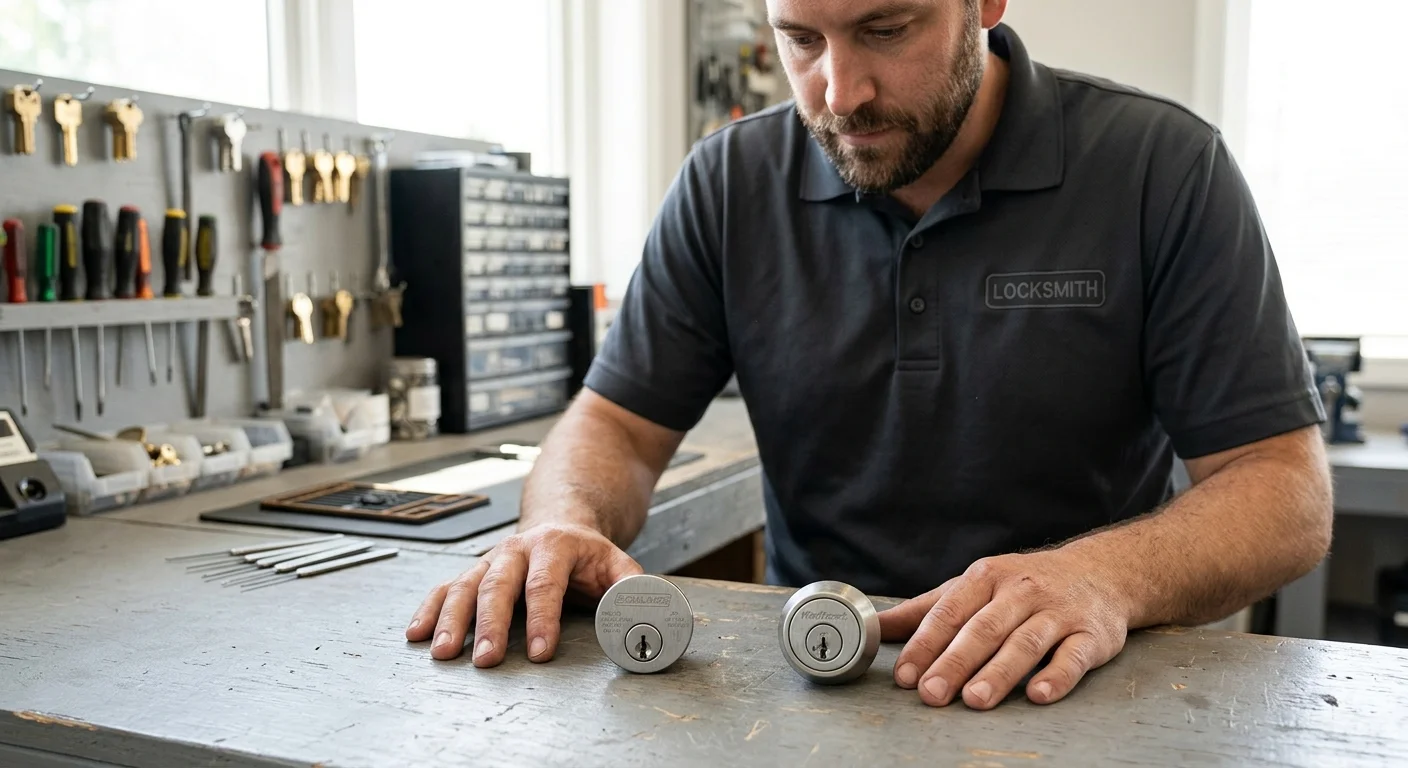
Separate SmartKey from a standard rekey
SmartKey is a Kwikset product name. In San Diego it often gets used as a catch-all for any lock someone hopes to change at the kitchen table. That mix-up is how a Schlage deadbolt meets the wrong tool.
A standard rekey keeps the hardware on the door and changes the combination inside the cylinder. On a pin tumbler, that means new pins and springs so a new key works. The old key stops working. That is the work a licensed locksmith does on a typical Schlage cylinder. It is also the work behind most lock rekey calls after a move, a roommate change, or a lost spare.
Kwikset built SmartKey for a different motion. The current working key and Kwikset’s learn tool are part of that design. The cylinder is meant to accept a new Kwikset key without a pin kit. That process lives in Kwikset’s instructions for the exact SmartKey model on the door. It does not transfer to a Schlage plug.
A smart lock is a third category. Electronics on the inside do not turn a Schlage keyway into SmartKey. Many Schlage electronic deadbolts still use a mechanical pin cylinder as the keyed backup. The mechanical side still takes a Schlage rekey, which we cover in rekeying an existing smart lock.
The usual local failure is a mixed door. A Pacific Beach bungalow gets a new Kwikset SmartKey knob. The Schlage deadbolt above it stays put. The owner expects one learn-tool session to update both. The SmartKey side may follow Kwikset’s design. The Schlage side still needs pin work, or a cylinder that matches the key you want to keep.
If the lock face, the manual, or the current spec sheet does not say SmartKey, treat it as a standard cylinder. Forcing a Kwikset tool into a Schlage deadbolt is how a working lock becomes a parts run.
What Kwikset SmartKey is built to do
Kwikset designed SmartKey so the person who already controls the lock can change keys without pulling the cylinder. The stated use cases are ordinary: a lost spare, a tenant leaving a Clairemont rental, a closing on a Mission Valley condo. The current working key is part of the design. The learn tool is part of the design. A new Kwikset key on the correct blank is part of the design.
This page will not walk through the click sequence. That process belongs to the current Kwikset instructions for the exact model. If you do not have the working key, or the cylinder will not accept the tool, stop. That is locksmith work.
Inside, SmartKey is a wafer and sidebar style cylinder, per Kwikset’s own product materials. That is why a locksmith cannot treat it like a Schlage pin plug. The keyway shape is different. The internal parts are different. A Schlage key will not enter it.
SmartKey also does not merge two brands into one system. A SmartKey deadbolt can be set to a new Kwikset key. A Schlage deadbolt on the back door will ignore that key until someone changes the Schlage pins to a matching Schlage blank, which is a different blank. The one-key limit is the whole subject of Schlage and Kwikset locks on one key.
Coastal air does not care which system you bought. Salt on an Imperial Beach slider or a street-level door in Ocean Beach will gum any cylinder. Inland heat in El Cajon can swell a door until the bolt drags. If a SmartKey lock feels gritty, or the key lifts out too easily, have a locksmith inspect it before anyone leans on the tool.
Confirm the face stamp and the current Kwikset spec sheet. Kwikset also sells traditional pin cylinders. Not every Kwikset on a San Diego door is SmartKey. Read the model, then pick the process that matches it.
What Schlage cylinders actually use
A common residential Schlage deadbolt is a pin tumbler cylinder. The key is usually a Schlage C keyway, often cut on an SC1 blank for five-pin residential work. Commercial lines and some high-security Schlage families use other keyways. Check the key in your hand, the cylinder stamp, and the spec sheet for that SKU. Do not assume every Schlage in the county is a C keyway.
Rekeying that cylinder is pin work. A locksmith licensed by California’s Bureau of Security and Investigative Services (BSIS) decodes or dumps the pin stack and sets it to a new key. You can verify a license with the state. There is no current Schlage learn tool that mirrors Kwikset SmartKey on the residential pages a homeowner would use. Schlage did market a user-rekeyable line called SecureKey in an earlier generation. A current Schlage deadbolt SKU that uses a Kwikset-style wafer and learn tool could not be confirmed for this page. If your lock says SecureKey, the model number and Schlage’s current spec for that SKU are the source of truth.
How to identify the Schlage model
Look at the interior thumbturn housing, the latch face, the original box, and the head of the key. Schlage often casts its name into the interior assembly. Model families you will see on San Diego doors include mechanical deadbolts and electronic units with a keyed backup. Write the number down before anyone orders parts. A mechanical B-series deadbolt and an Encode-style unit do not take the same service path.
About 49.6% of homes in the city of San Diego were built before 1978. That older stock is where mixed hardware hides: a builder Kwikset on the knob, a later Schlage deadbolt added after a scare, maybe a smart lock on a North Park garage man-door. Encinitas beach cottages pick up salt and sandy grit in the keyway. El Cajon entries bake, rack, and drag the bolt. Same county, different cylinder problems. The locksmith has to see both locks.
Grades are on the spec sheet
Schlage sells locks in more than one ANSI / BHMA grade. Grade 1, Grade 2, and Grade 3 are lab ratings for the hardware. They are not a promise that a hollow slab in City Heights will hold. For the local reading of those ratings, see what ANSI Grade 1 means on a San Diego deadbolt. Read the current spec for the exact SKU. A shelf slogan is not the grade.
People ask whether Schlage deadbolts are “good,” or whether Yale wins. Brand ranking is the wrong first question. A well-installed, grade-rated Schlage deadbolt on a solid door, with a reinforced strike, is a common, serviceable choice. Salt, a warped stucco-entry door, or a mismatch with the knob below it will still make a sound cylinder feel bad. Buying by brand sits in Schlage vs Kwikset: which to buy. This page is only about the rekey system.
Why the two brands still need matching keyways
A keyway is the shape of the slot. If the blank does not match the slot, the key does not enter. Rekeying cannot fix that. Filing a Schlage key toward a Kwikset SmartKey slot does not create a keyed-alike house.
Typical residential pairings in this county look like this. Many Schlage deadbolts use a C keyway (often an SC1 blank). Many Kwikset and SmartKey locks use a KW1-style keyway. Those two blanks are not the same. Both brands also ship other keyways, including six-pin and restricted commercial ways. Confirm on the keys you actually hold.
Keyed alike means several cylinders are pinned or set to the same key. That only works inside one keyway family. You can have three Schlage cylinders on one Schlage key. You can have three Kwikset SmartKey cylinders set to one Kwikset key. A Schlage deadbolt and a Kwikset SmartKey share one key only after the hardware is changed so both cylinders use the same keyway.
The practical San Diego fix is usually one of two paths. A locksmith rekeys every cylinder that already shares a keyway. Or the locksmith replaces the odd cylinder, often the deadbolt, so the door matches. Deadbolt installation is the second path when the cylinder family will never match. Lock rekey is the first path when the keyways already agree.
Do not pull cylinders yourself to “see the keyway” on a street-level door in East Village or a dark breezeway in Chula Vista. The matched locksmith can read the keyway from the face and from the key.
When a locksmith should inspect both locks
Have both locks inspected when the keys already disagree, when one lock is SmartKey and the other is Schlage, or when a key works the knob and dies in the deadbolt. That last pattern is common on pre-1978 cottages in Normal Heights and on 1980s tracts in Rancho Peñasquitos, where owners replaced one piece at a time.
Inspect before a close, a roommate change, or a lost key. California locksmith companies are licensed through BSIS. Employees are registered. Ask to see the pocket license, then check it with the state. Swift Key San Diego is a referral service. We match you with licensed, independent local locksmiths. We do not rekey cylinders, we do not carry a Schlage pin kit, and we do not hold a locksmith license. The customer contracts and pays the professional directly.
The locksmith should look at the brand and model on each cylinder, the keyway on each lock and on the keys you still have, and whether a SmartKey cylinder still takes its working key. Door condition matters as much as the cylinder. Swollen wood near the coast, sun-baked slabs inland, and misaligned strikes will make a fresh rekey feel like a bad pin job. The inspection is how you learn whether a rekey is enough or a cylinder swap is cleaner.
If the SmartKey side has no working key, do not force a random blank. If the Schlage side turns hard, the pins may be worn, or the door may have dropped. Those are findings on site. They are not a diagnosis from a blog.
Skip any how-to that starts with taking the cylinder apart. Unauthorized rekey of a lock you do not control is not a household chore. Proof of occupancy is part of real locksmith work.
When the inspection is done, you will know the path: pin the Schlage cylinders, reset SmartKey to a new Kwikset key, or replace one side so the house finally uses one blank.
When to call us
Call when a Schlage deadbolt and a Kwikset lock refuse to share a key, when a SmartKey cylinder will not take the working key, or when you need a licensed locksmith to rekey or replace cylinders after a move. Call us at (858) 400-4082 and we’ll connect you with a licensed local locksmith.