Swift Key San Diego is a referral service. Independent locksmiths open doors. We match you. We do not quote the job.
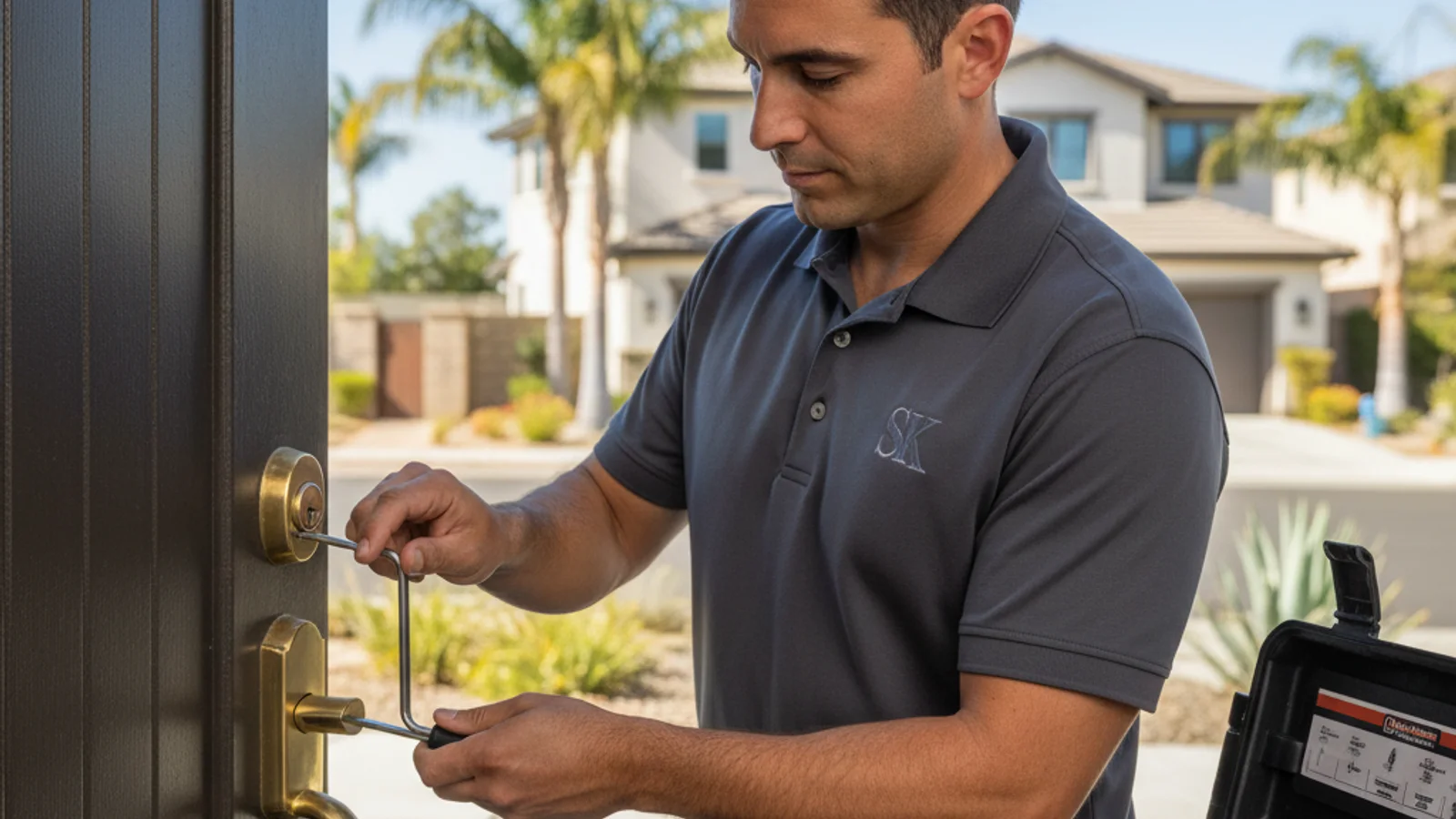
Locksmiths often open locked doors by picking or bypassing the cylinder, not by drilling it. A pick and tension wrench set pins to the shear line so the plug turns, the way a key would. Drilling destroys the cylinder and is the fallback on hardware that will not pick, or on a lock that is already broken. Ask the locksmith whether they will attempt non-destructive entry and what happens if they cannot.
How locksmiths open doors, step by step
- Verify who’s asking. Before touching the lock, a reputable technician checks a government-issued photo ID and confirms you’re the resident, owner, or an authorized manager. Being asked for ID is a sign you called the right kind of company. See locksmith ID proof requirements.
- Assess the lock. They look at whether it’s a standard pin tumbler, a high-security cylinder (ask about names such as Medeco or Mul-T-Lock), or a damaged lock that needs a different approach.
- Apply tension. For a standard pick job, they insert a tension wrench and apply light rotational pressure.
- Set the pins. A pick lifts each binding pin to the shear line.
- Turn and open. When the last pin sets, the plug can rotate. Ask whether they expect the existing keys to still work.
- Drill only if needed. If the lock is high-security, damaged, or they recommend speed over picking, they should explain why, quote the replacement cylinder, then drill. You should hear that before the hole.
A standard residential entry is often one of the quicker jobs once they’re on site. Getting someone there is usually the bigger variable. Timing belongs to that locksmith.
How locksmiths open doors: lock picking explained
A standard residential door lock on many San Diego homes is a pin tumbler cylinder. Five or six spring-loaded pin stacks sit in a row. Each stack has a driver pin on top and a key pin below. With no key, driver pins cross the shear line and the plug will not turn.
The correct key lifts each stack so the drivers sit at the shear line. The plug can rotate.
Picking uses light tension plus a pick on the binding pin first, then the next. When the last pin sets, the lock can open.
This uses no forced kick. It is still work inside the cylinder. Ask whether they will attempt it and whether they will replace hardware if something binds.
Licensing still matters. California locksmith work is regulated by the Bureau of Security and Investigative Services. Ask for the LCO and check it at search.dca.ca.gov.
Other non-destructive entry methods
Bypassing a spring latch. Many interior doors and some older exterior doors use a spring latch, the angled bolt that retracts when the door closes. A thin tool can press that latch back through the gap. That is fast. It is also why an exterior door should have a deadbolt, not a latch alone. A latch-only exterior door is easy to slip. That is a hardware gap, not a job-count statistic.
Deadbolts resist that slip because they throw straight and need rotation to retract. Ask the locksmith what throw and strike they see. Do not treat a Grade 1 label as a slip-proof promise.
Impressioning. On some locks, a locksmith can work a blank to a working key by reading pin marks. This takes more time than picking. Useful when a key must be made and no code is available.
Decoding and cutting. Some locks can be decoded by measuring pin depths, then cutting a key. Ask whether that leaves this cylinder in service.
Car entry tools
Vehicle lockouts use a different kit. House cylinder picks are not an air wedge.
A common car method uses an air wedge and a long-reach tool. The wedge opens a narrow gap at the door. A rod can press an unlock button or pull a handle. Newer cars with no interior mechanical override may need a programmed key or a vehicle-specific path. Ask an auto locksmith. Don’t treat a house pick set as a car kit.
When drilling is honest and necessary
Drilling destroys the lock cylinder. It is the right conversation in three situations.
First, high-security cylinders. Locks such as Medeco, Mul-T-Lock, and ABLOY are designed to resist picking. Ask the locksmith whether this cylinder is one they will drill rather than pick. Trying to pick a listed high-security unit for a long stretch often wastes the visit.
Second, damaged or frozen cylinders. Corrosion, a prior attack, or a key fragment pushed deep can seize the plug.
Third, genuine urgency. If someone is trapped, or the customer needs in now, drilling and replacing on the spot can be the honest option even on a pickable lock. A good locksmith states that and quotes the new hardware first. Late-night timing is the locksmith’s, not a Swift Key hours block.
Honest drilling includes a replacement cylinder quoted before the hole. Anyone who drills and then says they cannot replace it, or quotes parts only after drilling, is someone to avoid. For a lockout visit, the home lockout page is the referral path for what to expect.
What entry methods teach you about your home’s security
The same openings a locksmith uses are openings a burglar could use. Most residential burglaries still go through force, not picking. A weak deadbolt is still pickable. A high-security cylinder is a different shopping question.
Grade 1 deadbolts with long strike screws into framing are the usual force upgrade. The cylinder matters. The strike and jamb matter as much. See how to choose a Grade 1 deadbolt.
Spring latches on an exterior door are light security. If the exterior door is latch-only, that door can be slipped with little skill.
High-security upgrades (a standard Schlage B60 versus a Medeco or Mul-T-Lock) are worth asking about on elevated-risk doors. Ask for listings. They cost more. They are harder to pick. They are not called pick-proof here.
Smart locks add codes and logs. Many still have a mechanical cylinder. The keypad is not the same as pick resistance. For the rest of the door, see improve front door security.
The verification frame: how locksmiths confirm you belong there
Before a locksmith opens a door, they should confirm you have a right to be there. That is what a reputable locksmith asks. We are not calling the ID step a legal requirement on this page.
Expect a government-issued photo ID, the address, and a note that you are the resident, owner, or documented manager. Property managers should bring authority papers. Details: locksmith ID proof requirements.
A locksmith who does not ask for ID before opening should concern you.
Frequently asked questions
Can a locksmith open a door without damaging the lock?
Ask them to say whether they will attempt non-destructive entry and what they will do if they cannot. Picking is the usual first try on a standard pin tumbler. Drilling is on the table for high-security, damaged, or seized cylinders, or when they recommend speed. There is no no-damage guarantee on this page.
Do locksmiths have to drill locks?
Not as a default. Drilling is the fallback. A standard Kwikset or Schlage deadbolt can often be picked. You should hear why drilling is needed, and the replacement cylinder cost, before it happens.
How long does it take a locksmith to open a door?
Entry on a standard residential lock is often one of the quicker jobs once they are on site. High-security or damaged locks take longer. Getting there is usually the bigger variable. Call (858) 400-4082 and we will connect you. That locksmith quotes. Swift Key does not quote.
What kind of locks are hardest to pick?
Ask the locksmith. High-security cylinders from Medeco, Mul-T-Lock, and ABLOY are sold as pick-resistant. Confirm the listing on the unit. Standard Kwikset and many lower-tier Schlage cylinders are more common and easier to pick.
Does getting picked change how the lock works?
Often the cylinder still works with the existing keys. Ask them to test before they leave. Drilling changes the lock permanently. Do not assume pins are untouched.
Should I upgrade my locks after a lockout?
A lockout does not by itself mean the lock is compromised. It is a reasonable moment to look at the hardware. If you want a Grade 1 deadbolt and a reinforced strike, we connect you for deadbolt installation. The locksmith quotes. Home lockout with no spare covers spare-key setup.
What tools do locksmiths use to open doors?
For many residential lockouts, a tension wrench and picks. For spring latches, a slip tool. Car lockouts use an air wedge and a long-reach tool. Damaged or high-security cylinders may need a drill and replacement hardware. The skill is reading the lock.
Is lock picking legal in California?
A licensed locksmith does this work after they confirm you have authority over the lock. Ask for the LCO and check it at search.dca.ca.gov. Opening a lock you do not have permission to open is a different problem. We are not citing a code section here.
When to call us
If you’re locked out, call (858) 400-4082 and we will connect you with a licensed independent locksmith. That locksmith verifies identity before entry, chooses the method, and quotes. Swift Key does not quote.