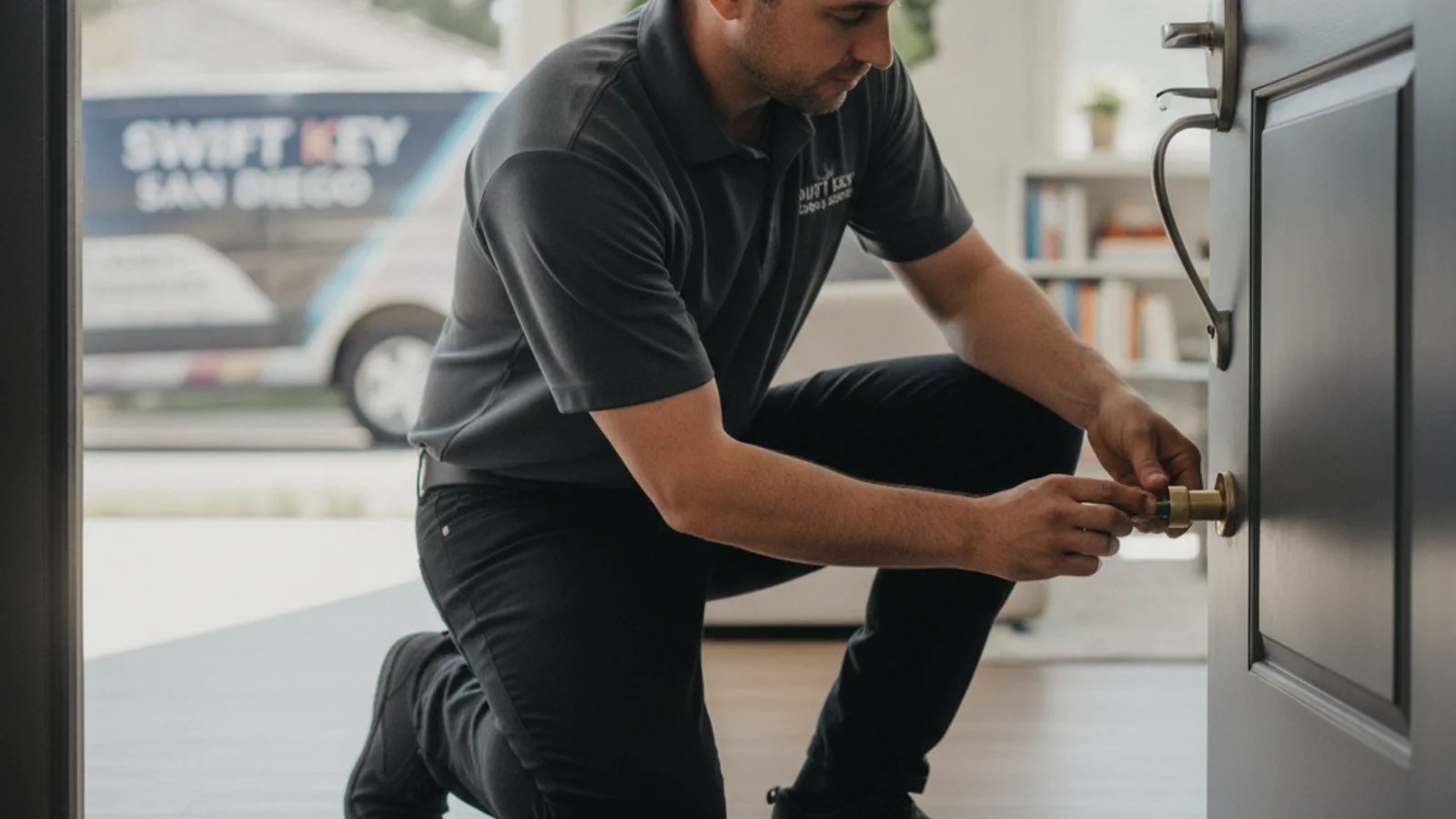
Start with your lease, then with the facts of who lives in the unit. California does not give every tenant a general right to change locks whenever they want. Many San Diego County leases require written approval before any lock change or rekey, and they often require you to give management a working key. Two current Civil Code sections create separate lock-change paths after qualifying abuse or violence. They are not a general turnover-rekey law.
This page explains those current statutes in plain language. It is not legal advice. A tenant attorney or qualified victim-services lawyer should review your documents, lease, and court papers.
The lease usually controls ordinary lock changes
Read the lock, key, and alteration clauses before anyone touches the hardware. Typical leases:
- Bar changing, adding, or rekeying a lock without prior written consent.
- Require you to deliver a copy of any new key to the landlord or manager.
- Require original hardware to be restored at move-out, or they bill for replacement.
If the lease is silent, that still does not mean you can exclude the owner. Landlords commonly retain a contractual right of entry. Changing locks and withholding the only keys can become a lease dispute. The safer ordinary path is a written request, a written yes, and a shared key.
Swift Key San Diego is a referral service. It does not perform locksmith work, set prices, or decide lease rights. Independent licensed locksmiths do the work after you and the property controller authorize it. Call (858) 400-4082 if you already have that authorization and need a match.
Civil Code 1941.3 requires operable locks, not a turnover rekey
California Civil Code section 1941.3 requires a landlord of a building intended for human habitation to install and maintain an operable dead bolt lock on each main swinging entry door, with the statute’s listed exceptions and specifications. It also requires operable window locking devices on windows designed to be opened, subject to height and type exclusions, and locking mechanisms on certain common-area exterior doors in multifamily housing.
The tenant must notify the owner or authorized agent when a required lock is inoperable. The landlord is not liable under that section unless the defect is not corrected within a reasonable time after actual notice or notice of the deficiency.
Section 1941.3 does not say the landlord must rekey between tenancies. A working deadbolt that still accepts a prior occupant’s key can still be “operable” under that hardware rule. If you want unknown prior keys to stop working, ask the landlord in writing for a rekey or replacement. Do not treat that request as a 1941.3 mandate.
California Civil Code section 1940.5 concerns waterbeds and other liquid-filled bedding. It does not create a rekey duty at turnover.
Abuse or violence: two different lock-change statutes
Call 911 if you are in immediate danger. Then get case-specific legal help. The lock statutes below are current as saved from California Legislative Information on 2026-09-13. Later amendments can change the details.
When the alleged abuser is not a co-tenant: Civil Code 1941.5
Section 1941.5 applies when a person is alleged to have committed abuse or violence against the eligible tenant, or that tenant’s immediate family or household member, and that person is not a tenant of the same dwelling unit.
After a written request that includes one form of documentation listed in subdivision (d), the landlord must, at the landlord’s expense, change the locks of the eligible tenant’s dwelling unit not later than 24 hours and give the eligible tenant a key to the new locks.
The tenant chooses one qualifying documentation form. Current options include:
- A copy of a qualifying protective, restraining, or emergency protective order.
- A copy of a written peace-officer report stating that the tenant, household member, or immediate family member filed a report alleging they are a victim of abuse or violence.
- Specified qualified-third-party documentation in substantially the statutory form.
- Any other form of documentation that reasonably verifies that the abuse or violence occurred, including a signed statement from the eligible tenant.
If the landlord fails to change the locks within 24 hours, the eligible tenant may change the locks without the landlord’s permission, even if the lease says otherwise. That self-help path, for leases executed on or after January 1, 2011, requires all of the following:
- Change the locks in a workmanlike manner with locks of similar or better quality than the original lock.
- Notify the landlord within 24 hours that the locks have been changed.
- Provide the landlord with a key by any reasonable method agreed upon by the landlord and eligible tenant.
The landlord must reimburse the eligible tenant’s lock-change expenses no later than 21 days after the eligible tenant changes the locks under that subdivision. The statute does not say the new key itself must be delivered within 24 hours.
When the restrained person is a co-tenant: Civil Code 1941.6
Section 1941.6 is a separate rule. It applies when a person restrained from contact with a protected tenant under a court order is a tenant of the same dwelling unit.
The landlord must, at the landlord’s expense, change the locks not later than 24 hours after the protected tenant’s written request that includes a copy of a qualifying court order excluding the restrained person from the dwelling. The landlord must give the protected tenant a key to the new locks. “Court order” here means a lawfully issued order within the last 180 days under the statutes listed in 1941.6(f)(1).
If the landlord misses that 24-hour deadline, the protected tenant may change the locks without permission, for leases executed on or after January 1, 2011, with the same workmanlike-change, 24-hour notice, agreed key-delivery, and 21-day reimbursement rules as above.
A person excluded under this section remains liable under the lease for rent as provided in the lease. Do not treat 1941.5 paperwork as enough for a 1941.6 co-tenant exclusion. The court-order requirement is different.
Asking for a move-in rekey
You can still ask, in writing, for a rekey before or at move-in. That is a practical request, not a hidden California turnover statute. Keep the email. If the landlord agrees, confirm who pays, who authorizes the locksmith, and how keys will be distributed.
Related: Rekey or replace your locks when you move in?
When a roommate moves out
A returned key does not prove no copies exist. Whether you may rekey depends on who holds the lease and what the lease says. Coordinate with the owner or manager first. Related: Roommate moved out? Rekey checklist.
What this page does not claim
It does not set a dollar price, service-call fee, arrival window, or reimbursement amount beyond the 21-day landlord-reimbursement rule in 1941.5 and 1941.6. Independent locksmiths set their own prices after they see the hardware.
It does not tell you to deduct lock work from rent, file a named agency complaint, or rely on a named hotline. Habitability remedies and retaliation rules have their own procedures. Get current advice before using them.
It does not promise that Swift Key or any named locksmith will change rental locks without the person who controls the unit.
Practical checklist
- If anyone is in danger, call 911.
- Read the lease lock and key clauses.
- Decide whether this is an ordinary request or a 1941.5 or 1941.6 request.
- Put the request in writing and attach only the documentation that matches that section.
- Keep copies of what you sent and when.
- If a locksmith is authorized, ask for an itemized estimate before work starts.
- Make sure the landlord or manager receives a working key by the method your lease or the applicable statute requires.
Frequently asked questions
Can I change the locks on my apartment in California?
Usually only with landlord permission, or under the matching Civil Code section if you qualify. Ordinary changes follow the lease. Section 1941.5 covers qualifying abuse or violence when the alleged actor is not a co-tenant. Section 1941.6 covers a restrained co-tenant excluded by a qualifying court order.
Does California require landlords to rekey between tenants?
No current statute cited on this page creates a general turnover-rekey duty. Section 1941.3 requires specified operable locks. Section 1940.5 is about liquid-filled bedding. Ask for a rekey in writing if prior keys are unknown.
Do I have to give my landlord a key if locks change?
For ordinary lease-authorized changes, follow the lease. Under 1941.5 or 1941.6 self-help after a missed landlord deadline, notify the landlord within 24 hours and provide a key by a reasonable agreed method. The statutes do not state that the key must arrive within 24 hours.
What should I do first in an abuse or violence situation?
Call 911 if you are in immediate danger. Then get legal help on which statute, documents, and living arrangement apply. Do not collapse 1941.5 and 1941.6 into one set of papers.
Swift Key San Diego matches San Diego County callers with independent licensed locksmith professionals. The professional confirms authorization, feasibility, and price. Call (858) 400-4082.