A damaged deadbolt can leave you wondering whether the lock actually stopped an attack. A burglar can try drilling or sawing a Schlage B60. However, Schlage doesn’t publish an attack-specific resistance time or promise that the B60 is drill-proof or saw-proof.
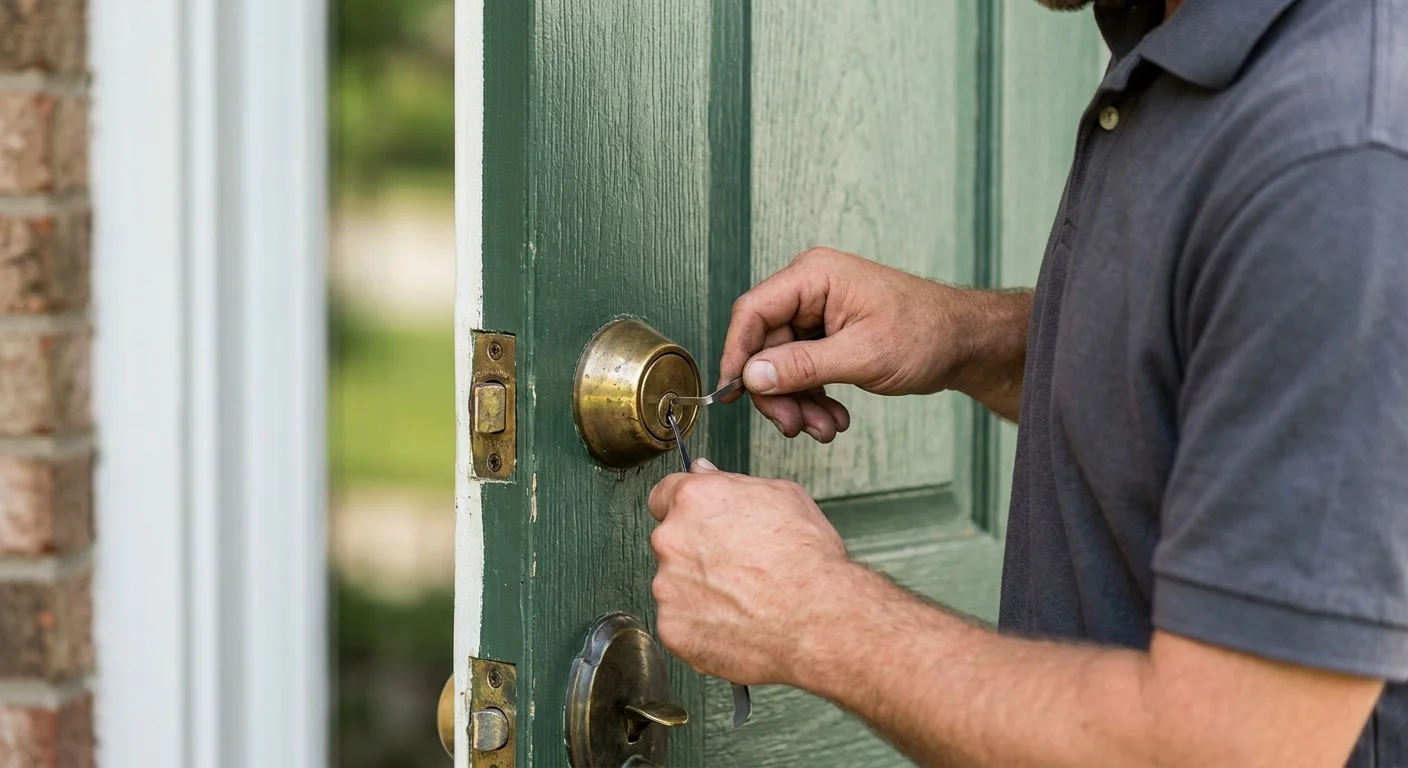
What drilling and sawing actually attack on a deadbolt
“Drilling” and “sawing” describe tools, not one predictable attack. A drill may contact visible deadbolt hardware, the cylinder area, or nearby door material. A saw can only work against material the person manages to reach. The tool name alone doesn’t reveal which part was targeted or whether the attempt worked.
That distinction matters when judging Schlage B60 drilling resistance. A mark on the outside trim doesn’t prove the cylinder was defeated. It also doesn’t prove the deadbolt remained fully usable. Damage elsewhere on the door may affect operation even when the visible lock still looks intact.
Sawing questions need the same care. Searchers often ask whether burglars can saw through a Schlage B60 deadbolt. Schlage’s published B60 information doesn’t provide a saw resistance time. It also doesn’t describe a test result for a burglar using a particular saw, blade, angle, or access point. Calling the B60 saw-proof would go beyond the verified product information.
A forced-entry review should separate three questions:
- Which surfaces show fresh damage?
- Does the deadbolt still operate correctly?
- Did the surrounding door or frame move, split, or lose alignment?
Those observations are more useful than guessing from one scratch. Picking and bumping are different attack methods, so they aren’t covered here. For broader product context, read our Schlage B60 and Kwikset comparison.
What Schlage publishes about the B60 and what it does not
Schlage identifies the residential B60 as a single-cylinder deadbolt. Its product page says the standard model ships with a 5-pin C keyway and two brass keys. A 6-pin cylinder is available. Those details describe the keyway and cylinder configuration, not drill or saw performance.
The same product page prints “ANSI/BHMA A156.36-2010 Grade 1” and a BHMA AAA rating. That is the grade Schlage publishes against the named standard. It isn’t a resistance time, a burglary rating, or a guarantee that every attempted entry will fail.
The specific test criteria behind that designation haven’t been verified in this site’s approved source record. That includes cycle counts, force figures, blow counts, and resistance times. Readers who need the standard’s current test language should confirm it through ANSI or BHMA rather than relying on an unsourced summary.
Schlage’s B60 product page also doesn’t publish answers to these attack-specific questions:
- How many minutes the lock withstands drilling
- Which drill bits or saw blades were tested
- Whether every installation produces the same result
- Whether a damaged lock can remain in service
- Whether the surrounding door and frame will resist the same attack
The residential B60 shouldn’t be confused with other Schlage products. It isn’t the Encode 29-273 cylinder. The commercial B600 is also a different lock. Specifications from those products can’t be transferred to the B60.
The accurate answer is narrow. Schlage publishes a Grade 1 designation and BHMA AAA rating for the B60. It doesn’t publish enough attack-specific information to call the lock drill-proof or saw-proof.
Why the door and frame usually fail before the bolt
The claim in this heading is common, but it isn’t confirmed by the approved B60 source. Schlage’s product page doesn’t compare the failure order of the bolt, cylinder, door, strike area, fasteners, or frame. It also doesn’t say the door and frame will usually fail first.
That means the condition of a specific opening matters more than the slogan. A product grade describes the lock against a named standard. It doesn’t describe the complete doorway in a particular San Diego home.
Schlage says the B60 fits doors from 1-3/8 inches to 1-7/8 inches thick. That compatibility range doesn’t establish the strength or condition of any individual door. It also doesn’t confirm whether the existing opening, strike area, and alignment are suitable after an attack.
This distinction has local relevance. About 49.6% of homes in the city of San Diego were built before 1978. That figure doesn’t prove an older door is weak or improperly fitted. It does show why the condition of the actual opening can’t be inferred from a lock label alone.
The same principle applies across San Diego County, from coastal North County to East County and the South Bay. A B60 installed on one property isn’t automatically equivalent to a B60 installed elsewhere. The lock, door, and frame should be reviewed together.
If replacement becomes appropriate, a licensed professional can discuss lock replacement and deadbolt installation for that specific opening. Swift Key San Diego refers customers to independent locksmiths. It doesn’t inspect or install hardware itself.
Signs a lock has already been attacked
Start by recording what you can actually see. Don’t assign an attack method from one mark. Ordinary wear, an installation scar, and fresh damage can look similar without closer inspection.
Useful observations include:
- New scratches, gouges, or circular marks near exterior hardware
- Loose, shifted, bent, or missing visible pieces
- Metal fragments or fresh debris near the doorway
- A key that now enters, turns, or withdraws differently
- A bolt that no longer moves as it did before
- New rubbing, binding, or gaps when the door closes
- Cracks, dents, or movement near the door edge or frame
These signs don’t prove that drilling or sawing occurred. They also don’t establish whether the lock remains suitable for use. Take clear photos and explain what changed. Include what the door felt like before and after the suspected event.
Avoid treating normal operation as proof that nothing happened. Visible damage may still deserve inspection. The opposite is also true. A stiff lock isn’t automatic proof of an attempted break-in.
A licensed locksmith can compare the exterior marks with the lock’s operation and the surrounding opening. If damaged hardware needs to be removed, the customer contracts with that independent professional directly. Swift Key San Diego doesn’t perform the work, set the price, or provide a warranty.
This is also a good moment to review the rest of the entrance. Our guide to improving front door security provides a broader planning framework. It doesn’t turn an unverified mark into a diagnosis, but it can help you organize questions for the locksmith.
What a licensed locksmith checks after an attempted forced entry
Ask the locksmith to evaluate the entire opening, not only the most visible scratch. The inspection should answer whether the hardware operates correctly, whether the door still closes as intended, and which damaged parts need attention.
A useful review can include these requests:
- Identify every visible point of contact or damage
- Check the cylinder area and exterior deadbolt hardware
- Operate the key and bolt from their normal positions
- Examine the door edge and nearby strike area
- Check the frame for movement, splitting, or changed alignment
- Confirm the door thickness falls within the selected hardware’s range
- Explain which parts can remain and which should be replaced
- Separate confirmed damage from suspected attack methods
Don’t ask for a universal resistance time. Schlage doesn’t publish one for B60 drilling or sawing in the verified product information. Ask the locksmith to explain conclusions based on the actual door and hardware instead.
You can also ask for the exact replacement model and written manufacturer information. A Grade 1 label shouldn’t be translated into an invented number of minutes. If the recommendation changes to another lock, compare the new product using its own published specifications.
California locksmiths must be licensed through the Bureau of Security and Investigative Services. You can check a company or professional through the state’s DCA license search. Swift Key San Diego matches callers with licensed, independent local locksmiths, but the customer hires and pays the professional directly.
An attempted entry can also expose unrelated fit or alignment issues. The inspection should keep those findings separate. Clear labels such as “observed damage,” “operational problem,” and “possible cause” make the recommendation easier to evaluate without overstating what happened.
When to call us
Call when a B60 shows fresh damage, stops operating normally, or needs an installation-specific assessment. Swift Key San Diego can refer you to an independent professional, but we don’t inspect locks or perform repairs ourselves. Call us at (858) 400-4082 and we’ll connect you with a licensed local locksmith.