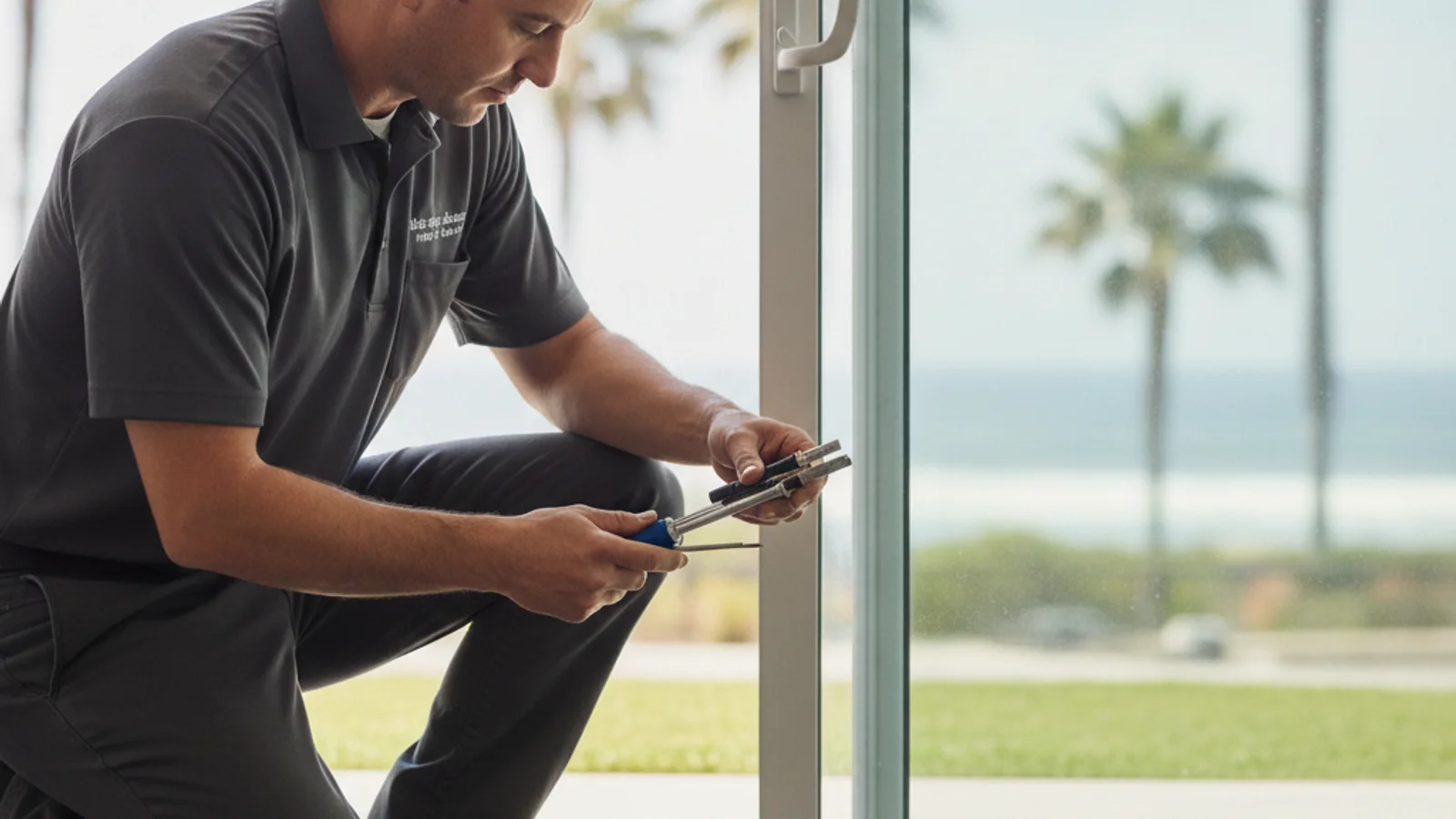
Most sliding glass door repairs in San Diego start with a worn mortise latch that won’t catch because the door has sagged off its track. That’s not a lock failure in the traditional sense. The factory hardware on most patio doors was never really a lock to begin with.
If your slider won’t latch, the handle feels loose, or the keyed cylinder stopped turning, you’ve got one of three problems: a latch that’s worn or misaligned, a handle assembly that’s broken, or a cylinder that’s seized from corrosion. All three are repairable. This guide walks through each one, what the locksmith quotes, and what you can do beyond the repair to make the door more secure.
Why slider latches fail
Most patio doors use a hook-style mortise latch. The latch mechanism sits inside the door stile, and when you lift the handle, a hooked bolt swings up and catches a strike keeper on the frame. It’s a simple, low-force design built for frequent use and weather exposure.
The problem is wear and alignment. A sliding door rides on a track, and tracks accumulate debris, bend slightly over years of use, and allow the door panel to settle. When the door sags even a quarter inch, the hook no longer lines up with the keeper. You lift the handle, the hook rises, and it misses the catch. The door feels like it latched but it didn’t, or you have to lift hard and hold tension to get it to engage.
Beyond misalignment, the latch hook itself wears. The hook is typically zinc alloy, which is light and corrosion-resistant but not especially hard. After years of engagement and disengagement, the hook rounds off and the catch loosens. You start getting play in the latch, then the door rattles, then it stops holding reliably.
Handle assemblies fail separately. The handle connects to the latch via a cam or lever inside the door stile. That connection point, usually a small metal tab or roll pin, cracks or breaks under repeated use or after someone forces a stiff latch. When that connection breaks, the handle moves but the latch doesn’t.
Keyed cylinders on patio doors are often the same cylinder used in standard pin-tumbler locksets, just mounted horizontally in the handle assembly. In San Diego’s marine climate, especially within a few miles of the coast, salt air accelerates corrosion inside the cylinder. Pins stick, springs weaken, and eventually the key stops turning. This is accelerated on west-facing doors that get direct sea breeze exposure.
Repair options and what they cost
| Repair | What’s involved | Quote driver |
|---|---|---|
| Track cleaning and door realignment | Clean and lubricate track, adjust roller height, retest latch engagement | Lightest job |
| Mortise latch replacement | Remove handle assembly, swap latch cartridge, reinstall and align | Latch cartridge plus labor |
| Handle set replacement | Full handle assembly swap, including latch; may include cylinder | Hardware plus labor |
| Keyed cylinder replacement | Remove and replace cylinder; rekey to existing key if needed | Cylinder plus rekey |
| Full hardware replacement (latch + handle + cylinder) | Complete rebuild of the locking assembly | Heaviest hardware job |
These are parts-and-labor jobs for a standard single patio door. Double-door configurations or specialty brands like Andersen, Pella, or Milgard sometimes require OEM parts, which the locksmith should flag before they start.
If the track itself is bent or the rollers are cracked, that’s a separate repair, usually handled by a door specialist or the manufacturer’s service network rather than a locksmith. A locksmith focuses on the latch and lock hardware; the door’s structural components are a different trade.
For most latch failures, the repair is worth doing before considering replacement. A full patio door replacement is a much larger spend than a latch repair. As long as the door panel itself is in good shape, repairing the latch first is usually the smarter path.
The security upgrade ladder
The factory latch on a sliding glass door is not a serious security device. It’s a retention mechanism, enough to keep the door from sliding open in the wind, not enough to resist determined force. Once you’ve repaired what’s broken, there’s a straightforward upgrade path from cheap and effective to more serious.
Loop locks and security bars sit at the bottom of that ladder in cost, not in effectiveness. A loop lock is a small keyed latch that drops into the track and physically blocks the door from opening more than a few inches. A cut-down wooden dowel or a commercially made aluminum security bar laid in the track accomplishes the same thing without the key. These are inexpensive hardware-store parts and are among the most effective secondary measures available. The door can’t slide open if there’s a solid object blocking the track, regardless of what happens to the latch.
The dowel-in-the-track approach has a reputation as an old trick, and that reputation is deserved in a good way. It works. The limitation is that you have to remember to set it and remove it, and it doesn’t help if the door is left unlocked while you’re outside. A loop lock with a key gives you something you can set from the outside.
Double-bolt patio door locks are the next step up. These mount on the door frame and send a bolt horizontally into the door panel itself, separate from the latch mechanism. They’re more involved to install but provide genuine dead-bolt-level resistance. A locksmith can install a double-bolt patio lock without much disruption to the existing door. The locksmith quotes that install after they see the frame.
Anti-lift devices address a different attack vector: lifting the entire door panel out of its track. Older sliding doors can sometimes be lifted off the lower track and removed entirely without engaging the latch. Anti-lift blocks, which mount in the upper track to reduce the clearance, prevent this. They’re often included in higher-end patio door hardware but can be added to existing installations with a small hardware-store part.
What a lock can’t fix
There’s an honest ceiling to what any lock accomplishes on a sliding glass door, and it’s the glass. The panels are large, often single-pane in older San Diego homes, and the glass itself is the weak point if someone is determined to get in.
A good latch, a loop lock, and a security bar will stop opportunistic entry through the door mechanism. They won’t stop someone willing to break glass. For that, the relevant upgrades are window security film, which holds shards in place and makes breaking through significantly louder and harder, and glass-break sensors tied to a monitored alarm system.
Window security film is worth mentioning specifically because it’s often overlooked. 3M and similar manufacturers make safety film designed for large glass panels that substantially increases the force needed to break through and creates obvious noise and visible damage. It’s not the same as a lock, but it addresses the actual vulnerability of glass-framed doors in a way that hardware doesn’t.
This isn’t meant to be discouraging. Most residential entries don’t involve broken glass because it’s loud, visible, and leaves evidence. The San Diego burglary data analysis points to unlocked or easily opened doors and windows as a common entry method. A functioning latch plus a secondary bar or loop lock closes that gap for most realistic scenarios. Glass-break resistance is a secondary layer for people who want to go further.
A lock also can’t fix a door that won’t line up with the latch in the first place. If the panel sags, the rollers are worn, or the track and frame have shifted so the latch never seats, that’s a door-and-track repair rather than a lock job, and a handyman like Fix Pro San Diego handles roller, track, and frame alignment. Describe the sag and the latch when you call. The independent locksmith can say whether the hardware is the issue or whether the door itself needs a different trade.
Our guide to improving front door security covers the same principle for main entries: layered security handles more threat types than any single upgrade.
Coastal corrosion on slider hardware
San Diego’s climate is hard on zinc and aluminum hardware, and sliding glass door components are exposed in a way that interior locks aren’t. West-facing and south-facing patios, anything within about three miles of the coast, see accelerated corrosion on latch hooks, cylinder pins, and handle mechanisms.
The signs are gradual: a latch that feels increasingly stiff, a key that requires more force each year, a handle that develops a rough turning motion. If your slider faces the ocean and the hardware is more than eight to ten years old, it’s worth inspecting the mechanism before it fails completely, because a seized cylinder in a frequently used patio door becomes an inconvenience quickly.
Lubrication helps but doesn’t stop the underlying process. Dry PTFE spray or graphite on the latch mechanism and cylinder extends service life. Avoid WD-40 inside cylinders, it displaces water short-term but leaves a residue that attracts debris and makes things worse over time.
When coastal corrosion has run its course, the realistic option is hardware replacement with marine-grade components or stainless steel where available. The additional cost over standard replacement parts is modest, and the service life difference in a coastal location is significant. The same applies to smart lock hardware for those considering a keypad or connected lock on a patio door, which smart lock coastal corrosion considerations for San Diego homes covers in more detail.
Renter-friendly options
If you’re renting, you can still address a broken latch through normal channels. A latch that doesn’t engage is a habitability and safety issue in California, and your landlord is responsible for maintaining functional door hardware. Put the request in writing and document the issue. Most landlords handle it promptly when it’s framed as a security matter.
For security upgrades beyond the factory latch, renters have a few options that don’t require permanent modifications. The dowel-in-the-track approach leaves no marks and is completely reversible. Loop locks that mount in the track via screws can be removed and the screw holes filled when you move out, and most California leases don’t prohibit this type of low-impact addition.
If you want a keyed secondary lock, a surface-mount patio door bar lock that screws into the door stile and frame is removable. Talk to your landlord first if you’re unsure. Many are fine with tenants adding secondary security hardware at their own expense, especially if you offer to restore the door to original condition on move-out.
For renters navigating security questions more broadly, our post on California tenant rekey rights covers what you’re entitled to ask for and what landlords are required to provide.
Frequently asked questions
How much does it cost to fix a sliding glass door lock?
A simple latch replacement or realignment is the lighter job. A full handle set replacement including cylinder work is heavier. Double-door configurations or specialty brands may need OEM parts. Ask the locksmith for those as separate lines.
Can a locksmith repair a sliding door lock?
Yes. A locksmith handles the latch mechanism, handle assembly, and keyed cylinder on a patio door. Those are the components that control locking and retention. If the problem is the track itself, bent rollers, or structural door damage, that’s a door-repair or window-company job rather than a locksmith job. Most patio door issues, the latch won’t catch, the handle is broken, the cylinder is seized, fall in the locksmith category.
What’s the best lock for a sliding glass door?
The factory mortise latch maintained in good working order, combined with a loop lock or security bar in the track, handles the most common threat effectively and cheaply. For more serious security, a double-bolt patio lock provides dead-bolt-level resistance without requiring glass to be broken for entry. Anti-lift devices address the separate issue of the door being lifted out of its track. None of these address glass breakage, which requires film or sensors rather than locks.
How do I know if my sliding door latch needs repair or replacement?
If the latch doesn’t catch without lifting hard on the handle, the first step is track cleaning and door realignment, which is cheap and often solves the problem. If the latch still won’t engage after alignment, or if there’s visible wear on the hook, the latch itself needs replacement. If the handle moves but nothing happens, the connection between handle and latch is broken and the handle assembly needs to come apart. If the key turns poorly or not at all, that’s the cylinder.
Does a sliding glass door need a deadbolt?
Standard sliding doors don’t have deadbolts and most aren’t designed to accept one in the traditional sense. The equivalent is a double-bolt patio lock, which provides similar resistance. For most San Diego homes, a functioning mortise latch plus a secondary bar or loop lock is adequate. A double-bolt upgrade makes sense if the door is a primary entry point, if it faces a less visible side or rear of the property, or if the occupant wants a higher security baseline.
How long does sliding glass door lock repair take?
Ask the locksmith how they plan the visit. A latch replacement and realignment is often shorter than a full handle set replacement. If parts need to be sourced for a specialty door brand, they should say so before they start. Standard mortise latch and handle hardware for common brands is often on the truck, but that is theirs to confirm.
If your patio door latch isn’t catching, the handle has broken, or the cylinder won’t turn, Swift Key San Diego is a referral service. Call (858) 400-4082. You contract with an independent locksmith. That locksmith quotes the repair. Swift Key does not open doors, set a price, or promise a one-visit fix.
For lock replacement or a home lockout, the same number connects you.